How to Deal With Regrets in Life: Change How You Replay It
Dealing with a regret is not about feeling better about the thing. It is about changing the position you replay it from. The same memory, worked over from inside your own eyes, predicts more distress and less problem solving. Worked over from a step back, it predicts lower emotional reactivity, fewer intrusive returns of the thought, and more actual problem solving behaviour. Two people can spend the same hour on the same regret and get opposite results, and the variable that separates them is not how bad the regret was.
That is the useful part, because position is a thing you can change on purpose in the next ten minutes. How much you regret something is not.
Last reviewed September 9, 2026. Every figure below is quoted from the linked study or federal source and nothing here is an unsourced number. Population level findings describe groups rather than individuals. Two of the studies below were run on older adults rather than men in their forties, and that limit is stated in the text each time it applies rather than quietly ignored. This is general information and not medical advice. If a regret has stopped being a thought you have and become a state you live in, the last section of this article is the one to read first. If you are having thoughts of harming yourself, in the United States call or text 988.
The short answer
Sort the regret, then change the position you think about it from, then decide whether the door is open or shut.
Sorting means separating a regret you can still act on from a regret whose object no longer exists. Position means the difference between recounting a memory and reconstruing it, which is the single mechanism with the most direct experimental support in this whole area. The door question decides whether the work in front of you is a plan or an acceptance, and getting that backwards is the most common way men spend a decade on a regret and move nothing.
What does not appear anywhere in the evidence is the instruction most men give themselves, which is to stop thinking about it. Distraction does work, and it works about as well as anything else for the first hour. It stops working by the next day.
The mechanism that decides whether replaying costs you anything
The reason the same memory helps one man and corrodes another is that "thinking about it" describes two different mental operations that happen to look identical from outside.
Susan Nolen-Hoeksema, Blair Wisco and Sonja Lyubomirsky reviewed two decades of work on the first one in Rethinking Rumination, published in Perspectives on Psychological Science in 2008. Their summary of what has held up is blunt. Rumination exacerbates depression, enhances negative thinking, impairs problem solving, interferes with instrumental behaviour, and erodes social support. Those last two are the ones that matter for a regret specifically. A man ruminating about a career he did not take is measurably less likely to do anything about it and measurably more likely to wear out the people who would have helped.
The review also corrects the original theory in a way worth knowing. Rumination more consistently predicts the onset of depression than its duration, and it interacts with negative cognitive styles to predict how long symptoms last. It is associated with anxiety, binge eating, binge drinking and self harm as well as depression. This is not a habit with a narrow blast radius.
The same review flags the distinction that the rest of this article rests on: rumination is not the same thing as self reflection, and the more adaptive forms of looking at your own experience do not carry the same costs. Which raises the practical question. What separates them?
Recounting against reconstruing
Ethan Kross and Ozlem Ayduk answered that with an experiment rather than a definition, in Facilitating adaptive emotional analysis, published in Personality and Social Psychology Bulletin in 2008.
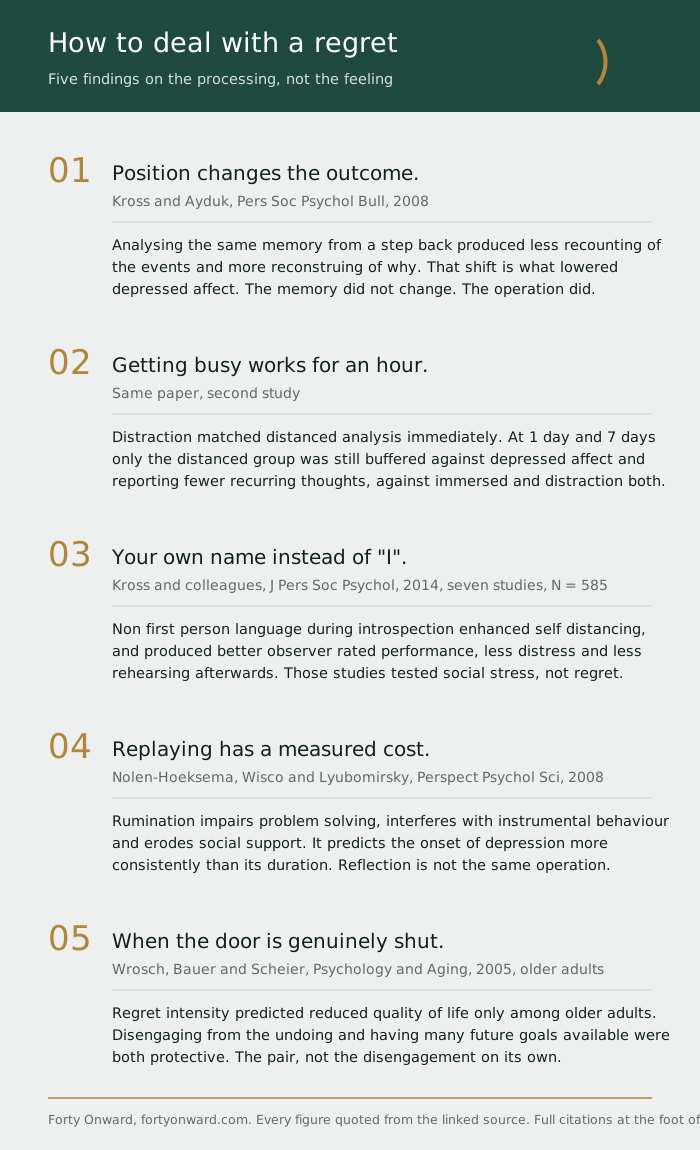
Participants recalled a depression experience and then analysed their feelings from one of two positions. The self immersed group worked through it from inside their own perspective. The self distanced group worked through the same material from a step back. The distanced group focused less on recounting their experience and more on reconstruing it, and that shift in construal is what produced lower depressed affect. The mechanism was not the memory. It was the operation performed on it.
Recounting is replaying the tape: what was said, what you did, the order of events, the moment it turned. Reconstruing is working on why it went the way it did and what that means. Recounting produces the emotion again. Reconstruing produces information.
| Recounting | Reconstruing | |
|---|---|---|
| What you are doing | Replaying the sequence of events | Working out why it went that way |
| Typical sentence in your head | "And then he said, and then I said" | "The reason I did not push back was" |
| What it produces | The original feeling, again | Something you did not know before |
| Where you are standing | Inside your own eyes | A step back from yourself |
| Effect measured at 7 days | Not protective | Still buffered against depressed affect |
Ayduk and Kross followed this with three studies in the Journal of Personality and Social Psychology in 2010, From a distance, which tested whether people who do this on their own, without being told to, get the same benefit. They did. The more participants spontaneously self distanced while reflecting on negative memories, the less emotional and cardiovascular reactivity they showed in the short term, and the lower their emotional reactivity and intrusive ideation over time.
That paper closes the objection most men raise at this point, which is that stepping back sounds like a polite name for not dealing with it. The researchers tested exactly that. The link between self distancing and lower emotional reactivity was mediated by how participants construed the experience, meaning less recounting relative to reconstruing, and not by avoidance. The third study went further and found spontaneous self distancing associated with more problem solving behaviour and less reciprocation of negativity during conflicts among couples in ongoing relationships. It is the opposite of looking away. It is the position from which people actually engage.
The part that survives a week
The most practically important result in this literature is a comparison almost nobody quotes.
In the second study of the 2008 paper, distanced analysis was compared not only against immersed analysis but against straightforward distraction. In the immediate term, distanced analysis and distraction came out about the same. Both reduced depressed affect relative to the immersed group. If the experiment had stopped there, the honest conclusion would have been that thinking about it carefully and deliberately not thinking about it work equally well.
The experiment did not stop there. One day later and seven days later, the distanced analysis group remained buffered against depressed affect and reported fewer recurring thoughts about the experience, compared with both the immersed group and the distraction group.
That is the whole case against the standard male protocol. Getting busy is not a bad first hour. It is a bad week. The thing that is still working on day seven is the one that involved looking directly at the regret from a position you could tolerate.
The cheapest version of the lever
If self distancing sounds like something requiring a quiet room and an hour, there is a version of it that is nearly free.
Ethan Kross and eight co authors published Self-talk as a regulatory mechanism in the Journal of Personality and Social Psychology in 2014, across seven studies with 585 participants in total. Two proof of principle studies established that using non first person pronouns and your own name during introspection, rather than "I", enhances self distancing. The rest tested what that does under pressure. Compared with the first person group, the non first person group performed better according to objective raters, displayed less distress, and engaged in less maladaptive post event processing, which is the technical name for lying awake rehearsing how it went. A meta analysis across the studies found none of these effects moderated by trait social anxiety.
One limit, stated plainly because this magazine has shipped a base switching error before and does not intend to again: these seven studies tested social stress, not regret. The stressors were making a good first impression and public speaking. What they establish is that a small change in the language of introspection reliably shifts you into the distanced position. That the distanced position helps with regret specifically is what the 2008 and 2010 papers show. The two findings connect through the same mechanism, and this article is joining them rather than quoting one study that did both.
In practice it means the difference between "why did I not take that job" and using your own name to ask the same question. It sounds ridiculous. It measured better across seven studies.
Sort the regret before you work on it
None of the above tells you whether to act. That depends on something the technique cannot see, which is whether the object of the regret still exists.
Carsten Wrosch, Isabelle Bauer and Michael Scheier examined this across the adult lifespan in Regret and quality of life, published in Psychology and Aging in 2005. Across two studies, older adults perceived reduced opportunities to undo the consequences of their regrets, and regret intensity predicted reduced quality of life only among older adults. The protective factors they identified were being disengaged from undoing the consequences of the regret, and having many future goals available.
That is easy to turn into the wrong advice. It is not a finding that letting go is good. It is a finding that letting go is good when the opportunity to undo the thing has genuinely gone, and that it works alongside having somewhere else to put the effort. Disengagement without available future goals is not what was protective. The companion piece works through the sorting test in more detail than this article needs to repeat.
The second limit worth stating: this sample was older adults, and men of 40 to 55 are not that sample. The reason the finding is relevant here is the direction of the mechanism rather than the number. If regret bites hardest when opportunity has closed, then a man in his forties is in the part of life where most doors are still open, which is an argument for acting rather than accepting on more of the list than he assumes. Where a specific door is genuinely shut, the study says what helps: disengage from undoing it, and have somewhere else for that effort to go.
| The regret | Is the object still there | What the evidence points to |
|---|---|---|
| A business you never started | Yes, in some form | Reconstrue, then set a date. Regret without a deadline stays open indefinitely |
| A degree you did not finish | Usually yes | Check the actual current requirement before assuming it is shut |
| A friendship you let lapse | Usually yes, and cheaply | Contact is the test. Assumed closure is rarely verified |
| A marriage that ended | The relationship, no. What you learned, yes | Disengage from undoing it. Redirect to available future goals |
| A parent you did not say it to | No | Acceptance is the work here. Acting is not available |
| Years spent in the wrong job | The years, no. The direction, yes | Split it. Mourn the years, change the direction |
The right hand column is this magazine's reading of where each row sits against the Wrosch findings, not a result reported in the study.
If you are unsure which regrets on your own list are the ones that will still be there in twenty years, the ones that last and why they last covers the sorting question directly, and why aiming at zero regret backfires covers the forward looking half of the problem.
What carrying it does to the body
Regret that stays intense is not only a mood.
Wrosch, Bauer, Gregory Miller and Sonja Lupien ran two studies published in Psychology and Aging in 2007, Regret intensity, diurnal cortisol secretion, and physical health. In the first, with 183 older adults, intense life regrets were associated with a larger volume and a steeper morning rise of cortisol secretion, and with higher levels of acute physical symptoms. In the second, 103 older adults were followed for three months with an experimental writing manipulation designed to engage them in adaptive social cognitive processes. Regret intensity generally declined only in the experimental group, while certain aspects of it stayed flat in the control group. The intervention also had a beneficial effect on the relationship between initial regret intensity and increased sleep problems over time.
Same age caveat as above, and one more worth being exact about: this is an association between regret intensity and a biological measure, not a demonstration that regret causes illness. What the second study adds is the more useful half. The intensity moved when the processing changed. It did not move on its own in the control group over three months.
A working method
This is an ordering of the findings above into something you can run, not a protocol from any single study. Labelled as such.
- Name the regret in one sentence, out loud, using your own name rather than "I". The 2014 studies found this shifts you into the distanced position more reliably than intending to be objective.
- Ask why it went that way, not what happened. The moment you catch yourself narrating the sequence of events, you are recounting, and recounting is the route the evidence says costs you.
- Decide whether the object still exists. Not whether it feels available. Whether it is. Most men answer this from memory and are wrong in the direction of assuming closure.
- If the door is open, give it a date. A regret with no deadline is what an open regret is made of, and every other thing in your life has one.
- If the door is shut, disengage from undoing it and name where that effort goes instead. The Wrosch finding is that disengagement worked alongside having available future goals. Half of that pair on its own is not what was protective.
- Write it down over more than one sitting. The three month writing intervention is the only thing in this evidence base that moved regret intensity when doing nothing did not.
If step 3 keeps returning no useful answer because the whole question of what you would even aim at is unclear, the work of finding purpose after 40 is the prior step rather than a parallel one.
When it stops being regret
There is a point at which this stops being an article's problem.
The National Institute of Mental Health's overview of depression draws the line this way: everyone feels sad or low sometimes and those feelings usually pass with time, while depression is different and can cause severe symptoms affecting how you feel, think and handle daily activities such as sleeping, eating or working. It notes that depression is one of the most common mental disorders in the United States, that symptoms range from mild to severe, and that it is a risk factor for suicidal thoughts and behaviours.
Set against the rumination review, the practical signal is this. A regret you return to is normal. A regret that has begun impairing sleep, eating or work, or that has stopped being a thought you have and become the weather you live in, is not a processing problem you fix with a better technique. Rumination predicts the onset of depression, which means the sequence in this article can run in the wrong direction for long enough to become something else. What a therapist actually does with this covers what that appointment looks like for men who have never made one.
If you are having thoughts of harming yourself, in the United States call or text 988 for the Suicide and Crisis Lifeline.
Test yourself
Key takeaways
FAQ
How do you deal with regrets in life?
Change the position you think about the regret from, then decide whether you can still act on it. In controlled experiments, people who analysed a painful memory from a self distanced perspective focused less on recounting the events and more on reconstruing why it happened, and reported lower depressed affect as a result. One day and seven days later they were still buffered, while a group that used distraction was not. Then sort the regret by whether its object still exists. If it does, the work is a plan with a date on it. If it does not, the work is disengaging from undoing it while naming somewhere else the effort will go.
Is it normal to still regret something after twenty years?
Yes, and the durable ones tend to be a specific type. The companion piece on life with regrets makes the case, from the studies it cites rather than the ones here, that the regrets which persist are usually about things not done rather than things done badly. Persistence on its own is not a sign that something has gone wrong with you. What matters is which mode you are in when it comes back. Returning to a regret and getting something new out of it is reflection. Returning to it and reproducing the same feeling is rumination, and the review evidence links that pattern to impaired problem solving, reduced instrumental behaviour and eroded social support.
Does writing about a regret actually help?
In the one study here that tested it directly, yes, with limits. Wrosch and colleagues followed 103 older adults over three months with a writing based intervention designed to engage adaptive social cognitive processes. Regret intensity generally declined only in the experimental group, and the intervention improved the relationship between initial regret intensity and worsening sleep. The control group's intensity did not resolve by itself over the same period. The sample was older adults, and the writing was structured rather than free journalling.
Should I try to stop thinking about a regret?
Not as your main strategy. Distraction is not useless and it performed as well as distanced analysis at reducing depressed affect immediately. The gap opens later. At one day and seven days, only the distanced analysis group was still buffered and reporting fewer recurring thoughts. The evidence also rules out the reverse worry: stepping back was shown to work through how people construed the experience rather than through avoidance, and it was associated with more problem solving behaviour, not less.
Does using your own name to talk to yourself help with a regret?
It measured that way across seven studies with 585 participants in total. What holds across all seven is that using non first person pronouns and your own name during introspection enhanced self distancing. In the subset that put people under a live stressor, making a first impression and public speaking, the ones using their own name performed better by objective raters' judgement, showed less distress, and did less rehearsing of the event afterwards. Those studies tested social stressors such as public speaking rather than regret, so what they establish is that the language trick reliably produces the distanced position. That the distanced position helps with a painful memory is what the separate 2008 and 2010 experiments show.
What if the thing I regret cannot be undone at all?
Then the target changes from repair to redirection, and the evidence is reasonably specific about the pair that helped. Among older adults, being disengaged from undoing the consequences of a regret and having many future goals available were both protective, and regret intensity predicted reduced quality of life only in the group that had lost the opportunity to act. Disengagement on its own was not the finding. It appeared alongside having somewhere else for the effort to go, which is the part most men skip.
Sources
Nolen-Hoeksema S, Wisco BE, Lyubomirsky S. Rethinking rumination. Perspectives on Psychological Science. 2008;3(5):400 to 424. https://pubmed.ncbi.nlm.nih.gov/26158958/
Kross E, Ayduk O. Facilitating adaptive emotional analysis: distinguishing distanced-analysis of depressive experiences from immersed-analysis and distraction. Personality and Social Psychology Bulletin. 2008 Jul;34(7):924 to 938. https://pubmed.ncbi.nlm.nih.gov/18469151/
Ayduk O, Kross E. From a distance: implications of spontaneous self-distancing for adaptive self-reflection. Journal of Personality and Social Psychology. 2010 May;98(5):809 to 829. https://pubmed.ncbi.nlm.nih.gov/20438226/
Kross E, Bruehlman-Senecal E, Park J, Burson A, Dougherty A, Shablack H, Bremner R, Moser J, Ayduk O. Self-talk as a regulatory mechanism: how you do it matters. Journal of Personality and Social Psychology. 2014 Feb;106(2):304 to 324. https://pubmed.ncbi.nlm.nih.gov/24467424/
Wrosch C, Bauer I, Scheier MF. Regret and quality of life across the adult life span: the influence of disengagement and available future goals. Psychology and Aging. 2005 Dec;20(4):657 to 670. https://pubmed.ncbi.nlm.nih.gov/16420140/
Wrosch C, Bauer I, Miller GE, Lupien S. Regret intensity, diurnal cortisol secretion, and physical health in older individuals: evidence for directional effects and protective factors. Psychology and Aging. 2007 Jun;22(2):319 to 330. https://pubmed.ncbi.nlm.nih.gov/17563187/
National Institute of Mental Health. Depression. nimh.nih.gov/health/topics/depression