Live Life With No Regrets: Why That Is the Wrong Target, and What to Aim at Instead
You cannot live with no regrets, and the attempt makes things worse rather than better. The measurements back it. When people are asked to evaluate their own negative emotions, regret comes out on top as the most beneficial of twelve. And the personality style that comes closest to pursuing a clean sheet, the drive to get every decision right, is the one that correlates with more regret and less satisfaction across seven separate samples. So the useful target at 45 is not zero regret. It is a much narrower thing: closing the specific gap that produces the regrets that never resolve.
This article is about the forward-looking half of the problem, the decisions you have not made yet. If you are trying to make sense of the regrets you already carry, the ones that last and why they last is the article that covers that ground.
Last reviewed September 1, 2026. Every figure below comes from a peer reviewed paper or a federal health source and is linked inline so you can check it yourself. Population level findings describe groups and not individuals, and no study cited here was designed to tell any single man what to do with his own life. This is general information. It is not therapy, not medical advice and not a diagnosis. If low mood, hopelessness or loss of interest is persistent rather than passing, that is a medical matter and it deserves a doctor. In the United States the 988 Suicide and Crisis Lifeline is available around the clock by calling or texting 988, or at 988lifeline.org.
The short answer
Stop aiming at no regrets and aim at one thing instead: close the distance between who you are and who you meant to be, in the two or three domains where you still see room to move. Everything below is the evidence for why that is the right target and the wrong one is the popular one.
Three findings carry the argument.
Regret is useful, so eliminating it is not a goal worth having. Chasing a perfect record turns you into a maximizer, and maximizing is reliably associated with more regret rather than less. And the regrets that harden into permanent ones are not the duties you dropped. They are the aspirations you never got to, because duty failures get repaired quickly and aspiration failures get postponed indefinitely.
Why the slogan fails as an instruction
The phrase asks you to remove an emotion that people, when asked directly, say they want to keep.
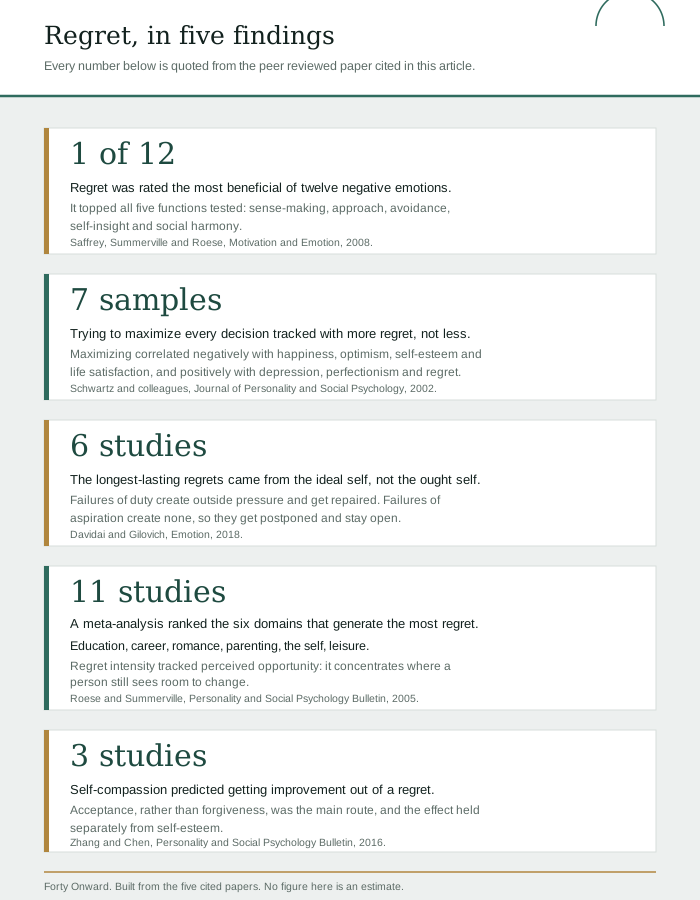
Saffrey, Summerville and Roese put that question to participants in two studies published in Motivation and Emotion in 2008. Rather than assuming regret is aversive, they asked people how they actually evaluated it. The result went the other way. Regret, and not the other negative emotions tested, was dominated by positive evaluations more than negative ones. In the second study, participants rated regret the most beneficial of twelve negative emotions on all five of the functions measured: making sense of past experience, driving them toward things, steering them away from things, producing insight into themselves, and keeping social relationships intact.
Read that list again and notice what it describes. It is a feedback signal. It tells you where you went wrong, which direction to move, which direction to avoid, what you are actually like, and when you owe someone an apology. A man with no regrets is not a man who lived well. He is a man operating with the instrument panel switched off.
So the instruction contains a category error. It treats regret as damage to be prevented rather than as information arriving late. The question worth asking is which signals are still worth acting on, and which ones you will keep receiving for the rest of your life because you never will.
The trap underneath the slogan
There is a name in the literature for the person who tries hardest to get every decision right, and the data on him is not encouraging.
Barry Schwartz and five co-authors introduced the Maximization Scale in the Journal of Personality and Social Psychology in 2002. Maximizers are people who want the best available option rather than a good enough one. Satisficers take the first option that clears their bar and stop looking. Across seven samples, maximization correlated negatively with happiness, optimism, self-esteem and life satisfaction, and positively with depression, perfectionism and regret.
Their later studies filled in why. Maximizers were less satisfied than satisficers with consumer decisions and more likely to compare themselves to other people. They were hit harder by upward comparison. In a bargaining game, they were more sensitive to regret and less satisfied with what they got.
That is the mechanism that makes "no regrets" self-defeating. The only way to guarantee you never chose wrong is to keep every option open and keep evaluating. That is maximizing, and maximizing is the profile with more regret attached to it, not less. The slogan promises you the outcome by prescribing the behaviour that prevents it.
There is a version of this you will recognise from your own forties. The job you did not take because a better one might come. The move you did not make because the timing was never clean. The conversation you did not start because you wanted to have it properly. None of those felt like regret at the time. They felt like standards.
What actually produces the regrets that never close
This is the finding that changes the target, and it is specific.
Shai Davidai and Thomas Gilovich's six studies, published in Emotion in 2018, tested a variable the older literature had left alone: whether an enduring regret traces back to duty or to aspiration. Ought-self regrets are failures to meet your obligations. Ideal-self regrets are failures to become what you hoped to be.
People's most lasting regrets came far more often from the ideal self than from the ought self. The reason they gave is the practical part. People move quickly to deal with a failed obligation. A missed duty produces immediate pressure from someone else, so it gets repaired, apologised for, or settled. A missed aspiration produces pressure from nobody. Nothing forces the issue. So ideal-related regrets stay open, and an open regret is the kind that is still there at 60.
That reframes the whole exercise. If you want fewer permanent regrets at 65, the work is not to avoid mistakes. Mistakes are the ought-self category and they mostly get cleaned up. The work is to build your own pressure onto the aspirational things, because the world will not supply any.
Where the regrets cluster, and why it is not where you think
The domains that produce the most regret are not the domains where you were hurt most. They are the domains where you still perceive room to move.
Neal Roese and Amy Summerville established that in the Personality and Social Psychology Bulletin in 2005, combining archival and laboratory work. Their meta-analysis of eleven regret-ranking studies put education first, then career, romance, parenting, the self and leisure. The companion piece on the regrets that last works through that ranking domain by domain. What matters here is the explanation they attached to it, because it is the part that tells you what to do next: regret intensity tracked how much opportunity a person still perceived in a domain, not how much damage had been done there.
Read the order again with that in mind. Education sits at the top not because school was the worst thing that happened to anyone, but because retraining is almost always still technically available. Career sits second for the same reason. Leisure sits last and still makes the list, because it is cheap to postpone and therefore gets postponed forever.
That may be why the problem feels sharpest in midlife, though no study cited here compared midlife against old age directly. At 45 almost every domain on that list is still formally open. You could retrain. You could change work. You could repair the relationship. The doors are unlocked and you are not walking through them, and the gap between the openness and the inaction is the thing that aches. It is also why the ache is a signal about the present rather than a verdict on the past.
There is a hard-edged corollary worth stating plainly. Regret concentrates in open domains, so it will keep concentrating in the domains you keep open without acting in them. A door you have looked at for ten years without opening has stopped being a possibility. It is a standing source of regret, and it renews every year you leave it shut.
The four rules that replace the slogan
Here is the practical translation. None of this requires the phrase "no regrets" and none of it requires you to get every decision right.
| Rule | What it does | Why it follows from the evidence |
|---|---|---|
| Satisfice on reversible decisions, maximize only on the irreversible ones | Cuts the volume of decisions you agonise over by most of it | Maximizing across the board tracks with more regret and lower satisfaction across seven samples |
| Put a date on one ideal-self item, this quarter, in writing | Manufactures the self-imposed deadline the aspiration category never gets on its own | Ideal-related regrets endure because nothing forces them, not because they matter less |
| Close a door you have kept open for years without walking through it, out loud or in writing, so it is not just quietly dropped | Removes a permanent regret generator by removing the perceived opportunity | Regret intensity tracks perceived opportunity within a domain |
| Treat each regret as one instruction, then act on it once | Converts the signal into a change instead of a rumination loop | People rate regret as their most useful negative emotion precisely for its instructional value |
The second rule is the same fix the companion piece recommends for regrets already on the books, and it works forward as well as backward: put a date on it, because nothing else will. The third rule is the one men resist, so it is worth defending. Deciding you are not going to do the thing is a real answer, and it is a better answer than keeping it nominally alive for another decade. Once the domain is genuinely closed, the perceived opportunity drops, and with it the regret. Keeping something open forever as a comfort costs more than deciding against it.
If the second rule is where you are stuck, the practical problem is usually drive rather than direction, and what to do when the motivation itself is gone is a better starting point than another plan.
What to do with the regrets you already carry
The forward-looking rules do nothing about the ones already on the books. There is evidence on those too, and it points somewhere most men find uncomfortable.
Jia Wei Zhang and Serena Chen ran three studies published in the Personality and Social Psychology Bulletin in 2016 on why some people get improvement out of a regret and others just get the ache. The variable that separated them was self-compassion. People who described a regret with more self-compassion were independently judged to have expressed more personal improvement. Higher trait self-compassion predicted more improvement, in both self-reports and observer ratings. And in the third study, people who were prompted into a self-compassionate perspective on a recalled regret reported greater acceptance, forgiveness and personal improvement. A mediation analysis put acceptance ahead of forgiveness as the route.
The effect held separately from self-esteem, which matters. This is about being able to look at the thing without flinching long enough to get the instruction out of it, which is a different skill from thinking well of yourself. Self-attack ends the analysis early, and a regret you cannot look at is a regret you cannot learn from.
The part that is a judgment call, not a finding
None of the studies above tell you which door to walk through. They tell you that the enduring regrets are aspirational, that they concentrate where you see room to move, and that no outside force is coming to make you act. Which aspiration is yours is not a research question.
What can be said, as an editorial position rather than a sourced claim, is that most men at this age have a short list rather than a long one. Two or three things. They have usually known what is on it for years. The problem was never identifying the item. It was that the item never came with a deadline, and everything else did. If the list itself is unclear, the work of finding purpose after 40 is the prior step, and what actually transfers to other people is the longer-range version of the same question.
The National Institute on Aging makes a related point from the health side. Its overview of what is known about healthy aging places leisure activities and hobbies alongside physical, mental and cognitive health as one of the pillars of aging well, and its dedicated guidance on participating in activities you enjoy frames that pillar explicitly in terms of meaningful activity and a sense of purpose. That is a federal health agency treating the aspirational category as load-bearing, not optional.
Regret in five findings
FAQ
Is "no regrets" a real goal or just a motivational phrase?
No, and the target is worth abandoning rather than pursuing harder. Regret is a feedback emotion, and when people are asked to evaluate their own negative emotions directly, they rate regret as the most beneficial of twelve on all five functions tested, including making sense of the past, driving action, and producing self-insight. A life with no regrets would be a life with that signal switched off. The achievable version is narrower: fewer regrets that never close, which means acting on aspirational goals while the domain is still open.
What does living with no regrets actually mean in practice?
It means deciding rather than deferring, and the four rules above give the specifics. The principle underneath them is that regret concentrates in the domains a person still sees as open, so an option you keep alive for years without acting on it is not a possibility you are preserving. It is a regret you are paying for in instalments.
Why do the things I did not do bother me more than my mistakes?
Because duty failures come with outside pressure to close them and aspiration failures do not. Research on the structure of enduring regrets found that the longest-lasting ones came more often from the gap between the actual self and the ideal self than from the gap between the actual self and the ought self, and the reason was coping speed rather than importance. Nobody is waiting on your ambition, so nothing forces the issue, and an unforced regret is the kind still there at 60.
Is regret a sign of a midlife crisis?
Not on its own. Regret concentrates in the life domains where a person still perceives room to change, and at 45 education, career, romance and the self are all still formally open, so the feeling intensifies for structural reasons rather than pathological ones. What separates it from something requiring help is persistence and function. If low mood, hopelessness or loss of interest is constant rather than episodic, that is a medical question and it deserves a doctor.
Should I try to stop feeling regret?
No. Try to spend it. Regret is rated by the people feeling it as the single most useful of their negative emotions, and its value is instructional. Each regret carries one instruction. Read it, act on it once, and let the emotion go. What turns a useful signal into damage is running it repeatedly without changing anything, which is rumination rather than regret.
What is the difference between living with no regrets and just being reckless?
Reckless is acting without deliberating. This is choosing where to deliberate. Spend the real deliberation on the decisions you cannot undo, and stop spending it on the ones you can. The behaviour that generates more regret is not carelessness, it is holding every option open and continuing to evaluate, which is the maximizing profile described earlier.
Is it too late at 50 to change how much regret you accumulate?
The evidence says the opposite of too late, though it also says the window is not permanent. Regret intensity tracks perceived opportunity, so the domains still open at 50 are exactly the ones producing the ache, and they are open. What changes with each passing decade is not whether the door works. It is how many doors are still on the wall.
Sources
Saffrey C, Summerville A, Roese NJ. Praise for regret: people value regret above other negative emotions. Motivation and Emotion. 2008 Mar;32(1):46 to 54. https://pubmed.ncbi.nlm.nih.gov/18535665/
Schwartz B, Ward A, Monterosso J, Lyubomirsky S, White K, Lehman DR. Maximizing versus satisficing: happiness is a matter of choice. Journal of Personality and Social Psychology. 2002 Nov;83(5):1178 to 1197. https://pubmed.ncbi.nlm.nih.gov/12416921/
Davidai S, Gilovich T. The ideal road not taken: the self-discrepancies involved in people's most enduring regrets. Emotion. 2018 Apr;18(3):439 to 452. https://pubmed.ncbi.nlm.nih.gov/28493750/
Roese NJ, Summerville A. What we regret most, and why. Personality and Social Psychology Bulletin. 2005 Sep;31(9):1273 to 1285. https://pubmed.ncbi.nlm.nih.gov/16055646/
Zhang JW, Chen S. Self-compassion promotes personal improvement from regret experiences via acceptance. Personality and Social Psychology Bulletin. 2016 Feb;42(2):244 to 258. https://pubmed.ncbi.nlm.nih.gov/26791595/
National Institute on Aging. What do we know about healthy aging? https://www.nia.nih.gov/health/healthy-aging/what-do-we-know-about-healthy-aging
National Institute on Aging. Participating in activities you enjoy as you age. https://www.nia.nih.gov/health/healthy-aging/participating-activities-you-enjoy-you-age