What Age Is Midlife for a Man? The Bracket, the Low Point, and How Little the Number Tells You
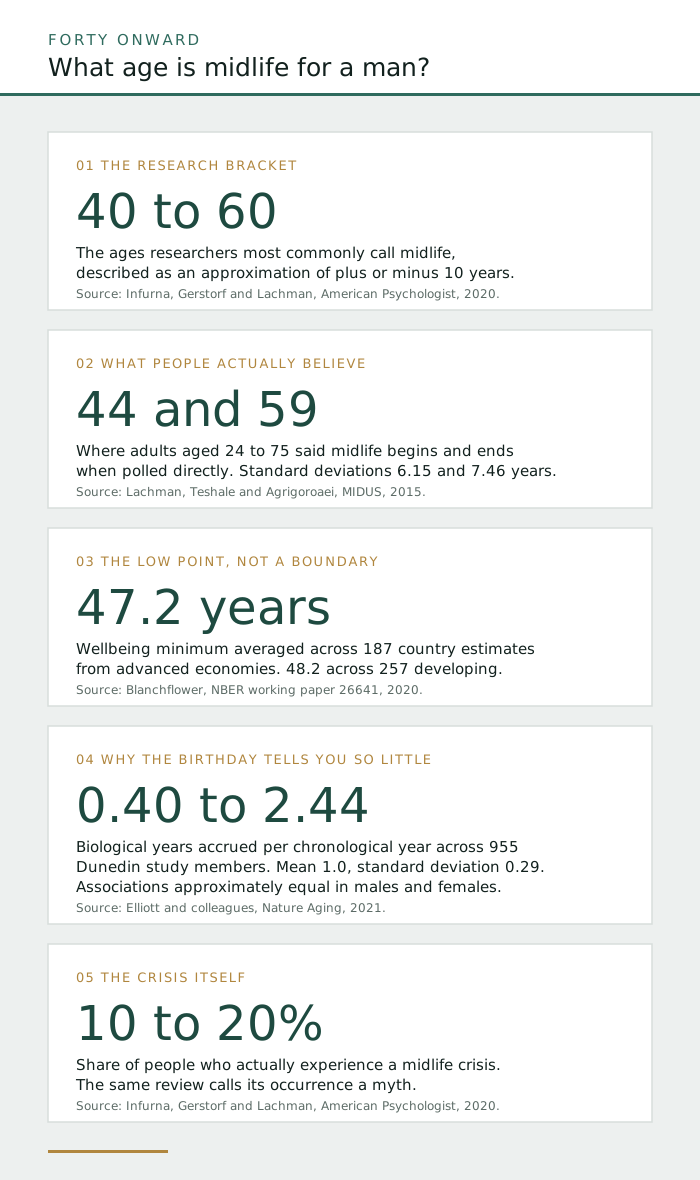
Midlife is most commonly bracketed as ages 40 to 60, and when you ask ordinary adults rather than researchers, they put the start at 44 and the end at 59. The single most cited number inside that span is 47.2 years, which is roughly where wellbeing bottoms out once you average 187 separate country-level estimates from advanced economies. So the honest short answer is that midlife runs from about forty to about sixty, and the middle of the middle sits at roughly forty-seven. None of those three figures was measured on men specifically, which turns out to matter less than the thing that replaces them.
That is the answer most men come looking for. It is also the least useful of the three answers on this page, and the rest of this article is about the other two.
Last reviewed September 15, 2026. Every figure below comes from the cited peer-reviewed or federal source and is linked inline so you can check it yourself. Population averages describe distributions, not individuals, and no average on this page predicts where any one man is. This is general information rather than medical or psychological advice.
The short answer, with the three numbers separated
The confusion about what age midlife starts comes from three different numbers being quoted as if they were the same number. They measure different things.
Forty to sixty is the research convention. In their review of midlife in the 2020s, Infurna, Gerstorf and Lachman write that researchers and the public have generally considered midlife to encompass the ages of 40 to 60, plus or minus 10 years, making it a relative approximation. That plus or minus ten is not a footnote. It means the field's own bracket runs anywhere from 30 to 70 depending on who is drawing it.
Forty-four to fifty-nine is what people actually believe. The Midlife in the United States study, the first national study built specifically around middle-aged adults, asked its participants directly. Adults between 24 and 75 said on average that midlife begins at 44 and ends at 59, with standard deviations of 6.15 and 7.46 years. The public sets the gate later than the researchers do and closes it slightly earlier.
Forty-seven point two is a low point, not a boundary. Drawing on 109 data files across 132 countries, the economist David Blanchflower produced 444 significant country estimates of the age at which wellbeing bottoms out. Averaging the 187 estimates from advanced countries put the minimum at 47.2 years, and across 257 estimates from developing countries it was 48.2. This number gets quoted as "the age of the midlife crisis" constantly. It is not that. It is the trough of a U-shaped curve, which means it is the point after which the average starts rising again.
Three numbers, three different questions. A bracket, a belief, and a nadir.
Why the bracket keeps moving
Midlife is a recent invention. Lachman and colleagues date the construction to about 150 years ago, and its upper edge has drifted a long way since then.
The psychologist G. Stanley Hall wrote a book about the second half of life in 1922, at the age of 78. His scheme had five stages, and he placed middle life or the prime at "twenty-five or thirty to forty or forty-five", with senescence beginning in the early forties. Read that again with a modern eye. The age range that the research convention now calls the start of midlife is the range Hall called the start of old age.
Go back further and midlife was the peak rather than the plateau. In sixteenth-century European paintings the life course was drawn as a set of ascending and then descending steps, with the apex typically labelled age 50, at a time when average life span was under fifty. Across the sixteenth and seventeenth centuries the same genre gave each decade an animal: the bull at 30 for strength, the lion at 40 for courage, the fox at 50 for wit, which was understood as the compensation for losing the first two.
Note which end of the bracket actually moved. The start has barely shifted at all: 40 is close to where Hall located the beginning of senescence, and it is where the modern convention begins midlife. The end has travelled about fifteen years, from Hall's "forty or forty-five" out to sixty. That fifteen year figure is an editorial working estimate read off the two brackets rather than a number any of these sources publishes.
So the number you are looking for has a history, and the history is a drift at one end. Every generation has put the far edge of midlife roughly where its own remaining runway suggested, and every generation has believed its placement was a fact about biology rather than a fact about life expectancy. There is no reason to think ours is the first to get it objectively right.
The three answers, and which one you should use
The first of the three answers breaks into three separate numbers, which is where most of the confusion on this topic starts. The other two answers are not numbers at all.
| Question you are actually asking | Best number | What it measures | How much it tells you about yourself |
|---|---|---|---|
| Where do researchers draw the line? | 40 to 60, plus or minus 10 | A labelling convention for grouping study participants | Very little |
| When do people feel midlife starts? | 44, ending at 59 | A population belief, SD 6.15 years at the start | A little, and it is drifting later |
| Where is the statistical bottom? | 47.2 years | The minimum of a U-shaped wellbeing curve across 187 estimates | Nothing about your own curve |
| How far through am I biologically? | Your pace of aging | Rate of decline across 19 organ-system biomarkers | A great deal |
| What phase am I actually in? | Your role constellation | Which obligations sit above and below you | The most of any measure here |
The bottom two rows are the ones worth your attention, and neither of them is a birthday.
The reason chronological age is the weakest answer
Take two people who are both exactly 45. There is a study that measured how different they can be, and the size of the gap is the single most useful fact on this page.
The Dunedin study followed a cohort of 1,037 people born in the same year in the same town, and tracked 19 biomarkers across the cardiovascular, metabolic, renal, immune, dental and pulmonary systems at ages 26, 32, 38 and 45. From those measurements the researchers calculated each person's Pace of Aging, expressed in biological years accrued per chronological year. A pace of 1.0 is the cohort average: one year of physiological change per year on the calendar.
Across the 955 study members for whom a pace could be calculated, the mean was 1.0 with a standard deviation of 0.29. The slowest ager in the cohort accrued 0.40 biological years per chronological year. The fastest accrued 2.44. Over the nineteen years between the first and last measurement, that is a difference of roughly thirty-nine biological years of physiological change between two people with the same date of birth.
Two things about that finding before you carry it anywhere. The Dunedin cohort is mixed sex, and the authors report that associations with the Pace of Aging were approximately equal in males and females, so this is not a male-specific effect and nothing here says men age faster or slower than women. And the authors' own conclusion is blunt: chronological age is a poor proxy for biological age, even in midlife. They wrote that about pension and healthcare policy, but it answers the question this page is about just as directly. If two 45 year olds can be decades apart physiologically, then "45" is a weak description of where either of them stands.
This is why the question "what age is midlife for a man" has a clean answer and an unsatisfying one at the same time. The bracket is real. It just has a very wide error bar attached to it, and the error bar is a fact about biology rather than about measurement.
The better question, and the marker that actually locates you
The MIDUS researchers reached the same conclusion from the opposite direction. After reporting the 44 and 59 figures, Lachman, Teshale and Agrigoroaei add that given the high degree of variability within age periods, chronological age may not be the best anchor for identifying what is midlife, and that midlife may be better considered in terms of roles, the timing of life events, and life experience.
Role constellation is the practical version of that, and it is the marker most men recognise the moment it is named. Midlife, structurally, is the period in which you are simultaneously load-bearing in two directions: responsible for people younger than you and increasingly responsible for people older than you, at the same time. It is the only stretch of a life where both are true at once.
That structure arrives at wildly different ages depending on when you started. A man who became a father at 22 and whose parents are still independent at 70 may hit it at 35. A man who became a father at 40 and whose parents needed him at 75 may not hit it until 55. Both are in midlife by the only definition that describes anything about their week.
The three markers, in the order of how much they tell you:
- Are you load-bearing in both directions? Someone depends on you downward, someone is beginning to depend on you upward. If yes, you are in it regardless of your birthday.
- Has your body's rate of change become information rather than noise? Not whether you have symptoms, but whether recovery, sleep and injury have started behaving like a trend instead of a bad week.
- Have you started counting backwards? At some point a man stops estimating his age from his birth and starts estimating it from the end. No study on this page measures that switch, so treat it as an editorial marker rather than a finding. It is the one most men recognise immediately when it is named, and it has no fixed age at all.
We wrote about what tends to follow that switch in midlife crisis in men, including the distinction between a crisis and a correction that decides how the next decade goes.
What the age question is usually standing in for
The age question is rarely asked for its own sake. It usually stands in for one of two others.
"Am I on time?" The bracket answers this, and the answer is reassuring. If you are between 40 and 60 you are inside the convention, inside the polled belief, and inside the range where the wellbeing curve is at or near its floor. There is nothing unusual about where you are. Why that trough is a floor rather than a verdict, and what actually moves a man off it, is the subject of midlife crisis in men and we will not re-argue it here. Blanchflower closed his own abstract on 132 countries with a single sentence: the happiness curve is everywhere.
"Is what I am feeling a crisis?" The bracket does not answer this, and the honest number is smaller than the cultural noise suggests. Reviewing the evidence, Infurna and colleagues report that the occurrence of the midlife crisis has turned out to be a myth, with research showing 10 to 20 percent of people actually experience it. They also name the real cost of treating it as normative: attributing mental or physical health symptoms to a phase, and therefore not treating them.
That second point deserves more weight than it usually gets. "Midlife crisis" is a label with no clinical status that sits conveniently over several conditions that do have one. If what you are experiencing has lasted months, has physical signs, and does not lift when circumstances improve, the age bracket is not the relevant framework. We covered how to tell the difference and what to do about it in when to see a therapist for a midlife crisis.
The pivot, not the half
There is one more reason the age question is less interesting than it looks, and it is the reason this site exists.
The MIDUS work describes middle age as a pivotal period in three specific senses: it balances growth and decline, it links the earlier and later periods of a life, and it bridges younger and older generations. That framing is a century old in outline. Jung called midlife the afternoon of life and treated it as the hinge between the morning and the evening. Erikson named its central task generativity, which is the obligation to produce and maintain something that outlasts you.
None of those definitions contains a number, and that is the point. What they describe is a position, not an age: the point in a life where you are still adding and already subtracting, and where the balance between the two becomes the thing you manage.
Longitudinal data from MIDUS gives a more positive picture of midlife wellbeing than the older cross-sectional studies did. The middle years turned out to be less of a decline and more of a mixed ledger, with real gains running alongside real losses, and with wide individual variation in which side moves. Which side moves for you is the part no birthday predicts, and on this evidence it is that variation rather than the average that decides how the decade goes.
Where you put the boundary matters far less than what you do inside it. If you want the version of this that is about what to build rather than what to measure, start with finding purpose after 40 and then aging gracefully, which covers the physical half of the same ledger.
FAQ
What age is midlife for a man?
Three different answers get quoted as one. Researchers bracket it at 40 to 60, ordinary adults polled in the MIDUS study put it at 44 to 59, and 47.2 is the averaged low point of the wellbeing curve rather than a boundary. None of the three is a threshold anything crosses, and none was measured on men specifically. The breakdown of which number answers which question is in the table above.
Is 40 the start of midlife, or is it earlier?
Forty is the low end of the modern research bracket, not a threshold anything crosses. Ordinary adults set the start later, at 44 on average. The historical comparison is stranger than it looks: in 1922 G. Stanley Hall put the prime of life at 25 to 45 and located the start of senescence in the early forties, so the age the modern convention calls the beginning of midlife is close to the age Hall called the beginning of old age. The start of the bracket has barely moved in a century. The far end is what travelled.
What is the significance of age 47 in midlife research?
Age 47.2 is an average of 187 separate country-level estimates from advanced economies of where wellbeing reaches its minimum, alongside 48.2 across 257 estimates from developing countries. It is a statistical low point on a U-shaped curve, not a crisis age and not a boundary of midlife. It describes distributions rather than individuals, so no single person's curve is guaranteed to bottom out there or in that year at all.
Why do two men the same age feel like they are at different stages of midlife?
Because people the same age are not the same age biologically. The Dunedin study tracked 19 biomarkers across six organ systems in a mixed-sex cohort born in the same year and calculated each person's Pace of Aging in biological years accrued per chronological year. Across the 955 study members with a calculable pace the mean was 1.0 with a standard deviation of 0.29, while the slowest ager accrued 0.40 biological years per chronological year and the fastest 2.44. The authors report the associations were approximately equal in males and females, so this is a human finding rather than a male one, and it means two people sharing a birthday can be many biological years apart.
How can I tell whether I am in midlife without using my age?
Use role position rather than birthday. The structural signature of midlife is being load-bearing in two directions at once: responsible for people younger than you and beginning to be responsible for people older than you. The MIDUS researchers make the same point, that midlife is better considered in terms of roles, the timing of life events, and life experience than in terms of chronological age. That configuration can arrive at 35 for one man and 55 for another.
Does reaching midlife age mean a midlife crisis is coming?
No. Reviewing the evidence on midlife in the 2020s, researchers report that the occurrence of the midlife crisis has turned out to be a myth, with roughly 10 to 20 percent of people actually experiencing one. The more useful warning in that same review is the opposite of the stereotype: treating a crisis as normative at this age leads people to attribute genuine mental or physical health problems to a phase, and therefore to leave them untreated.
Is midlife the same as the second half of life?
The research uses "pivotal period" rather than "half", and the distinction carries weight. A half is an arithmetic fact about how much time has passed. A pivot describes a position: the stretch where you are still adding and already subtracting, linking the earlier and later parts of a life and bridging the generations above and below. Jung framed it as the afternoon between morning and evening, Erikson named its central task as generativity, and neither description contains an age at all.
How long does midlife last for a man?
On the research convention it runs about twenty years, from 40 to 60. On the polled average it runs fifteen, from 44 to 59. Neither figure has a hard edge, and the spread in the polled answers is wide enough that the honest reading is a gradual entry and a gradual exit rather than two dates. The more durable answer is that it lasts as long as you are load-bearing in both directions.
Sources
- the ages of 40 to 60, plus or minus 10 years (pmc.ncbi.nlm.nih.gov)
- midlife begins at 44 and ends at 59 (pmc.ncbi.nlm.nih.gov)
- 187 estimates from advanced countries (nber.org)
- biological years accrued per chronological year (pmc.ncbi.nlm.nih.gov)