Midlife Crisis in Men: What It Actually Is, and What It Is Not
A man wakes up at forty-six with everything he said he wanted. The house is paid down. The title on his email signature took twenty years. And the first honest thought of the day is: is this it.
That thought is not a defect. It shows up so reliably, in so many countries, that economists have been arguing about it in journals for twenty years. What follows is what the evidence actually supports, stripped of the sports car jokes and the self help.
Last reviewed August 3, 2026.
The short answer
A midlife crisis, as most men experience it, is not a breakdown. It is a reckoning: the moment the story you have been telling about your life stops matching the life. The gap was always there. Somewhere around forty the noise gets quiet enough to hear it.
The useful distinction is between a crisis and a correction. A crisis is what happens when the gap gets addressed with one dramatic irreversible act. A correction is what happens when it gets addressed with a series of small reversible ones. Same starting pain. Very different second half.
What the data actually says about the dip
Wellbeing over a life is not a straight line down. It is a U.
In a study of roughly 500,000 Americans and West Europeans, David Blanchflower and Andrew Oswald found that a typical person's happiness reaches its minimum in middle age, on both sides of the Atlantic and for both men and women. They found the same curve in 72 developed and developing nations, and a matching pattern in mental health scores among 16,000 Europeans and in reported depression and anxiety among a million UK citizens.
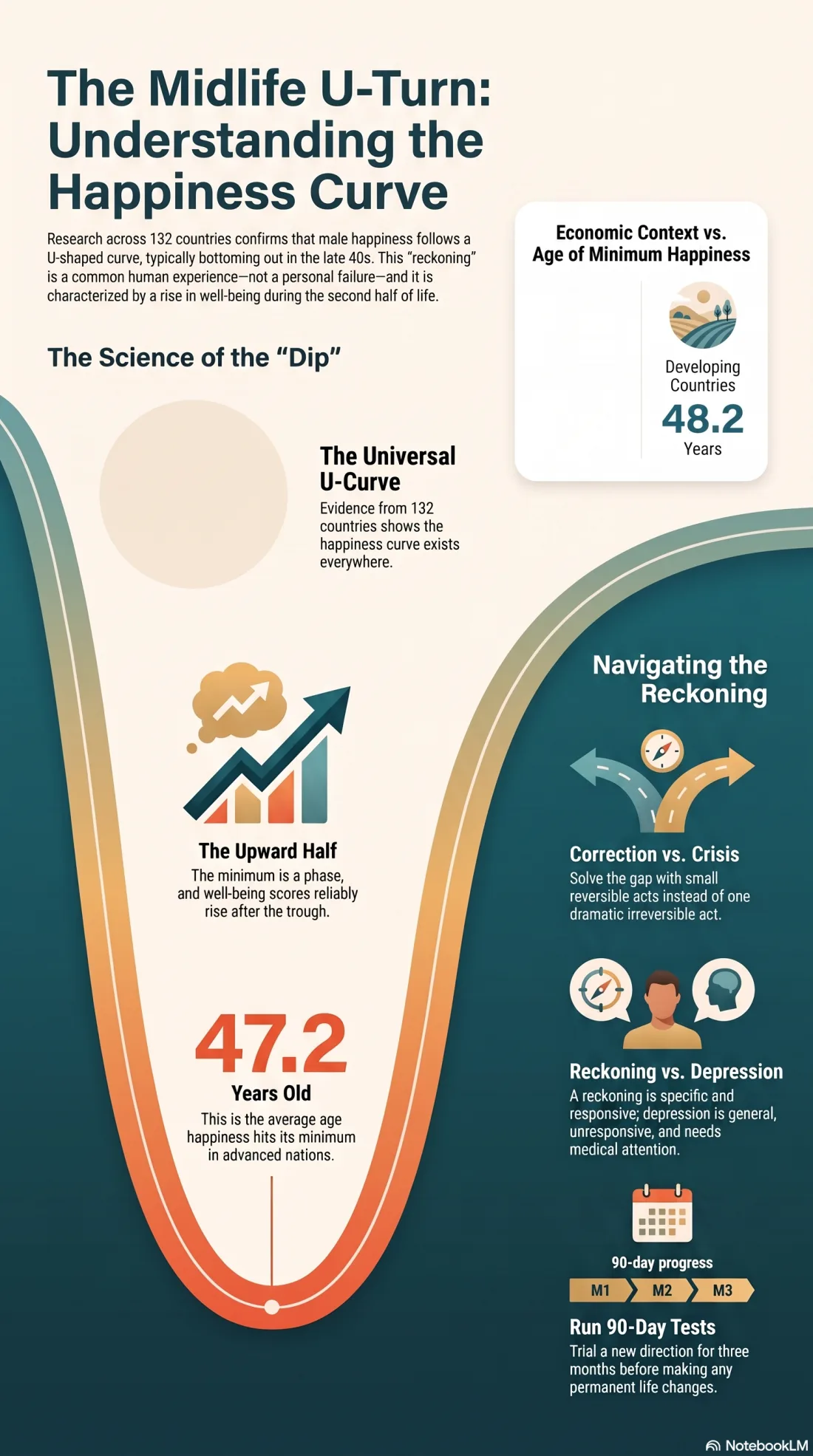
Blanchflower later widened the net. Drawing on 109 data files across 132 countries, he produced 444 significant country estimates. Averaging the 187 estimates from advanced countries put the low point at 47.2 years. Across 257 estimates from developing countries it was 48.2. He closed that abstract with a single sentence: the happiness curve is everywhere.
Two things follow from that, and both matter more than they sound.
First, if you are forty-seven and flat, you are not failing at life. You are standing at the statistical bottom of a curve that most of the species walks through.
Second, and this is the part nobody tells men in the dip: the curve comes back up. The minimum is a minimum. What you do in it decides how steep the recovery is.
The four things men mistake for a midlife crisis
Most of what gets called a midlife crisis is one of four separate problems wearing the same coat. They have different fixes, so naming yours matters.
| What it looks like | What it usually is | What actually helps |
|---|---|---|
| Flat, bored, going through motions | A purpose gap. The goals you are executing were set by a younger man with different values | Re-set the goal, not the life. Small tests before big moves |
| Exhausted, cynical, short-tempered | Overwork and depletion, not existential doubt | Recovery and load reduction first. Do not make life decisions while depleted |
| Restless, tempted by an exit | An intimacy or honesty gap at home, misread as a wanting-a-different-life problem | Say the true thing to the actual person before rearranging the furniture of your life |
| Heavy, blank, no pleasure in anything | Possible clinical depression, which is a medical condition and not a phase | A doctor. Not an article, not a retreat, not a motorcycle |
That fourth row is the one men skip. Which is why it gets its own section.
Crisis or depression, and how to tell
This site does not diagnose anyone and neither should you. But the difference between a rough stretch and a clinical one has a rough shape worth knowing.
A midlife reckoning tends to be specific and responsive. You feel flat about work but you still laugh at your friend, still want the trip, still taste the food. It moves when circumstances move.
Depression tends to be general and unresponsive. The flatness covers everything, including the things you used to love, and it does not lift when the week improves. It often comes with changes to sleep, appetite, concentration, and a persistent sense of worthlessness. It can last for weeks without a trigger.
If you are reading the second paragraph and recognising yourself, that is not a character verdict. Depression is common and it is treatable, and the treatment works considerably better than waiting. Speak to a doctor. If you are in crisis in the United States, call or text 988. In the UK, call 116 123. Elsewhere, contact your local emergency services.
Everything below assumes you are in the first category.
What actually helps
Run tests, not detonations. The man who leaves the marriage, the job and the city in the same quarter is not solving the gap, he is outrunning it. Every one of those doors is expensive to reopen. The correction version: pick the smallest reversible version of the change and run it for ninety days. Want out of the industry? Do not resign, take on one project in the new one. Want a different life on Saturdays? Change one Saturday.
Fix depletion before you interpret it. Meaning judgements made while exhausted are unreliable. Every option looks pointless at 11pm in the fourteenth straight week. Sleep, load, and physical condition are not a side quest here. The National Institute on Aging calls physical activity a cornerstone of healthy aging, noting that people who exercise regularly not only live longer, they tend to live more years without pain or disability. Deal with the body before you cross examine the life, and aging gracefully covers which measurements actually predict how that body holds up.
Say the true sentence out loud. Most men in the dip are carrying one unsaid thing: to a wife, a business partner, a father, a son. The unsaid thing costs more than the saying. This is not a feelings exercise, it is maintenance on the only relationships that will still be there at seventy. If there is nowhere safe to say it, a paid room is one option, and we set out what that actually does and does not do in therapist for a midlife crisis.
Point at something. A purpose does not have to be grand and it does not have to be your job. It has to be real, and it has to have someone on the other end of it. We wrote the full method in finding purpose after 40, including why the "find your passion" advice fails men at this age.
Do not confuse a reckoning with a starting gun. If the honest answer is that the work is genuinely finished and a real change is due, that is legitimate and it happens. Do it as a plan, not as an escape. That is a whole discipline of its own, and it is covered in starting over at 40.
The move that makes it worse
There is one reliable way to convert a survivable dip into a decade of damage: make the permanent decision while in the trough, then defend it with a story.
The trough is not a neutral vantage point. It is the single least accurate moment in the whole curve for evaluating a marriage, a career, or a self. Decisions made there tend to get justified for years afterwards, because the alternative is admitting the cost was paid for a misreading.
The rule is unglamorous. In the trough, take actions that are reversible. Save the irreversible ones for when the curve has started to climb.
The good news is not that the feeling is imaginary. It is that the feeling is a signal with a known shape, a known low point, and a known upward half nobody warned you about. Most men are told the second half is about managing decline. The measurements say something else entirely.
The midlife dip in one picture
Test yourself
Key takeaways
FAQ
Why do men have a midlife crisis?
Two things stack. Wellbeing follows a U shaped curve across the life course, bottoming around 47 years on the averaged country estimates, so feeling flat in the middle is the statistical norm rather than a personal failure. Sitting on top of that is the gap between the story a man has been telling about his life and the life itself, a gap that was always there and only becomes audible once the noise of the first half quiets down. What gets called a crisis is usually one of four separate problems underneath: a purpose gap, depletion from sustained overwork, an unaddressed honesty gap at home, or clinical depression. Each has a different fix, which is why naming yours matters more than naming the phase.
At what age do men have a midlife crisis?
The research does not identify a crisis age, but it does identify a low point in wellbeing. Averaging 187 country estimates from advanced economies, Blanchflower put the minimum at 47.2 years, and 48.2 across developing countries. In practice men commonly report the reckoning anywhere between forty and fifty-five, often triggered by an external event such as a parent's death, a child leaving, or a career milestone that arrived without the feeling attached. Where midlife itself starts and ends is a separate question, and the three numbers usually quoted for it do not agree with each other.
Is a midlife crisis a real psychological condition?
No. It is not a clinical diagnosis. What is well documented is the U shaped pattern of wellbeing across the life course, which bottoms out in midlife and rises afterwards. "Midlife crisis" is the popular name for how that dip is experienced. Depression, by contrast, is a genuine clinical condition, it is distinct from a midlife dip, and it needs a doctor.
How long does a midlife crisis last in men?
There is no fixed duration, and anyone quoting one is guessing. What the population data shows is a curve that bottoms in the late forties and improves afterwards, which suggests the flat stretch is a phase rather than a permanent state. How long your version runs depends heavily on whether the underlying gap gets addressed or merely outrun.
Do all men go through a midlife crisis?
No. The U shape is an average across large populations, not a script every individual follows. Plenty of men pass through their forties without a reckoning. The point of the average is the reassurance it offers to the ones who do: it is common, it is not a failure of character, and it has an upward half.
What is the difference between a midlife crisis and burnout?
Burnout is depletion caused by sustained load, and it responds to recovery and reduced demand. A midlife reckoning is a meaning problem, and it responds to changing what you are pointed at. They frequently occur together, which is why men misdiagnose one as the other. The order matters: treat the depletion first, because exhausted men are unreliable judges of whether their life is worth anything.
What is a midlife crisis?
A midlife crisis is the popular name for a reckoning, the point at which the story a man has been telling about his life stops matching the life he is actually living. The gap was always there. Somewhere around forty the noise gets quiet enough to hear it. It is not a clinical diagnosis and it is not a breakdown. What is documented is the underlying pattern: wellbeing across a life follows a U shape that bottoms out in middle age, at 47.2 years on the averaged estimates from advanced economies, and the same curve shows up across 132 countries. The useful distinction is between a crisis and a correction. A crisis is what happens when that gap gets addressed with one dramatic irreversible act. A correction is what happens when it gets addressed with a series of small reversible ones. Same starting pain, very different second half. In practice most of what gets called a midlife crisis is one of four separate problems wearing the same coat: a purpose gap, depletion from sustained overwork, an unaddressed honesty gap at home, or clinical depression, which is a medical condition and needs a doctor rather than a phase label.
Sources
- reaches its minimum in middle age (pubmed.ncbi.nlm.nih.gov)
- 132 countries (nber.org)
- a cornerstone of healthy aging (nia.nih.gov)