Strength Training for Men Over 40: How Little It Takes
Strength training for men over 40 asks for two days a week. That is the federal guideline, and in the largest pooled look at muscle-strengthening activity and death, the risk of dying from any cause was at its lowest at 40 minutes a week. Not 40 minutes a day. A week. Most men over 40 who do not lift are not lazy about it. They are working from a wrong estimate of the price.
Somewhere along the way the number in their head became five days a week, an hour a session, a gym membership, a program, a pair of shoes for it. Against that estimate, doing nothing is a rational decision, and a rational decision is exactly what most of them have made. The actual number in the evidence is much smaller, and it is smaller in a way that should annoy you slightly once you see it.
Last reviewed September 10, 2026. Every number below is quoted from the linked federal source or peer-reviewed paper, and where a finding comes from an observational study rather than a trial, that is stated in the sentence rather than buried. Population-level associations describe groups, not you specifically. This is general information and not medical advice. If you have a cardiac condition, an unmanaged blood pressure problem, a hernia, or a joint injury you have not had looked at, the sequence starts with a doctor rather than with a barbell.
The short answer
Train every major muscle group twice a week. That is the whole floor, and it is a federal recommendation rather than a gym opinion.
The evidence for the twice figure is more specific than most guidelines get. When trials that compared training frequencies were pooled on a volume-equated basis, hitting a muscle group twice a week beat hitting it once, and the effect on muscle growth was roughly 60 percent larger. Going to three has not been tested against two on enough matched-volume trials to say either way.
Beyond that floor, more work does produce more muscle, but the return per set is small and steady rather than dramatic. And the association between strength work and living longer does not keep climbing as the volume rises. It reaches its lowest risk estimate at 40 minutes a week, then drifts back up, while still staying on the good side of the line out to roughly 140 minutes a week.
So the shape of the correct answer for a man of 43 with a job and children is: two sessions, the whole body each time, a small number of hard sets per muscle, and enough protein. The thing standing between most men and that is not capacity. It is an estimate.
What the guideline actually says, in its own words
The Physical Activity Guidelines for Americans, 2nd edition is the federal document every American public health body works from. On strength it says this, verbatim:
Adults should also do muscle-strengthening activities of moderate or greater intensity and that involve all major muscle groups on 2 or more days a week, as these activities provide additional health benefits.
Three things in that sentence do real work. Moderate or greater intensity rules out the version of strength training where you move a light weight while thinking about something else. All major muscle groups rules out the arms-and-chest habit most men fall into and never leave. 2 or more days a week is the entire time commitment, stated by the government, in a document that ran to more than a hundred pages and could easily have asked for more.
The same document reports what share of the country manages it. Only 26 percent of men, 19 percent of women, and 20 percent of adolescents report enough activity to meet both the aerobic and the muscle-strengthening guidelines. Nearly 80 percent of adults miss the pair, while about half meet the aerobic half on its own.
Read those two facts next to each other. The country has broadly accepted the walking and the running. It has broadly ignored the two days. That is the gap this piece is about: not effort, but a wrong belief about what is actually being asked of you.
The mortality curve bottoms out at 40 minutes a week
In 2022 a team pooled 16 prospective cohort studies to ask what muscle-strengthening activity does to disease risk and death, independent of aerobic activity. The result, published in the British Journal of Sports Medicine, is the one finding in this whole area that changes behaviour when people hear it.
Muscle-strengthening activity was associated with a 10 to 17 percent lower risk of all-cause mortality, cardiovascular disease, total cancer, diabetes and lung cancer. That much you would expect. The shape is the surprise.
Be precise about the headline number, because the paper's abstract compresses it in a way that is easy to misread. The often-quoted "30 to 60 minutes a week" is not the width of one curve. It is the span across three different outcomes that each bottom out at a different point. Total cancer reaches its maximum risk reduction of 9 percent at 30 minutes a week. All-cause mortality reaches its maximum of 17 percent at 40 minutes. Cardiovascular disease reaches its maximum of 18 percent at 60 minutes. Diabetes behaves differently again, with an L-shaped curve showing a large reduction up to about 60 minutes a week and a flattening after.
The number that matters most to a reader asking whether this keeps him alive is the all-cause one, and it is sharper than the range suggests. Six of the sixteen studies were eligible for the dose-response analysis, covering 236,331 participants and 37,178 deaths. The lowest relative risk in that analysis was 0.83, with a confidence interval of 0.79 to 0.86, and it sat at 40 minutes a week.
Be careful about what that does and does not license. J-shaped does not mean that more becomes harmful. The same analysis reports that the risk estimate stayed below 1.00 out to approximately 140 minutes a week, which is to say the association remained protective across the entire range most people will ever train in. What the authors decline to claim is that the extra minutes buy anything further, and in the conclusion they call the influence of higher volumes unclear rather than negative. These are observational cohorts, so reverse causation and residual confounding are live possibilities, and people who report very high strength-training volumes are an unusual group in ways a questionnaire does not capture.
What it does license is this. If your reason for not training is that you cannot commit to the schedule you imagine is required, the schedule you imagine is required is not the one with the evidence behind it. A man doing two 20 minute sessions a week is standing on the low point of that curve.
| Weekly muscle-strengthening volume | What the pooled cohorts found | How confident to be |
|---|---|---|
| Zero | The reference group everything else is measured against | High. This is the comparison, not a finding |
| 30 minutes | Lowest point of the total cancer curve, a 9 percent reduction | Low to moderate. Four studies in that dose-response analysis |
| 40 minutes | Lowest point of the all-cause mortality curve, relative risk 0.83 | Moderate. Six studies, 236,331 participants, observational |
| 60 minutes | Lowest point of the cardiovascular curve, an 18 percent reduction, and the end of the diabetes reduction | Moderate. Same design limits |
| Up to about 140 minutes | Risk estimate still below 1.00 for all-cause mortality | Moderate. Protective, but not better than 40 minutes |
Twice a week per muscle group is the frequency floor
The number in the federal guideline is not a round figure someone picked. A 2016 systematic review and meta-analysis in Sports Medicine went looking specifically at how training frequency affects muscle growth, and found ten trials that compared different weekly frequencies directly while measuring actual tissue change by biopsy, imaging, circumference or densitometry.
Comparing higher against lower frequency, the effect on hypertrophy was significant, with an effect size of 0.49 plus or minus 0.08 for the higher frequency against 0.30 plus or minus 0.07 for the lower. The authors' conclusion is worth having exactly: comparing studies that trained muscle groups between one and three days a week on a volume-equated basis, frequencies of twice a week promote superior growth to once a week, so the major muscle groups should be trained at least twice a week. Whether three times a week beats twice remains to be determined.
Volume-equated is the phrase that matters. Those trials held the total weekly work constant and only moved how it was distributed. So this is not a finding that more work is better. It is a finding that the same work, split across two days instead of one, produces more muscle. That is a free improvement, and it is available to a man who has exactly two evenings.
Volume matters, and the return per set is gentle
Once the frequency floor is met, the next question is how much. The same research group ran a meta-regression the following year on the relationship between total weekly sets and muscle size, covering 34 treatment groups drawn from 15 studies.
The finding was a graded dose-response. Each additional weekly set per muscle was associated with an increase in effect size of 0.023, which corresponded to an increase in the percentage gain of 0.37 percent. Comparing the higher and lower volume arms within each study, the effect size difference was 0.241, equating to a percentage gain difference of 3.9 percent.
That number comes with two catches worth being straight about. When the authors split weekly sets into three bands, fewer than 5, 5 to 9, and 10 or more per muscle, the effect was only a trend rather than a clear result, at a p value of 0.074. And these are percentage differences in muscle size gain, not in strength, health or how you feel on a Tuesday.
The practical reading is the useful one. A dose-response that pays about a third of a percent per extra set is real, and it is also not urgent. It means a man doing 6 hard sets per muscle group per week is getting most of what a man doing 12 gets, at half the time cost. That paper measured muscle size and nothing else, so it says nothing about injury at either volume and neither will this article. If you are choosing between six sets you will actually do and twelve you will abandon in March, the arithmetic is not close.
What actually changes after 40
The National Strength and Conditioning Association published a position statement on resistance training for older adults in 2019 that runs to 34 pages in the Journal of Strength and Conditioning Research. Its framing is the part worth carrying: aging is associated with biological changes that reduce skeletal muscle mass, strength and function, those losses decrease physiologic resilience and increase vulnerability to catastrophic events, and countering muscle disuse through resistance training is a powerful intervention against them.
What changes with age is smaller than you would guess, and it comes down to three specifics.
Recovery between hard sessions gets longer, so frequency is the variable to protect and intensity is the one to earn. In practice two well-recovered sessions tend to beat four half-recovered ones, and the need for recovery lengthens with age. That sentence is editorial judgement rather than a finding: the frequency evidence above is about how a fixed volume is distributed, not about recovery quality.
Protein does slightly less for you per gram, which is an argument for more of it rather than less. More on that below.
Connective tissue adapts more slowly than muscle does. Muscle can improve faster than tendon can tolerate, which is the mechanism behind most of the injuries men pick up in their first six to eight weeks back. The answer is boring: add load in small increments, and treat that same six to eight week window as tissue preparation rather than training.
What does not change is whether it works. The NSCA statement exists precisely because the evidence in older adults is strong, not marginal. If your working assumption is that you have missed the window, that assumption is the thing to discard. It sits in the same family as the assumption we take apart in aging gracefully, which is that what happens to your body after 40 is mostly a matter of appearance and mostly out of your hands.
The protein ceiling is softer than the number makes it look
A 2018 meta-analysis in the British Journal of Sports Medicine pulled data from 49 randomised controlled trials with 1,863 participants, all of them at least six weeks of resistance training with dietary protein supplementation. Protein supplementation significantly enhanced gains in muscle strength and size over prolonged training.
Then it found what everyone quotes as the ceiling. The abstract says protein supplementation beyond a total intake of about 1.62 grams per kilogram of body weight per day produced no further training-induced gains in fat-free mass. That sentence has travelled a long way from what the paper actually did, and the difference matters.
Read the break-point analysis rather than the abstract. It is a biphasic regression on 42 study arms and 723 participants, a subset of the 49 studies and 1,863 participants behind the paper's main effects. Its break point is 1.62 g/kg/day with a confidence interval running from 1.03 to 2.20. And the authors state that it is presented as a segmental regression despite not being statistically significant, at a p value of 0.079. Given how wide that interval is, their own recommendation is the opposite of a ceiling: it may be prudent, they write, to recommend about 2.2 grams per kilogram per day for people seeking to maximise training-induced gains in fat-free mass.
So the honest version is that 1.62 is a soft, non-significant point estimate inside a wide band, and the paper's authors round up rather than down. Treat anything between roughly 1.6 and 2.2 grams per kilogram as the target zone, not 1.62 as a line you stop at.
Two moderating results sit alongside it, and one is directly about you: the effect of protein supplementation on fat-free mass gains was reduced with increasing age, and was larger in people who already trained.
Note what the figure is and is not. It is total daily protein from all sources, not the amount from a supplement. It is not a maximum safe intake, and it is not a target you must hit before training is worth doing.
| Body weight | 1.62 g/kg, the point estimate | 2.2 g/kg, the authors' prudent target |
|---|---|---|
| 70 kg, about 154 lb | About 113 g a day | About 154 g a day |
| 85 kg, about 187 lb | About 138 g a day | About 187 g a day |
| 100 kg, about 220 lb | About 162 g a day | About 220 g a day |
Both columns are arithmetic on figures published in that paper, shown to make the band concrete. Neither column is a finding about you specifically, and the gap between them is the honest width of the evidence rather than a rounding choice.
The week that satisfies all of it
Nothing above requires a program with a name. It requires two sessions that each touch every major muscle group, about 6 hard sets per muscle group across the week, loads heavy enough to count as moderate or greater intensity, and enough protein that you are not training against your own intake.
That is 40 to 55 minutes a session for most men once warm-up and the rest between sets are counted, so 80 to 110 minutes a week. That is more than the 40 minutes where the mortality curve bottoms out, and it is worth being explicit about why that is fine rather than quietly hoping you do not notice. The all-cause risk estimate in that analysis stayed below 1.00 out to roughly 140 minutes a week, so 80 to 110 sits inside the protective range. The 40 minute figure tells you the point of diminishing return, not a limit. And the mortality curve is only one of the two things this article is trying to satisfy. The frequency and volume evidence is about muscle, and muscle is what the sets are for. Push, pull, hinge, squat, carry. Two sessions covering those five patterns covers the guideline's all major muscle groups requirement without a spreadsheet.
If the problem is not knowing what to do but not wanting to, that is a different problem with a different literature behind it, and we have taken it apart separately in lost exercise motivation at 45. The short version is that the gap sits between intending and doing rather than between caring and not caring, and the fix is structural rather than motivational. If the flatness extends well past exercise into work and everything else, the three-way triage is the better place to start, because depression and expired goals need opposite responses and neither one is solved with a barbell.
What this article is not
It is not a program. It is the set of constraints a program has to satisfy, which is more durable than any particular program and which is the part that has evidence attached.
It is not a claim that lifting will make you live longer. Every mortality figure quoted here comes from observational cohorts. They establish association and they cannot establish cause, and the authors of the 2022 pooling say so directly.
It is not medical clearance. If you have a cardiac condition, uncontrolled blood pressure, a hernia or an unassessed joint, the first appointment is with a doctor.
And it is not an argument that strength work replaces aerobic work. The federal guideline asks for both, and the 2022 pooling reports that people doing muscle-strengthening and aerobic activity combined had a lower risk of all-cause, cardiovascular and cancer mortality than people doing neither. That comparison is against doing none, not against doing one of the two, so it is evidence for doing both rather than a ranking of the two against each other.
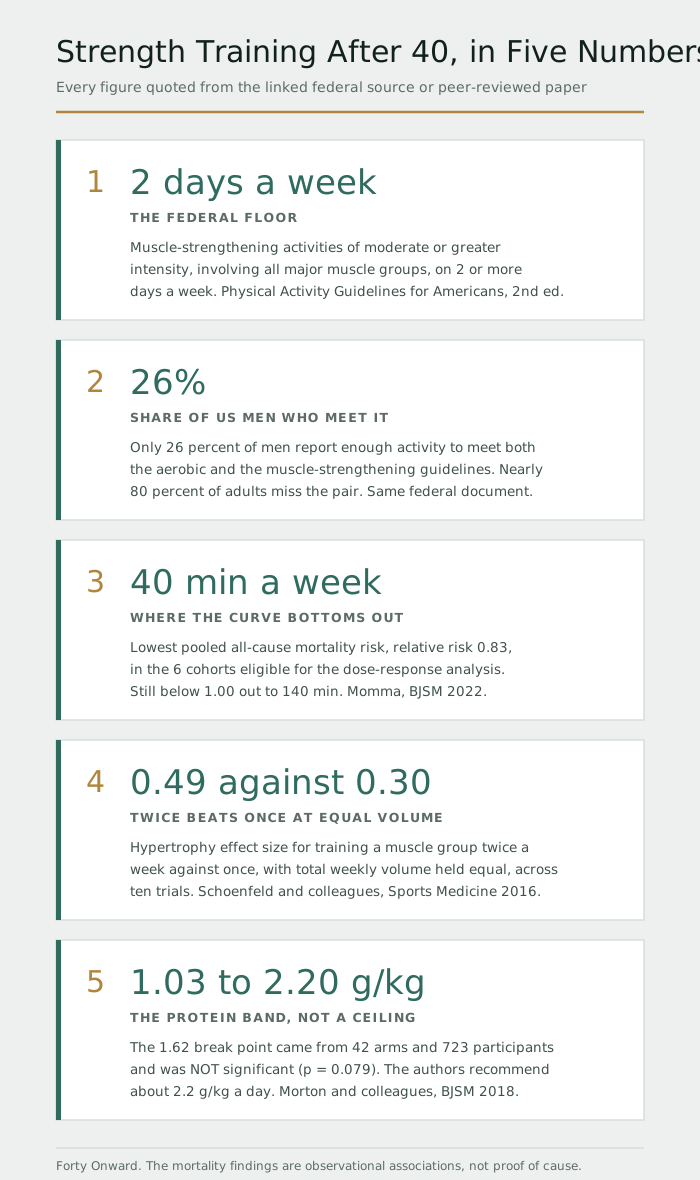
Strength training over 40 in five numbers
| The number | What it is | Source |
|---|---|---|
| 2 days a week | The muscle-strengthening minimum, all major muscle groups, moderate or greater intensity | Physical Activity Guidelines for Americans, 2nd edition |
| 26% | Share of US men meeting both the aerobic and the muscle-strengthening guidelines | Physical Activity Guidelines for Americans, 2nd edition |
| 40 min a week | Where pooled all-cause mortality risk was lowest, relative risk 0.83 | Momma and colleagues, 6 cohorts in the dose-response analysis, BJSM 2022 |
| 0.49 against 0.30 | Hypertrophy effect size, twice a week against once, at equal weekly volume | Schoenfeld and colleagues, 10 trials, Sports Medicine 2016 |
| 1.03 to 2.20 g/kg a day | Confidence interval around the protein break point. The 1.62 point estimate was not significant, p = 0.079 | Morton and colleagues, break-point subset of 42 arms, 723 participants, BJSM 2018 |
Test yourself
Key takeaways
FAQ
How often should a man over 40 strength train?
Twice a week, with every major muscle group trained in both sessions. That is the floor in the Physical Activity Guidelines for Americans, which asks for muscle-strengthening activities of moderate or greater intensity involving all major muscle groups on 2 or more days a week. The figure is supported by a 2016 meta-analysis of ten trials that compared frequencies while holding total weekly volume equal, in which twice a week produced a larger effect on muscle growth than once a week, 0.49 against 0.30. Those authors state that whether three times a week beats twice is still undetermined.
How long should a strength training session be for a man over 40?
Long enough to cover every major muscle group with a small number of hard sets, which is usually 40 to 55 minutes. The reason not to go much longer is diminishing return rather than danger. In the 2022 pooling, the all-cause mortality curve reached its lowest relative risk of 0.83 at 40 minutes a week across six cohort studies, and the risk estimate stayed below 1.00 out to roughly 140 minutes a week. So two sessions of 40 to 55 minutes sits inside the protective range while being well past the point where extra minutes stop buying anything measurable.
Is 45 too late to start lifting?
No, and the strongest evidence on this point is aimed specifically at older adults. The National Strength and Conditioning Association's 2019 position statement on resistance training for older adults concludes that countering muscle disuse through resistance training is a powerful intervention against the loss of muscle strength and mass and their consequences for mobility, independence and healthy life expectancy. The document exists because the evidence in this age group is strong.
How much protein do I actually need?
Somewhere between about 1.6 and 2.2 grams per kilogram of body weight a day, from all sources. The widely quoted 1.62 figure comes from a break-point analysis inside a 2018 meta-analysis, run on 42 study arms and 723 participants rather than the full 49 trials, with a confidence interval of 1.03 to 2.20 and a p value of 0.079, which is to say it was not statistically significant. The authors' own recommendation, given that width, is about 2.2 grams per kilogram a day for anyone trying to maximise gains in fat-free mass. For an 85 kg man that band runs from roughly 138 to 187 grams a day. The same analysis found the effect of supplementation was reduced with increasing age, which is an argument for landing inside that band rather than treating protein as optional.
Do I need a gym to strength train after 40?
The guideline specifies intensity and coverage, not equipment. What it asks for is moderate or greater intensity across all major muscle groups, twice a week. That can be met with bodyweight progressions, bands or a pair of adjustable dumbbells at home, as long as the load is genuinely hard by the end of a set and every major muscle group is covered. Equipment becomes the limiting factor later, when bodyweight progressions stop being difficult.
Will lifting make me live longer?
The honest answer is that nobody has run the trial that would prove it. Every mortality figure in this article comes from observational cohorts. Those cohorts found muscle-strengthening activity associated with a 10 to 17 percent lower risk of all-cause mortality and several major diseases, independent of aerobic activity, with the all-cause figure reaching a 17 percent reduction at 40 minutes a week. Association is not causation, and the authors of that pooling are explicit about the limits of the design.
Should you do cardio as well as strength training after 40?
Yes, and the two are not interchangeable. The federal guideline asks for both. In the 2022 pooling, people doing muscle-strengthening and aerobic activity combined had a lower risk of all-cause, cardiovascular and cancer mortality than people doing neither. Read that as support for doing both, since the comparison group was people doing none rather than people doing one.
What is the most common mistake men make restarting after 40?
Adding load faster than connective tissue adapts. Muscle responds more quickly than tendon does, so the first six to eight weeks are the window where an eager return turns into an injury that costs a season. Treat that period as tissue preparation, add weight in small increments, and let the frequency rather than the intensity do the early work.
Sources
Physical Activity Guidelines Advisory Committee, US Department of Health and Human Services. Physical Activity Guidelines for Americans, 2nd edition, 2018. Source for the muscle-strengthening recommendation quoted verbatim, and for the 26 percent of men and nearly 80 percent of adults participation figures, which the document attributes to the CDC National Health Interview Survey.
Momma H, Kawakami R, Honda T, Sawada SS. Muscle-strengthening activities are associated with lower risk and mortality in major non-communicable diseases: a systematic review and meta-analysis of cohort studies. British Journal of Sports Medicine. 2022;56(13):755 to 763. PMID 35228201. Sixteen prospective cohort studies in total, of which six were eligible for the all-cause mortality dose-response analysis (236,331 participants, 37,178 cases). Source for the 10 to 17 percent risk reductions, the per-outcome peaks (total cancer 9 percent at 30 min/week, all-cause mortality 17 percent and relative risk 0.83 at 40 min/week, cardiovascular disease 18 percent at 60 min/week, diabetes L-shaped to 60 min/week), the risk estimate remaining below 1.00 to approximately 140 min/week, and the combined muscle-strengthening plus aerobic finding.
Schoenfeld BJ, Ogborn D, Krieger JW. Effects of Resistance Training Frequency on Measures of Muscle Hypertrophy: A Systematic Review and Meta-Analysis. Sports Medicine. 2016;46(11):1689 to 1697. PMID 27102172. Ten trials. Source for the 0.49 plus or minus 0.08 against 0.30 plus or minus 0.07 effect sizes and the volume-equated twice-a-week conclusion.
Schoenfeld BJ, Ogborn D, Krieger JW. Dose-response relationship between weekly resistance training volume and increases in muscle mass: A systematic review and meta-analysis. Journal of Sports Sciences. 2017;35(11):1073 to 1082. PMID 27433992. Thirty-four treatment groups from 15 studies. Source for the 0.37 percent gain per additional weekly set, the 3.9 percent higher-against-lower difference, and the p = 0.074 trend in the three-band analysis.
Morton RW, Murphy KT, McKellar SR, Schoenfeld BJ, Henselmans M, Helms E, Aragon AA, Devries MC, Banfield L, Krieger JW, Phillips SM. A systematic review, meta-analysis and meta-regression of the effect of protein supplementation on resistance training-induced gains in muscle mass and strength in healthy adults. British Journal of Sports Medicine. 2018;52(6):376 to 384. PMID 28698222. Forty-nine studies and 1,863 participants for the main effects. The break point is a separate biphasic regression on 42 study arms and 723 participants: 1.62 g/kg/day (95% CI 1.03 to 2.20), reported by the authors as not statistically significant (p = 0.079), alongside their recommendation of about 2.2 g protein/kg/day for maximising training-induced gains in fat-free mass. Also the source for the reduced effect with increasing age.
Fragala MS, Cadore EL, Dorgo S, Izquierdo M, Kraemer WJ, Peterson MD, Ryan ED. Resistance Training for Older Adults: Position Statement From the National Strength and Conditioning Association. Journal of Strength and Conditioning Research. 2019;33(8):2019 to 2052. PMID 31343601. Source for the position on resistance training as a countermeasure to age-related loss of muscle mass, strength and function.