Lost Motivation at 45: Three Different Problems Wear That Same Face
You have not lost your motivation. Motivation is not a substance you carry around in a jar and can misplace on a bad Tuesday. What has broken is the connection between what you do all day and something you actually want, and in a man's forties that connection breaks for three quite different reasons. All three feel the same from the inside. All three need a different response. Picking the wrong one is how men lose years.
The three are clinical depression, burnout in the narrow occupational sense the World Health Organization actually defines, and a goal structure that expired without anybody telling you. Most men at 45 assume they have the third when they have the first, or self diagnose the second because it is the only one of the three that sounds like a compliment. This piece is about telling them apart using what the evidence says, and about the order you have to check them in.
Last reviewed August 26, 2026. Every figure below comes from the cited federal source, international body or peer reviewed paper and is linked inline so you can check it yourself. Population level findings describe groups rather than individuals, and none of the trials cited here were designed to tell any single man what is wrong with him. This is general information about published research, not therapy, not medical advice and not a diagnosis. Persistent flatness, hopelessness or loss of interest that does not lift is a medical matter and deserves a doctor. If you are in crisis in the United States, the 988 Suicide and Crisis Lifeline is available around the clock by calling or texting 988, or at 988lifeline.org.
The short answer
Lost motivation is a symptom, not a diagnosis. At 45 it usually resolves into one of three things, and you have to rule them out in a fixed order rather than the order that flatters you.
Depression first, because it is the only one of the three that can kill you and the only one that makes you an unreliable judge of the other two. The National Institute of Mental Health lists "feeling flat or having trouble feeling positive emotions" among the common symptoms of mental disorders in men, alongside anger, irritability and unexplained physical aches. That is the presentation most men do not recognise as depression, because there are no tears in it.
Burnout second, and only if your problem is genuinely about your job. The WHO's definition is far narrower than the way the word gets used, and it explicitly says the term should not be stretched to cover the rest of your life.
The third case is the one nothing is wrong with. Your goal structure delivered what it promised, or permanently stopped being reachable, and nothing replaced it. Motivation did not fail. Its object expired. That is not an illness and no amount of rest will fix it, because rest is not the missing ingredient.
The three problems that wear the same face
| What it actually is | The tell that separates it from the other two | What moves it |
|---|---|---|
| Depression | The flatness is total rather than selective. It follows you into the things you used to enjoy, it does not lift when the week goes well, and it usually arrives with changes to sleep, appetite or concentration | A doctor first. Treatment, and behavioural change alongside it rather than instead of it |
| Burnout, strict sense | It is bounded by your job. Energy depletion, growing mental distance from the work, and a sense that you are no longer any good at it. Outside work you can still want things | Reduced load and real recovery, plus a change to the conditions that caused it. Rest alone returns you to the same job |
| An expired goal structure | Nothing hurts. You function fine. You simply cannot answer what any of it is for now that the thing you were driving at is either done or permanently out of reach | A new object worth wanting. Rest makes this one worse, because the emptiness gets quieter and more obvious |
The reason the order matters is in the last column, where the three responses point in opposite directions. Rest is the treatment for one of them and actively counterproductive for another. Give a man whose goal structure has expired a fortnight in the sun and he comes back flatter than he left.
Burnout is a much narrower word than you are using it for
Burnout appears in the eleventh revision of the International Classification of Diseases, and the WHO's own clarification is blunt about what that does and does not mean. It is classified as an occupational phenomenon and it is not classified as a medical condition. It sits in the chapter covering reasons people contact health services that are not themselves illnesses.
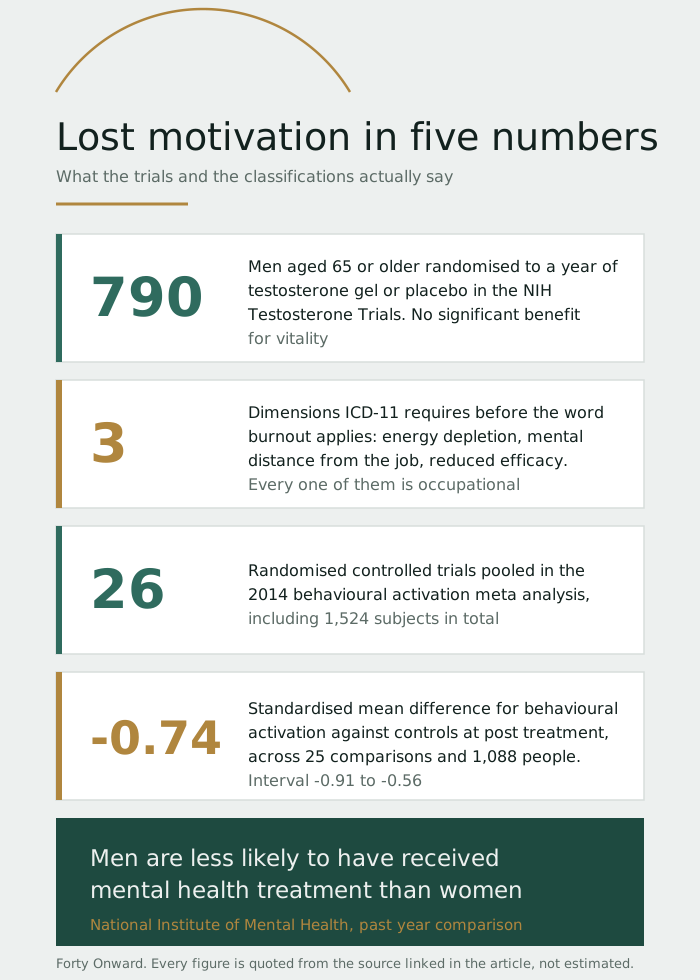
The definition names three dimensions: "feelings of energy depletion or exhaustion; increased mental distance from one's job, or feelings of negativism or cynicism related to one's job; and reduced professional efficacy." Then it adds the sentence almost nobody quotes. Burnout "refers specifically to phenomena in the occupational context and should not be applied to describe experiences in other areas of life."
Read that against your own situation honestly. If your job is tolerable and the flatness follows you home on a Saturday, you do not have burnout. You have something else, and calling it burnout routes you toward a solution that cannot touch it. Annual leave is a treatment for depletion. It is not a treatment for meaninglessness, and a man who books three weeks off to fix a meaning problem arrives back in exactly the same place with less money.
If the word does fit you, the three dimensions are also the three places to look for what has to change. Name what is draining the energy, name what specifically is producing the cynicism, and name where you have genuinely stopped being effective. Those three answers are what you take to a manager or use to redesign the job around. Rest is what you take afterwards, to recover from what has already been spent.
Christina Maslach and Michael Leiter, whose inventory produced most of the evidence base behind that definition, made a related point in World Psychiatry in 2016. They note the pressure to redefine burnout as simply exhaustion, and they flag how little evaluative research exists on interventions to treat or prevent it. They also observe that the usual treatment goal for burnout is to return the person to their job and have them succeed in it. That is worth sitting with. If returning to the same job successfully is not the outcome you actually want, burnout may not be your diagnosis even when the exhaustion is real.
This is the same distinction the property draws in what a midlife crisis in men actually is: depletion responds to recovery, a meaning problem responds to changing what you are pointed at, and the two arrive together often enough that men confidently treat the wrong one.
What depression looks like in a man who is not sad
The picture most men carry of depression is a man who cannot get out of bed and cries. That version exists. It is not the version that gets missed.
NIMH's list of symptoms of mental disorders in men includes anger, irritability or aggressiveness; noticeable changes in mood, energy level or appetite; difficulty sleeping or sleeping too much; difficulty concentrating; misuse of alcohol or drugs; feeling flat or having trouble feeling positive emotions; and aches, headaches or digestive problems without a clear cause. Men and women develop most of the same conditions, NIMH notes, but they may experience different symptoms.
Almost every item on that list reads, from the inside, as a personality trait or a bad patch rather than an illness. A short temper gets filed under character, sleeping badly under being 45, the extra drink under a phase, and feeling nothing much about anything under having become realistic. Assembled, they are a recognised clinical picture.
Two further facts from the same source sharpen the risk. Men are less likely than women to have received mental health treatment in the past year, and men are more likely to die by suicide than women, per the Centers for Disease Control and Prevention. The gap between how common this is and how rarely it gets treated is the entire problem, and it is not closed by reading an article. It is closed by an appointment. If you have never been through that door, the property has a plain guide to finding a therapist for a midlife crisis, including what it costs.
The threshold is not complicated. If the flatness is total rather than selective, has run for more than two weeks, does not lift when circumstances improve, and comes with changes to sleep, appetite or concentration, stop reading and book the appointment. Everything else in this article assumes you have already done that.
The testosterone answer, and what the trial found
The first explanation most men reach for is hormonal, because it is the one with a product attached. Low testosterone, low drive, top the tank up, get the man back.
The best evidence available on that proposition is the NIH funded Testosterone Trials, published in the New England Journal of Medicine in 2016. The design is unusually clean. Seven hundred and ninety men aged 65 or older, every one of them with a serum testosterone concentration below 275 nanograms per decilitre and symptoms suggesting hypoandrogenism, randomised to testosterone gel or placebo gel for a year. These were not men with normal levels. They were the exact population the treatment is sold to.
Testosterone treatment raised their levels into the mid normal range for men aged 19 to 40. Sexual activity, sexual desire and erectile function all improved significantly. Mood and severity of depressive symptoms were slightly better than placebo.
And vitality, assessed with the Functional Assessment of Chronic Illness Therapy Fatigue scale, showed no significant benefit at all. The trial's own conclusion says it plainly: a moderate benefit for sexual function, some benefit for mood and depressive symptoms, and no benefit with respect to vitality or walking distance.
Two honest caveats, because this result gets over-claimed in both directions. These men were 65 and older, not 45, so the trial does not directly describe a man in his forties. And the investigators noted the number of participants was too few to draw conclusions about the risks of treatment. What the trial does establish is narrow and useful: in the population most likely to benefit, raising testosterone for a year did not restore energy. If a man of 45 has genuine symptoms, a blood test is a reasonable thing to ask a doctor for. Expecting the result to explain why nothing feels worth doing is expecting something the evidence does not support.
The third case, and at 45 it is the common one
Strip out depression and strip out occupational burnout and a large group of men remain. Nothing is wrong with them. They sleep adequately, they perform, they are not sad. They simply cannot say what any of it is for.
The most useful framework for that state is self determination theory, set out by Richard Ryan and Edward Deci in American Psychologist in 2000. Their argument is that intrinsic motivation is not a personal quantity that some people have more of. It is a response to conditions. Three psychological needs have to be met for it to persist: competence, autonomy and relatedness. Where conditions support all three, motivation is generated and maintained. Where conditions thwart them, it degrades, and it degrades in people who previously had plenty.
Now apply that to a specific man. He built a life at 25 around a goal structure that supplied all three needs at once: he was visibly getting better at his job, he had chosen the path himself, and it fed a family and a group of friends.
Twenty years on, each leg has quietly gone. He is competent but no longer improving, because he reached the top of the curve at 38 and has been maintaining ever since. The autonomy went when the mortgage and the school fees converted his choices into obligations he cannot exit for two years without damage. And the relatedness thinned out in the way it does for most men in this decade, which the property covers separately in the male loneliness epidemic.
Nothing dramatic happened to him. Three needs eroded on separate timelines and no single day was the day it broke. That is exactly why he cannot name a cause, and why he keeps concluding the problem must be internal and moral. It is not moral. His conditions changed and his motivation responded the way the theory predicts it would.
This is also the honest answer to why a new job sometimes fixes it and sometimes does not. A move that restores competence and autonomy works. A lateral move into the same conditions at a different logo does nothing, which is the trap examined in changing career at 40.
Waiting until you feel like it is the wrong order
The instinct is to wait for motivation and then act. Every man reading this has tried that and knows how it goes.
Behavioural activation inverts it. The behaviour comes first, chosen deliberately and scheduled rather than felt, and the mood follows the behaviour rather than preceding it. It is one of the least glamorous treatments in the field and one of the better evidenced.
David Ekers and colleagues updated the meta analysis in PLoS One in 2014. Twenty six randomised controlled trials including 1,524 subjects were included. Pooled at post treatment, behavioural activation was superior to controls with a standardised mean difference of -0.74, confidence interval -0.91 to -0.56, across 25 comparisons and 1,088 people. Against antidepressant medication it came out at -0.42, confidence interval -0.83 to -0.00, though that comparison rests on only four trials and 283 people and its upper bound touches zero.
The authors are candid about the limits, and repeating them is not hedging. Study quality was low in the majority of the trials, and the follow up periods were short. That means the size of the effect is better established than its durability.
The practical translation is not motivational and it is not supposed to be. You schedule the activity for a fixed time, you do it at that time whether or not you want to, and you stop treating your appetite for it as the input that decides whether it happens. That approach was tested against control conditions and against drugs, and it held up in both directions.
A two week sort
This is an editorial working estimate rather than a validated instrument, and it is offered as a way to gather information about yourself, not as a diagnostic tool. Two weeks is the window because that is the duration carried in the clinical definition. NIMH, following the fifth edition of the Diagnostic and Statistical Manual, describes a major depressive episode as a period of at least two weeks when a person experienced a depressed mood or loss of interest or pleasure in daily activities, and had a majority of specified symptoms such as problems with sleep, eating, energy, concentration or self worth. It is also long enough that a single bad week cannot dominate the result.
Pick three activities that used to give you something. One that requires skill, one you would choose freely with nobody watching, and one that puts you in a room with another person. Schedule each of them once a week for two weeks, at a fixed time, and do them regardless of whether you feel like it on the day. Write one line afterwards about whether anything registered.
Then read the pattern rather than the mood.
If none of the three registered anything at all, if the flatness held right through them, and if sleep, appetite or concentration are also off, that points at the first case and it points at a doctor. If they all registered fine and it is only the working day that is grey, that points at the second case and at your job's conditions rather than your character. If the skill activity and the freely chosen one both registered and only the third fell flat, look at relatedness before anything else, and start with the property's guide to the male loneliness epidemic.
And if all three registered clearly while your ordinary week remains empty, you are probably in the third case. That is not good news exactly, but it is the most workable of the three, because it means the machinery is intact and only the target is missing. The property's guide to finding purpose after 40 is written for that specific situation.
Lost motivation in five numbers
What this article is not
It is not a diagnosis and it cannot be one. Three of the sources here describe populations, and a population level finding is a starting point for a conversation with a doctor rather than a substitute for one.
The third case is not the interesting one. It is the one you can work on alone, while the other two involve either a clinician or an employer, and that is precisely why men prefer to conclude they have the third.
There is one more thing this article deliberately does not do, which is tell you that you have wasted twenty years. A goal structure that expired is not a goal structure that failed. It is one that finished. Those are different, and the difference matters more at 45 than at any other age, which is the argument made at length in why the regrets that last are the things you never did.
FAQ
Why have I lost all motivation at 45?
Because one of three separate problems produces that same symptom, and they are hard to tell apart from the inside. Either you are depressed, in the flat and irritable presentation rather than the tearful one. Or you are burned out in the narrow occupational sense, which the WHO restricts to your job and explicitly nowhere else. Or the goal structure you built in your twenties has finished, or become unreachable, and nothing took its place. Work through them in that sequence rather than the one that is easiest on your ego, because a depressed man is a poor assessor of the other two, and because the third is the only one of the three you can work on without involving anybody else.
Is losing motivation a sign of depression?
It can be, and this is the presentation most often missed in men. NIMH's list of common symptoms in men leads with anger and irritability, changes to energy and appetite, disturbed sleep, unexplained aches, and difficulty feeling positive emotions at all. Almost nothing on that list looks like sadness, which is why men do not recognise it in themselves. The distinguishing feature is scope. Depression flattens everything, including the things that used to reliably work, and it holds through a good week rather than lifting. NIMH puts the clinical threshold at two weeks, following the DSM-5 definition of a major depressive episode. Past that point, see a doctor rather than trying to reason your way out.
How do I get my motivation back?
Not by waiting until you feel like it, which is the order almost everyone tries and the one with the worst record. Behavioural activation inverts it. You put the activity in the diary at a fixed time and do it whether the appetite is there or not, so the mood follows the behaviour instead of leading it. A 2014 meta analysis in PLoS One, pooling 26 randomised trials, found it beat control conditions at post treatment by a little under three quarters of a standard deviation. It also came out ahead of antidepressant medication, on the strength of just four trials, with a confidence interval that touches zero. The authors flag that most trials were low quality with short follow up, so how large the effect is rests on firmer ground than how long it holds.
Can low testosterone cause a loss of motivation?
The evidence does not support treating it as the explanation. The NIH Testosterone Trials gave a year of testosterone gel or placebo to 790 men aged 65 or older who all had genuinely low testosterone and symptoms to match, which is precisely the population the treatment is marketed to. Sexual function improved and mood was slightly better. Vitality did not move. Two limits are worth holding on to: those men were 65 and older rather than 45, and the investigators said there were too few participants to reach any conclusion about treatment risk. If you have symptoms, ask a doctor for the blood test. Just do not expect the number that comes back to explain why nothing feels worth doing.
Why have I lost motivation for work specifically?
If the flatness is bounded by your job and lifts at the weekend, that is the shape the WHO's burnout definition describes, and all three of its dimensions sit inside the workplace: depleted energy, growing cynicism or distance from the work, and the sense that you have stopped being any good at it. The WHO states plainly that the term belongs to the occupational context and nowhere else. The practical consequence is that leave treats the exhaustion and not the thing producing it, so returning to unchanged conditions restarts the clock. Use the three dimensions as a checklist instead. Work out which part of the job is draining you, what is feeding the cynicism, and which work you have stopped doing well. Those specifics are what a manager can act on.
How long does a loss of motivation normally last?
There is no published figure, because lost motivation is a symptom rather than a diagnosis and its course depends on which of the three problems is producing it. Burnout persists for as long as the conditions that caused it persist. An expired goal structure does not resolve on its own at all, because nothing about waiting supplies a new goal. The one case with a defined threshold is depression. NIMH, following the DSM-5, describes a major depressive episode as at least two weeks in which a person had a depressed mood, or lost interest or pleasure in daily activities, plus a majority of the other listed symptoms. Treat two weeks as the point to stop waiting rather than a period to sit through.
What is the difference between losing motivation and being lazy?
Laziness is a moral category and it explains nothing. Ryan and Deci's self determination theory, published in American Psychologist in 2000, treats intrinsic motivation as a response to conditions rather than a fixed quantity of character. It rests on three things being in place: whether you are getting better at something, whether you chose it, and whether it connects you to another person. Remove any one of those for long enough and motivation degrades in someone who previously had a great deal of it. So the question that gets you somewhere is not why you became lazy. It is which of the three stopped being true, and roughly when.
Sources
- National Institute of Mental Health, Men and Mental Health, National Institutes of Health. Symptom list, treatment gap and suicide comparison quoted directly from that page.
- World Health Organization, Burn-out an "occupational phenomenon": International Classification of Diseases, 28 May 2019. Full ICD-11 definition and the restriction to occupational contexts.
- Snyder PJ, Bhasin S, Cunningham GR, and the Testosterone Trials Investigators, Effects of Testosterone Treatment in Older Men, New England Journal of Medicine, 18 February 2016. Randomised, placebo controlled, 790 men aged 65 or older with serum testosterone below 275 ng/dL, treated for one year.
- Ekers D, Webster L, Van Straten A, Cuijpers P, Richards D, Gilbody S, Behavioural activation for depression; an update of meta-analysis of effectiveness and sub group analysis, PLoS One, 17 June 2014. Twenty six randomised controlled trials including 1,524 subjects; the control comparison pooled 25 studies and 1,088 people.
- Ryan RM, Deci EL, Self-determination theory and the facilitation of intrinsic motivation, social development, and well-being, American Psychologist, January 2000. Source for competence, autonomy and relatedness as the conditions intrinsic motivation depends on.
- Maslach C, Leiter MP, Understanding the burnout experience: recent research and its implications for psychiatry, World Psychiatry, June 2016. Source for the pressure to redefine burnout as exhaustion alone and the shortage of evaluative research on interventions.
- National Institute of Mental Health, Major Depression, National Institutes of Health. Source for the two week threshold, quoted from the NSDUH definition of a major depressive episode, which follows the fifth edition of the Diagnostic and Statistical Manual of Mental Disorders.
- 988 Suicide and Crisis Lifeline, 988lifeline.org. Free and confidential support across the United States, available around the clock by call or text.