Lost Exercise Motivation at 45: Wanting It Was Never the Problem
If you have lost your exercise motivation at 45, the missing piece is the conversion from intending to doing, and that is a measured gap rather than a character flaw. In a meta-analysis of ten studies covering 3,899 people, 36 percent intended to be physically active and did not manage it, against 42 percent who intended and did. Only 2 percent were active without intending to be at all. Intention is close to necessary and nowhere near sufficient, so the useful question at 45 is which kind of reason you are running on rather than how to want it more, because the evidence separates the reasons that hold up over time from the ones that do not.
This article is about the behaviour problem specifically. If the flatness is broader than the gym, if it has taken your work and your interests with it, three different problems wear that same face and they need opposite responses. And if you want the physiology of what actually leaves a man's body after 40 and how fast, that is covered separately.
Last reviewed September 5, 2026. Every figure below comes from a peer reviewed paper or a federal health source and is linked inline so you can check it yourself. Population level findings describe groups and not individuals, and no study cited here was designed to tell any single man how to train. This is general information. It is not medical advice and it is not a diagnosis. If you have an existing injury or a chronic condition, the federal guidance itself says to bring a doctor or an exercise professional into the decision before you increase your activity.
The short answer
Stop trying to want it more, and change the reason instead. The type of motivation you are running on predicts follow through better than the amount of it, and the type that is easiest to reach for at 45 is the one the evidence backs least. Three moves follow: replace the slow reward with the same day one, delete the all or nothing session because the rule requiring it was withdrawn in 2018, and pick the activity you would do for its own sake rather than the one that burns the most.
The gap is not between caring and not caring
Almost nobody exercises by accident, and close to half of the people who form the intention do not act on it. That is the measured shape of the problem, and it comes from a meta-analysis rather than from a coaching opinion.
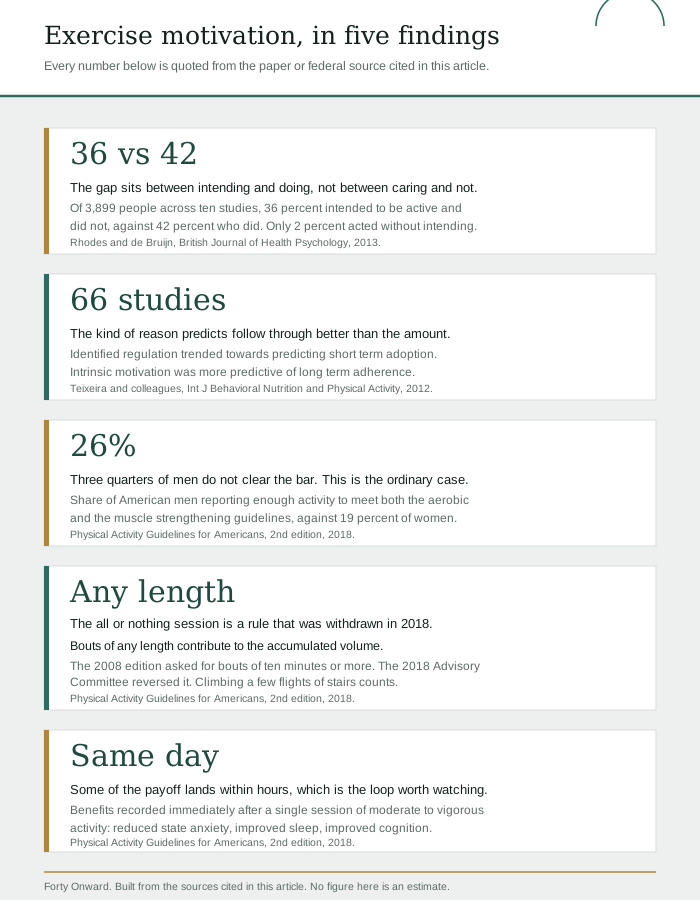
Ryan Rhodes and Gert Jan de Bruijn screened 2,865 records and found ten studies, covering 3,899 people, that measured both what people intended to do about physical activity and what they then did. Their pooled estimates split the sample four ways: 21 percent did not intend to be active and were not, 2 percent were active without intending it, 36 percent intended and failed, and 42 percent intended and succeeded.
Sit with the two middle numbers. Of everyone who formed the intention, 36 out of every 78, which is 46 percent, did not convert it. That arithmetic is ours, derived from the two figures the paper reports rather than quoted from it.
This is the most clarifying finding available to a 45 year old who has decided he has gone soft. The problem he thinks he has is a wanting problem. The measured problem in the population is a converting problem, and it fails at close to a coin flip among people who genuinely intended. Adding more resolve on Sunday night is repairing the half of the machine that already works.
Why the kind of reason matters more than the amount
The kind of reason predicts follow through better than the quantity of it, and the kinds separate by how long they last.
Pedro Teixeira and colleagues, including Richard Ryan, reviewed 66 empirical studies of exercise motivation in the International Journal of Behavioral Nutrition and Physical Activity. They were not measuring how much motivation people had. They were sorting motivation by kind, along the scale that runs from doing something because you are made to, through doing it because you would feel guilty otherwise, through doing it because you personally value the result, to doing it because the thing itself is worth doing.
The review found consistent support for the more autonomous kinds being associated with exercise. Inside that, it found something more specific. There was a trend towards identified regulation, the kind where you value the outcome yourself, predicting initial and short term adoption more strongly. And intrinsic motivation, the kind where the session itself is the point, was more predictive of long term adherence. Competence satisfaction, the sense that you are actually getting better at the thing, positively predicted participation across a range of samples and settings.
The review does not test what changes between 25 and 45, so what follows is this magazine's reading rather than a reported result. A reason that was supplied from outside, by a team, a season, or a scene that came with the training, stops being supplied when those things end. What the review does report is that the evidence for health, fitness and body related motives is mixed, and that the evidence for introjected regulation, the guilt driven kind, is mixed as well.
That is worth sitting with, because guilt and the state of his body are the two reasons a middle aged man reaches for most readily, and they are the two the review is least able to vouch for. The kind most predictive of long term adherence is the one that sounds least serious: that you like doing it.
The four kinds of reason, and what each one buys you
| The kind of reason | How it can sound at 45 (illustration, not a finding) | What the review reported |
|---|---|---|
| External, you are made to | A doctor said a number out loud and now your wife asks about it | Least autonomous end of the scale, and the review's consistent finding is that the more autonomous the regulation, the better it goes with exercise |
| Introjected, guilt | You do not want to be the father who cannot keep up, and you feel bad on the days you skip | Mixed evidence on the specific nature and consequences of this kind |
| Identified, you value the result | You have decided that being strong at 60 matters to you, whatever anyone else does | Trended towards predicting initial and short term adoption more strongly than intrinsic motivation |
| Intrinsic, the thing itself | You want to go, because the hour is good and you like being in it | More predictive of long term adherence than identified regulation |
Read the bottom two rows as a sequence rather than a competition. The review's own terms are initial and short term adoption against long term adherence, with no durations attached to either, so do not read exact weeks or months into it. Identified motivation is the one available to you on demand, because it is a decision. Intrinsic motivation is the one that holds up over the longer run, and it cannot be decided into existence. It has to be found, which is an argument for trying several activities rather than gritting through the one you have decided you ought to do.
You are not the exception, you are the ordinary case
The federal Physical Activity Guidelines for Americans, second edition, reports that only 26 percent of men, 19 percent of women and 20 percent of adolescents report enough activity to meet the relevant aerobic and muscle strengthening guidelines. The estimate comes from the National Health Interview Survey and is age adjusted across all adult men rather than isolated to the 40 to 55 band, so read it as the backdrop rather than as your cohort's exact score.
Three quarters of men do not clear the bar. That is not permission, and it does not make inactivity harmless. It is a correction to the story most men tell themselves at this age, which is that everyone else worked out how to keep going and they specifically failed. The base rate says otherwise. The behaviour is hard for almost everyone, which is why the structure around it matters more than the resolve inside it.
The reward horizon is the actual defect
The reward you are watching arrives too late to steer by, and moving it is the single most useful change on this list. A changed body is a slow return, slow enough that the feedback loop can break before the payoff lands. Harvard Health's Vijay Daryanani, a certified personal trainer with the Harvard affiliated Spaulding Outpatient Centers, names that failure mode directly: "It's so common to get frustrated if you don't see or feel results in a short time," he says, in an article whose own summary names declining motivation as the main reason people quit an exercise program.
The fix is not patience. It is changing which return you are watching. The federal guidelines note that some of the benefits to brain health occur immediately after a single session of moderate to vigorous activity, an acute effect that includes reduced feelings of state anxiety, improved sleep, and improved aspects of cognitive function. Those land the same evening.
So track what the guidelines actually measured: your sleep, your state anxiety, and how sharp the afternoon felt. Those are documented same day effects, and they are the only returns arriving fast enough to keep a feedback loop closed. The body composition change is real and it is still coming. It is simply the wrong instrument to steer by.
The all or nothing session is a rule that was deleted in 2018
If you are waiting for a clean hour before you train, you are enforcing a rule that no longer exists. The 2008 edition of the federal guidelines told people to accumulate activity in bouts of ten minutes or more, because the evidence for shorter bouts was not there yet. The 2018 Advisory Committee reversed it. The second edition states that bouts of any length contribute to the health benefits associated with the accumulated volume of physical activity, and says outright that even a brief episode like climbing a few flights of stairs counts.
That change removes an excuse that was never laziness. It was arithmetic. A man with a job and children looks at his Tuesday, cannot find a clean 60 minute block, concludes there is no session available, and does nothing. Under the current guidance the 60 minute block was never required. Eleven minutes before the school run counts toward the same weekly total as eleven minutes inside a longer session.
The all or nothing habit is worth naming as the specific defect it is. It converts a small win into a zero, every week, on the days that were always going to be broken.
The four barriers, and what the guidance actually says about each
The National Institute on Aging publishes a barriers and solutions table, and it is written for older adults rather than for men in their forties, so treat it as adjacent evidence rather than as a description of your exact cohort. The pattern still holds, and one row in it inverts a belief most tired men hold.
| The barrier | What it usually actually is | The sourced move |
|---|---|---|
| No time | An all or nothing session rule you are still enforcing on yourself | Bouts of any length count toward the weekly total, per the 2018 federal guidelines |
| Too tired | An assumption that activity spends energy you do not have | The NIA notes that many older adults feel less fatigue during and after physical activity, and suggests scheduling activity in the part of the day you feel most energetic |
| No motivation or confidence | Usually the wrong activity, or no competence feedback | The NIA suggests a trainer to learn form, and a buddy or group for accountability. Daryanani's version: if you struggle with motivation, try something different |
| Cost or equipment | A gym membership treated as the entry fee | The NIA lists free online videos, household objects for resistance, and chores, gardening and dancing as counted activity |
A four week restart that matches the evidence
Four weeks, one change each week, built from the findings above rather than from a template. None of it is a program and none of it is prescribed for you individually.
Week one, make the goal small and specific enough to be measurable. The NIA's own worked example is going from a vague goal of increasing physical activity to a measurable one, and the example it gives is a ten minute walk three times a week. That is deliberately unimpressive. The purpose of week one is to produce evidence that you do what you said, not to produce fitness.
Week two, start reading the same day returns. Note the sleep and the afternoon, since those are the acute effects the guidelines record. You are teaching the loop to close on a signal that actually arrives.
Week three, add a competence marker. The review found competence satisfaction predicting participation, and Daryanani's version of the same idea is picking a goal specific enough to measure progress against, whether that is heavier, further, or faster. Pick one number and let it move.
Week four, audit for enjoyment honestly. If you are still forcing it, that is information rather than failure. Intrinsic motivation is the thing most predictive of long term adherence, and it cannot be manufactured by trying harder at an activity you dislike. Change the activity. If you do not know what to try, the NIA's own list of counted activity is the cheapest place to start: free online videos, household objects for resistance, chores, gardening, dancing, swimming, taking the stairs. The same guidance notes that variety also lowers the overuse injury risk that ends restarts.
One more structural lever, because it is the one men use least. Group based activity and an exercise buddy appear in both the NIA guidance and Daryanani's advice as accountability that works. Men at this age are also, on the evidence, running short of exactly that kind of standing arrangement with other people. No source cited here tested a training partner against loneliness, so read that as an overlap worth noticing rather than a proven fix for both.
What this article is not
This is a behaviour piece about exercise, and its scope stops there. If the loss of drive is not confined to exercise, if it has flattened your work and your interests as well, the article on what else wears that same face covers the distinction between an expired goal structure, occupational burnout and clinical depression, and the last of those is a medical matter rather than a motivation one.
Exercise motivation in five findings
FAQ
Why have I lost all motivation to exercise at 45?
Most likely because the reason you were using stopped being supplied and nothing replaced it. Motivation research sorts reasons by kind rather than by amount, and a systematic review of 66 studies found that intrinsic motivation, wanting the session itself, predicts long term adherence better than the other kinds, while the evidence for health and body related motives is mixed. The replacements most men reach for at this age are the ones the evidence backs least.
Is losing exercise motivation in midlife normal?
It is the majority position rather than the exception. The federal Physical Activity Guidelines report that only 26 percent of American men get enough activity to meet both the aerobic and muscle strengthening guidelines. Three quarters of men do not clear the bar, which makes this an ordinary outcome rather than a personal failure, though it does not make inactivity harmless.
How do I start exercising again after years off?
Start smaller than feels serious and make it specific. The National Institute on Aging's worked example of a good goal is a ten minute walk three times a week, and the same guidance says to increase frequency, intensity and duration gradually over weeks to months to lower injury risk. The purpose of the first fortnight is to prove you do what you said you would, not to get fit.
Does a short workout actually count?
Yes, and the rule that said otherwise was withdrawn. The 2008 federal guidelines asked people to accumulate activity in bouts of ten minutes or more. The 2018 second edition states that bouts of any length contribute to the health benefits associated with the accumulated volume of activity, and gives climbing a few flights of stairs as an example that counts.
I am too tired to exercise, so is resting the right call?
The guidance points the other way, with a caveat. The National Institute on Aging lists being too tired as a common barrier and notes that many older adults feel less fatigue during and after physical activity, suggesting you schedule activity in the part of the day you feel most energetic. That advice is written for older adults rather than for the 40 to 55 band. The caveat matters: persistent exhaustion that does not lift is a medical question, not a motivation one.
How long until exercise feels worth it again?
Some of it is the same day. The federal guidelines record that some brain health benefits occur immediately after a single session of moderate to vigorous activity, including reduced feelings of state anxiety, improved sleep and improved aspects of cognitive function. The visible body change takes far longer, which is why it is a poor thing to steer by in the first month.
Should I force myself through an activity I hate?
Not for long, because the evidence says that is the version that ends. Intrinsic motivation is the kind most predictive of long term adherence, and it cannot be produced by effort applied to an activity you dislike. Harvard Health's Vijay Daryanani makes the same point directly: if you struggle with motivation, try something different, because it could be that you have not found the right type of exercise or activity yet.
Is losing exercise motivation at 45 a midlife crisis or just laziness?
Laziness is the wrong description and the evidence is against it. In a pooled meta-analysis of ten studies, far more people intended to be active and failed than were ever active without intending, so the failure sits in converting the intention rather than in having one. Men who have lost the gym are overwhelmingly men who still want it. Whether it amounts to a midlife crisis is a larger question than this article answers, and if the flatness extends well beyond exercise it deserves a separate read.
Sources
U.S. Department of Health and Human Services. Physical Activity Guidelines for Americans, 2nd edition. Washington, DC; 2018. Source for the 26 percent of men figure, the removal of the ten minute bout requirement, and the acute brain health effects of a single session. https://health.gov/sites/default/files/2019-09/Physical_Activity_Guidelines_2nd_edition.pdf
Rhodes RE, de Bruijn GJ. How big is the physical activity intention to behaviour gap? A meta-analysis using the action control framework. British Journal of Health Psychology. 2013 May;18(2):296 to 309. Source for the ten studies, the 3,899 participants, and the four way split of intenders and non intenders. https://pubmed.ncbi.nlm.nih.gov/23480428/
Teixeira PJ, Carraça EV, Markland D, Silva MN, Ryan RM. Exercise, physical activity, and self-determination theory: a systematic review. International Journal of Behavioral Nutrition and Physical Activity. 2012 Jun 22;9:78. Source for the 66 studies, the identified and intrinsic regulation findings, the competence satisfaction finding, and the mixed evidence on body related motives and introjected regulation. https://pubmed.ncbi.nlm.nih.gov/22726453/
National Institute on Aging. Tips for getting and staying active as you age. Content reviewed 14 January 2025. Source for the barriers and solutions table, the ten minute walk goal example, the fatigue observation, the counted activity list and the gradual progression advice. https://www.nia.nih.gov/health/exercise-and-physical-activity/tips-getting-and-staying-active-you-age
Solan M. What can you do to maintain exercise motivation? Harvard Health Publishing. 1 October 2025. Source for the Vijay Daryanani quotations and for declining motivation being named as the main reason people quit an exercise program. https://www.health.harvard.edu/exercise-and-fitness/what-can-you-do-to-maintain-exercise-motivation