What Is My Legacy? The Question Arrives at 45 for a Reason
Your legacy is the set of things that keep working after your attention stops: the people you invested in, the work that outlives your supervision of it, and the instructions you left behind so that none of it has to be guessed at. It is not a monument and it is not the balance in an account. The question itself arrives without an invitation, usually somewhere between 43 and 50, and usually at a bad moment. You are driving home, or standing in a hardware shop, or watching your father struggle with a stair he used to take two at a time, and the thought lands fully formed: what is any of this going to add up to. Most men treat that as a symptom. It is closer to a scheduled event.
This article answers the question in the only way that survives contact with evidence. It is not about building a monument, and it is not about how much you leave in an account. It is about which parts of a life actually transfer to other people, what the research says predicts a man's capacity to build any of it, and the order to work in.
Last reviewed August 30, 2026. Every figure below comes from the cited federal source, peer reviewed paper or nationally representative survey and is linked inline so you can check it yourself. Population level findings describe groups and not individuals, and no study cited here was designed to tell any single man what his life will amount to. This is general information. It is not legal advice, not financial advice and not therapy. Estate and inheritance law varies by state, and a licensed attorney in your jurisdiction is the only person who can tell you how any of it applies to you.
The short answer
Your legacy is the set of things that keep working after your attention stops: the people you invested in, the work that outlives your supervision of it, and the instructions you left behind so that none of it has to be guessed at. It is not your reputation, which decays fast and which you do not control. Your net worth fares no better, because the evidence ranks it a weak predictor of whether you build anything transferable at all. And the order matters more than most men expect, because the research points to one prerequisite that has to come first.
Why the question shows up now and not at 30
Psychology has a name for what you are experiencing, and the definition is unusually plain. Generativity is defined in the research literature as a concern for the well-being of future generations, involving both caring and a will to extend the self into the future. That definition comes from a study drawing on the Midlife in the United States survey, the long running national project that has followed the same American adults through three waves spaced about ten years apart.
The concept goes back to Erik Erikson, who placed the tension between generativity and stagnation squarely in the middle adult years rather than at the end of life. That placement is the part worth absorbing. The question does not arrive at 45 because you are declining. It arrives at 45 because that is the developmental slot it occupies, in a schedule that has been observed across large samples for decades.
Which means the correct read on the thought that ambushed you in the hardware shop is not that something has gone wrong. It is that something has come due. If you want the wider version of this argument, our piece on finding purpose after 40 covers the ground where purpose and midlife overlap.
The finding that reverses the usual advice
Here is the result that should change how you approach this, and it is the strongest thing on this page.
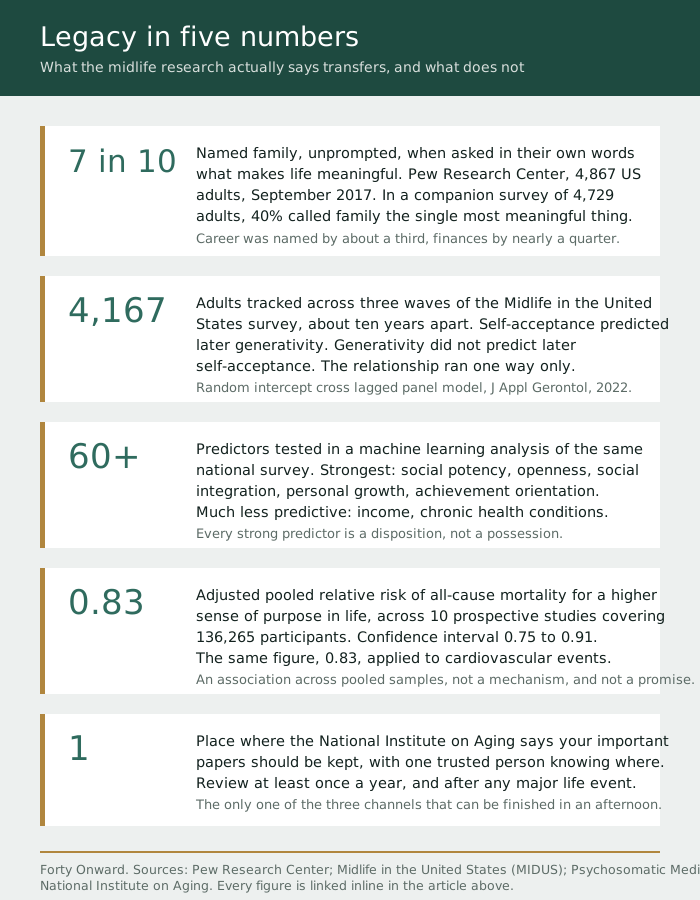
The MIDUS study above tracked 4,167 adults across those three waves and tested which way the relationship runs between self-acceptance and generativity, using a random intercept cross lagged panel model built for exactly that question. The result was one directional. Self-acceptance prospectively predicted generativity. Generativity did not predict self-acceptance. Coming to terms with your personality and your past life contributed to higher future levels of concern for the next generation. Building things for the next generation did not, in reverse, make people more at peace with themselves.
Read that against the standard midlife script and you can see how much of it is backwards. The script says a man who feels his life has not amounted to much should go and build something, and that the building will settle him. Across two decades of data, the settling came first and the building followed. A man who has not made peace with the shape of his own life tends to keep producing work aimed at proving a point, which is a different activity wearing the same clothes.
Two things follow, and neither is comfortable.
The first is that the regret you have not looked at directly is not a distraction from the legacy question. It is upstream of it. Our article on living with regrets deals with that inventory on its own terms, and live life with no regrets handles the forward-looking half, the decisions you have not made yet.
The second is a limit that has to be stated. This is one study, on one national sample, using one statistical model, and a prospective association is not a mechanism. It is strong evidence about direction rather than proof about cause. What it does rule out is the assumption most legacy advice quietly runs on, which is that the effect flows the other way.
What actually predicts it, and what does not
A separate analysis of the same national survey went looking for predictors across a wide field. It fed more than 60 variables into a random forest machine learning model, spanning personality, daily functioning, socioeconomic factors, health status and mental well-being, and ranked what actually predicted generativity.
The strongest predictors were social potency, openness, social integration, personal growth and achievement orientation. The paper's own notable finding was what ranked low: many demographic variables such as income, and many health related variables such as chronic health conditions, were much less predictive.
| What men assume the question is about | What the MIDUS predictor analysis actually ranked highest |
|---|---|
| How much money you leave | Social potency, meaning the capacity to influence and lead others |
| Whether your career was impressive enough | Openness, meaning appetite for new experience and ideas |
| Whether your health held up | Social integration, meaning being embedded in a community rather than adjacent to one |
| Whether you achieved a headline result | Personal growth, meaning an ongoing sense of developing rather than arriving |
| Whether you are remembered | Achievement orientation, meaning the drive itself rather than its trophies |
The predictor column is worth reading twice. Every item is a disposition rather than a possession. Not one of them requires a particular income, a particular job title or a particular state of health, and the paper found the variables that do gate on those things were the weaker predictors. That is the most practically useful result in this entire body of research for a man who is 47, ordinary, and quietly convinced he missed his window.
A caveat on scope, because the honest version matters more than the flattering one. This analysis identifies statistical predictors within a national sample. It does not prove that becoming more socially integrated causes generativity to rise in any individual, and the study population skews toward older adults rather than being confined to men in their forties.
The three channels that actually carry anything
Strip the word legacy of its ceremony and there are only three routes by which anything of yours reaches a person who is not in the room.
People. The ones you taught, backed, hired, raised, or refused to give up on. This channel is the reason family dominates every survey that asks the question openly. When Pew Research Center asked a nationally representative sample of 4,867 American adults, in an open ended question with no prompts, what made their lives feel meaningful, seven in ten mentioned family. In the companion closed ended survey of 4,729 adults, 40 percent named family as the single most meaningful thing in their lives, ahead of every other option offered. Career was named by about a third in the open ended version, and finances by nearly a quarter.
Work that outlives your supervision. A business that runs without you, a codebase, a repaired building, a method someone else now uses, a body of writing. The test is not whether it is impressive. The test is whether it keeps functioning when you stop attending to it. Most men's work fails this test not because it was poor but because it was structured so that only they could operate it.
Instructions. The least romantic channel and the only one that is purely administrative. It is also the one where failure is total rather than partial, because an unrecorded intention transfers nothing at all.
Legacy is not reputation, and confusing them wastes the decade
Reputation is what other people think of you. It is downstream of your behaviour, it is filtered through their interests, it decays quickly, and you do not own the ledger. Chasing it produces a specific and recognisable failure: a man optimising the appearance of contribution while the three channels above stay empty.
The tell is simple. A reputation project needs an audience to exist. A legacy project works whether or not anyone is watching, which is why so much of it looks unremarkable from the outside. Teaching one person properly is a legacy act with an audience of one. Nobody will describe it as impressive, and it will outlast almost everything you did that was.
There is a harder version of this for men who reach midlife with a thin social base. Every channel above except the paperwork depends on having people close enough to receive something. If that is your position, the constraint is structural rather than a matter of will, and we treat it directly in our article on the male loneliness epidemic.
Why building it appears to be good for you as well
There is a health dimension here, and it needs to be stated carefully because it is routinely oversold.
A meta analysis pooled 10 prospective studies covering 136,265 participants and found that a higher sense of purpose in life was associated with reduced all-cause mortality, at an adjusted pooled relative risk of 0.83, with a confidence interval of 0.75 to 0.91. The same analysis found an adjusted pooled relative risk of 0.83 for cardiovascular events, with a confidence interval of 0.75 to 0.92. Subgroup analyses by country of origin, by the questionnaire used, by age, and by whether participants with existing cardiovascular disease were included all produced similar results.
Note what that is and is not. It is a robust association across a large pooled sample. It is not evidence that manufacturing a sense of purpose extends a given man's life, and the authors themselves concluded that future research should focus on the mechanisms linking purpose to health outcomes. Purpose in life is also a related construct rather than an identical one to generativity. Treat this as a reason not to dismiss the question as sentimental, rather than as a prescription.
The part that is pure administration and gets skipped
Of the three channels, only one can be completed in an afternoon, and it is the one almost nobody does at 45 because it feels like an old man's errand.
The National Institute on Aging publishes a plain checklist of the documents to prepare and it is the least sentimental thing on this page. It asks you to put your important papers and copies of legal documents in one place, to tell someone you trust or a lawyer where to find them, to talk to your loved ones and a doctor about advance care planning, to give advance permission for a doctor or lawyer to speak with a caregiver if needed, and to review the plans at least once a year and after any major life event such as a divorce, a move or a significant change in health.
The document list it gives runs from full legal name, Social Security number, legal residence and date and place of birth through to the location of birth, death, marriage, divorce, citizenship and adoption certificates, employment and military records, and the names and phone numbers of close friends, relatives, doctors, lawyers and financial advisors. On the health side it includes current prescriptions, a living will, a durable power of attorney for health care, copies of any medical orders you hold, and health insurance policy details.
Two of those items deserve singling out because they are the ones that carry meaning rather than paperwork. A living will records what you would want done. A durable power of attorney for health care records who decides when you cannot. Both are instructions in the exact sense used above: without them, someone who loves you has to guess, under pressure, and then live with having guessed.
The NIA checklist is a national federal resource and not a substitute for state specific legal advice. Wills, trusts and probate are governed at state level and an attorney in your jurisdiction is the only person who can tell you what your documents need to say.
The order to work in
| Order | What to do | Why it comes here |
|---|---|---|
| 1 | Settle your account with your own history, including the parts you got wrong. The inventory in our piece on living with regrets is the place to start | Across three MIDUS waves, self-acceptance predicted later generativity and the reverse relationship did not hold. Skipping this step produces work aimed at proving a point |
| 2 | Complete the paperwork, including a living will and a durable power of attorney for health care | It is the only channel where failure is total rather than partial, and the only one that can be finished in an afternoon |
| 3 | Name the specific people you intend to invest in, and put real hours against them | Family is named unprompted by seven in ten adults as what makes life meaningful, ahead of career and money |
| 4 | Restructure one piece of your work so it runs without your supervision | This is the test that separates work that transfers from work that merely occupied you |
| 5 | Stop tracking reputation entirely | It is an output you do not control, and attention paid to it is subtracted from the three channels that carry anything |
Step one is the one men skip, and it is the one with the strongest evidence sitting under it.
What this article is not
This is not an estate planning guide, and nothing here is legal advice. The associations described will not necessarily hold for you personally, because population level findings do not make individual predictions. Nor does legacy require children, since the research construct concerns the well-being of future generations broadly rather than descendants specifically. And answering the question is not guaranteed to feel good. The evidence suggests the sequence starts with an honest accounting, and honest accountings are not pleasant. They are just load bearing.
If the question arrived alongside a wider sense that time is now visibly finite, that is a related but distinct problem, and our article on aging gracefully handles the physical half of it.
Legacy in five numbers
FAQ
What is my legacy?
Ask what would still be running a year after you stopped paying attention to it, and whatever answers that question is your legacy. Three things qualify. Somebody you taught or backed well enough that they carry it forward without you. Something you built and then structured so it does not need you standing over it. And a written record of your intentions, so nobody who loves you has to guess at them under pressure. Wealth is not on that list as a requirement, and neither is a job title. When a machine learning analysis of the Midlife in the United States survey ranked more than 60 predictors of generativity, income landed well below dispositions such as social integration and personal growth.
Why am I suddenly thinking about legacy at 45?
Because your forties are when it is scheduled to arrive. Erik Erikson put the tension between generativity and stagnation in the middle adult years, not in old age, and generativity has been measured in men and women of exactly your age ever since through national studies such as the Midlife in the United States survey. Researchers describe generativity as caring about how the next generation fares, combined with a will to extend yourself into a future you will not be present for. So the thought that ambushed you is not evidence of decline. It is the developmental question of your decade turning up more or less on time.
Is legacy about money?
Mostly no, and there is data behind that. Researchers ran more than 60 candidate predictors of generativity through a random forest model using Midlife in the United States survey data, covering personality, daily functioning, socioeconomic position, health and mental well-being. What rose to the top was social potency, openness, social integration, personal growth and achievement orientation. What sat well down the list included income and chronic health conditions. Money can certainly carry something to somebody after you are gone, so it is one route among several. What the analysis does not support is the assumption that having more of it makes a man more likely to build anything worth transferring.
Do I need children to have a legacy?
No. The construct studied in this research is concern for the well-being of future generations, which is broader than descendants. The people channel includes anyone you taught, backed, hired or refused to give up on, and a mentoring relationship transfers in exactly the same way a parental one does. Family does dominate the survey answers when adults are asked openly what makes life meaningful, but that reflects what most people have rather than a requirement.
When building a legacy, what comes first, working on yourself or building something?
The strongest evidence available says working on yourself. Across three waves of the Midlife in the United States survey covering 4,167 adults spaced about ten years apart, self-acceptance prospectively predicted later generativity while generativity did not predict later self-acceptance. Coming to terms with your personality and your past life contributed to higher future levels of concern for the next generation, and the reverse did not hold. That is a prospective association from one study rather than proof of a mechanism, but it points clearly against the common advice to build first and settle later.
Does having a sense of purpose actually affect how long you live?
The association is real and consistent, and it stops short of cause. Pooling 10 prospective studies and 136,265 people, researchers put the adjusted relative risk of dying from any cause at 0.83 for those reporting a higher sense of purpose, within a confidence interval of 0.75 to 0.91. Cardiovascular events came out at the same 0.83. The result held up when the data was cut by country, by which questionnaire was used, by age, and by whether people already had heart disease at baseline, which is the kind of consistency that makes a finding hard to dismiss. What nobody has yet shown is the mechanism, and the authors said so themselves in calling for exactly that research. Read it as grounds for taking the question seriously, not as a treatment.
What paperwork does a legacy actually require?
Less than most men assume, and it is a federal checklist rather than anything you have to invent. The National Institute on Aging wants your legal documents gathered in a single location, one trusted person or a lawyer told where that location is, an advance care planning conversation had with your family and your doctor, standing permission granted for a doctor or lawyer to speak with whoever would be caring for you, and the whole set looked at once a year and after anything major such as a divorce, a house move or a change in your health. The papers themselves run from personal and employment and military records through key contacts and current prescriptions to a living will, a durable power of attorney for health care and your insurance details. Two of those carry the real weight. One records what you would want done, the other records who decides when you cannot say. Because wills and probate are decided at state level, only an attorney where you live can confirm the wording yours needs.
What is the difference between legacy and reputation?
Ownership is the difference. Reputation lives in other people's heads, gets coloured by whatever they need from you, fades quickly once you are not in front of them, and is kept in a ledger you have no access to. Legacy is whatever carries on working when you are not there. There is a quick way to tell which one you are actually building: ask whether the thing collapses without someone watching. Anything aimed at reputation does, because an audience is the point of it. Teaching one person properly does not, and nobody will call that impressive at the time. It will still be going long after the work that did look impressive has stopped.
Is it too late to build a legacy at 50?
Nothing in the research treats midlife as a closing window. Generativity is studied across the whole of middle and later adulthood, and the predictors that ranked highest in the machine learning analysis were dispositions such as openness and social integration rather than fixed attributes such as income or health status. Dispositions can change. The evidence on sequencing suggests the useful first move at 50 is the same as at 40, which is an honest accounting with your own history rather than an immediate new project.
How do I know if what I built will keep working without me?
Apply one test: does it keep functioning when you stop attending to it. A business that stops when you stop is a job. A method someone else now uses independently has transferred. A file only you can find has not. Most men's work fails this test not because the work was poor but because it was structured so that only they could operate it, and restructuring one piece of it is usually a smaller job than starting something new.
Sources
- Joshanloo M, The Temporal Relationship Between Self-Acceptance and Generativity over Two Decades, Journal of Applied Gerontology, March 2022, volume 41, issue 3, pages 842 to 846. PMID 35030073. Source for the definition of generativity as a concern for the well-being of future generations involving both caring and a will to extend the self into the future, for the analytic sample of N = 4,167 drawn from three waves of the Midlife in the United States project collected at intervals of about 10 years, for the use of a random intercept cross lagged panel model, and for the finding that self-acceptance prospectively predicted generativity while generativity did not predict self-acceptance.
- Joshanloo M, Key Predictors of Generativity in Adulthood: A Machine Learning Analysis, The Journals of Gerontology Series B, 12 March 2025, volume 80, issue 4, article gbae204. PMID 39708298. Source for the inclusion of more than 60 predictors across personality, daily functioning, socioeconomic factors, health status and mental well-being, for the use of a random forest algorithm on Midlife in the United States survey data, for social potency, openness, social integration, personal growth and achievement orientation ranking as the strongest predictors, and for the finding that many demographic variables such as income and health related variables such as chronic health conditions were much less predictive.
- Cohen R, Bavishi C, Rozanski A, Purpose in Life and Its Relationship to All-Cause Mortality and Cardiovascular Events: A Meta-Analysis, Psychosomatic Medicine, February to March 2016, volume 78, issue 2, pages 122 to 133. PMID 26630073. Source for the 10 prospective studies with a total of 136,265 participants, for the adjusted pooled relative risk of 0.83 (CI 0.75 to 0.91) for all-cause mortality and 0.83 (CI 0.75 to 0.92) for cardiovascular events, for the subgroup analyses by country of origin, questionnaire, age and baseline cardiovascular disease returning similar results, and for the authors' conclusion that future research should focus on mechanisms.
- Pew Research Center, Where Americans Find Meaning in Life, 20 November 2018. Source for the open ended survey of 4,867 US adults conducted 14 to 28 September 2017 in which seven in ten mentioned family, about a third mentioned career or job and nearly a quarter mentioned finances or money, and for the closed ended survey of 4,729 US adults conducted 4 to 18 December 2017 in which 40 percent named family as the single most meaningful aspect of their lives and 20 percent named religion.
- National Institute on Aging, Getting Your Affairs in Order Checklist: Documents to Prepare for the Future, content reviewed 1 February 2023. Source for the checklist steps quoted, including keeping important papers and copies of legal documents in one place, telling a trusted person or a lawyer where to find them, discussing advance care planning with loved ones and a doctor, giving advance permission for a doctor or lawyer to speak with a caregiver, and reviewing plans at least once a year and after any major life event, and for the document list covering personal information, employment and military records, key contacts, current prescriptions, a living will, a durable power of attorney for health care, medical orders and health insurance details.