The Male Loneliness Epidemic: What the Data Actually Shows
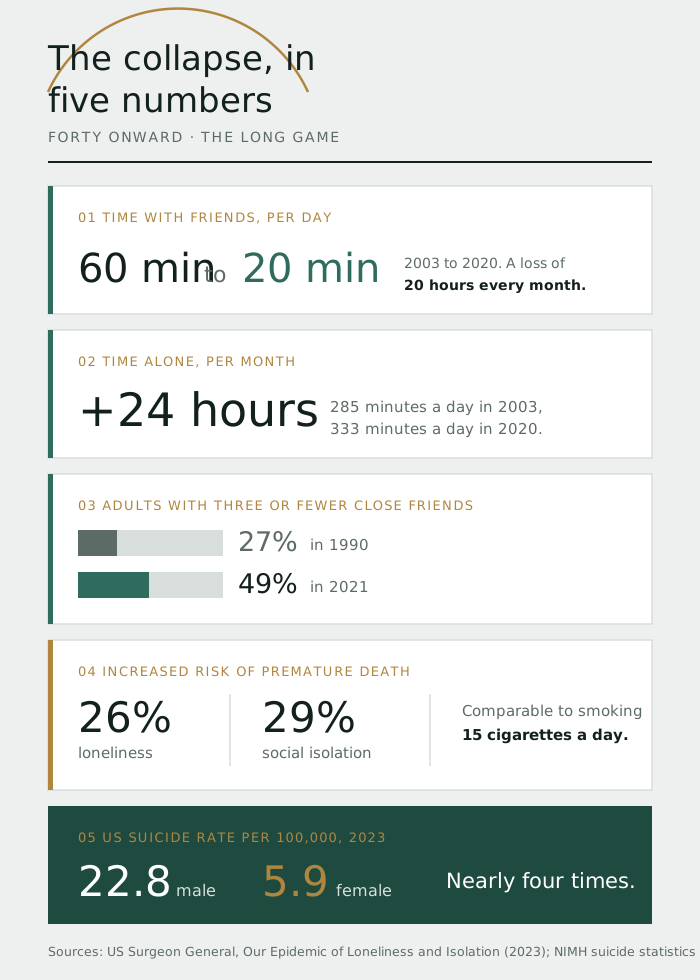
The male loneliness epidemic is real, but it is not the thing most people describe. Men do not show up in the federal data as lonelier than women. What shows up is a collapse in the machinery of connection: the average American went from 60 minutes a day with friends in 2003 to 20 minutes a day in 2020, and the share of adults with three or fewer close friends went from 27% in 1990 to 49% in 2021. Men lost the same hours everyone lost, then discovered they had built no system to replace them. The consequences land harder because men have fewer fallbacks, and the clearest evidence of that is the suicide rate, which is nearly four times higher among males than females.
You probably noticed it as logistics rather than sadness. A text thread that went quiet. A friend who moved and never got replaced. A calendar where every square is family or work and none of it is a person who knew you before you had a title.
Last reviewed August 19, 2026. Every statistic below is taken directly from the cited federal or primary source (US Surgeon General, NIMH, NIA, PubMed, American Perspectives Survey) and linked inline so you can check it yourself. This is general information and is not a substitute for individual advice from a licensed professional.
If you are thinking about ending your life, stop reading now. In the United States, call or text 988 to reach the Suicide and Crisis Lifeline, 24 hours a day. In the UK, call 116 123. Elsewhere, contact your local emergency services.
The short answer
The male loneliness epidemic is a real structural problem and a badly described emotional one. The US Surgeon General's 2023 advisory documents a population-wide collapse in social contact, not a male-specific one, and it does not report men as lonelier than women. What is specific to men is the shape of the loss and the size of the consequence.
Three things are true at once. First, everybody lost hours: Americans gained 24 hours a month alone between 2003 and 2020 and lost 20 hours a month with friends. Second, men concentrated what was left into one relationship, with 85% of married men naming their spouse as the first person they talk to about a personal problem. Third, when that single point of contact fails, men have no bench, and the mortality data reflects it.
The useful question is whether you have more than one person who would notice you were missing. If the answer is one person, or none, you have a structural problem, and structural problems get fixed with logistics rather than feelings.
What actually collapsed, in hours
The 2023 advisory from the US Surgeon General, Our Epidemic of Loneliness and Isolation, put numbers on something men in their forties had been feeling without a vocabulary for it. Drawing on time use data from 2003 to 2020, it reports that average time spent alone rose from 285 minutes a day to 333 minutes a day, an increase of 24 hours per month. Over the same period, time spent socializing with friends in person fell from 60 minutes a day to 20 minutes a day, a decrease of 20 hours per month.
Twenty hours a month is two and a half working days of human contact, deleted quietly across two decades. Nobody announced it. No single friendship ended badly. The hours just stopped being scheduled.
The advisory also records the drop in confidants. Almost half of Americans (49%) in 2021 reported having three or fewer close friends, against about a quarter (27%) in 1990. The May 2021 American Perspectives Survey, the primary survey behind that comparison, adds the sharper edge: 12% of Americans now report having no close friends at all, against 3% in 1990, and the share reporting a best friend fell from 75% in 1990 to 59%.
Is the male loneliness epidemic real?
Yes, with one correction that matters enormously for what you do about it.
The Surgeon General's advisory reports that approximately half of US adults experience loneliness, and it flags the highest rates among young adults. It does not report men as lonelier than women. If you go looking for a federal document that says men feel more lonely, you will not find one, and any article that claims otherwise is telling you a story rather than reading a table.
What the evidence does support is a difference in structure and a difference in stakes.
The structural difference is concentration. The American Perspectives Survey found that 85% of married men say their spouse is the first person they talk to when they have a personal problem, against 72% of married women. That is not a small gap. It describes a man who has routed his entire emotional operation through a single connection, which works beautifully right up until that connection is the thing that is in trouble, or is tired, or is the subject he needs to talk about.
The same survey found the workplace is where most friendships come from, with 54% of Americans who have close friends saying they met one at their own or their spouse's workplace. Read that against the concentration finding and the midlife trap draws itself. Men build friendships through proximity, primarily at work. Then work changes, or the commute goes, or the role goes senior and the peers become reports, and the supply line closes. Nothing replaces it, because nothing was ever built to.
The difference in stakes is where the word epidemic earns its keep.
Why it lands harder on men
| What the source measured | Finding | Source |
|---|---|---|
| US suicide rate by sex, 2023, age adjusted | 22.8 per 100,000 among males against 5.9 among females, nearly four times higher | NIMH |
| Suicide risk and living alone, over 500,000 middle aged adults | Probability of dying by suicide more than doubled among men who lived alone | Cited in the Surgeon General's advisory |
| Premature death risk | Loneliness is associated with a 26% increased risk, social isolation with a 29% increased risk | Surgeon General's advisory |
| Comparison risk factor | Lacking social connection is comparable to smoking up to 15 cigarettes a day | Surgeon General's advisory |
The suicide figures are the part men skip and should not. According to NIMH suicide statistics, in 2023 the age adjusted suicide rate among males in the United States was 22.8 per 100,000, nearly four times the female rate of 5.9 per 100,000.
The advisory goes further and connects that to living arrangements specifically. It cites a study of over 500,000 middle aged adults in which the probability of dying by suicide more than doubled among men who lived alone. It also notes that a century of research links a lack of social connection to death by suicide, and that social connection appears to protect against it especially for men.
Sit with the age bracket in that study. Middle aged. Not adolescents, not the very old. Men in roughly the bracket this publication is written for.
That is the honest case for the phrase. Not that men feel lonelier, but that men are worse at maintaining the connections that keep them alive, and the mortality curve knows it.
What isolation does to the body
The health effects are not soft. The Surgeon General's advisory reports that poor or insufficient social connection is associated with a 29% increased risk of heart disease and a 32% increased risk of stroke, alongside increased risk for anxiety, depression, and dementia.
The foundation under those numbers is a 2010 meta analysis. Holt-Lunstad, Smith, and Layton examined social relationships and mortality risk across 148 studies covering 308,849 participants, and found an average odds ratio of 1.50, meaning a 50% increased likelihood of survival for participants with stronger social relationships. The effect held across age, sex, initial health status, cause of death, and follow up period. The authors concluded that the influence of social relationships on mortality risk is comparable with well established risk factors.
Comparable with well established risk factors. Men in their forties will restructure an entire diet over a cholesterol number and will not spend forty minutes a week keeping a friendship alive, and the evidence says those two decisions belong in the same tier, along with the physical measurements in aging gracefully.
The National Institute on Aging draws a distinction worth carrying around, because men habitually collapse the two. Loneliness is the distressing feeling of being alone or separated. Social isolation is the lack of social contacts and having few people to interact with regularly. You can live alone without feeling lonely, and you can feel lonely in a full house. The NIA links both to higher risks including high blood pressure, heart disease, weakened immune function, anxiety, depression, and cognitive decline, and notes that people who are lonely or isolated may also exercise less, drink more, and sleep worse, which compounds everything underneath.
That distinction is the practical unlock. A man who says "I am not lonely, I am fine" is usually answering the feelings question, correctly, while the isolation question, the one about contacts and frequency, is the one quietly running the risk.
Why 40 is the hinge
Every structure that supplied a man with friends without him thinking about it tends to expire around the same decade.
School is long gone. The workplace, which is the single biggest supplier at 54%, either changes shape or goes remote or promotes you out of peer range. The kids' activities produce acquaintances organised around the children rather than around you, and they dissolve the year the child quits the team. Meanwhile the hours available shrink to their lifetime minimum.
The man at forty six has not failed at friendship. His system was never designed for this, and it just lost its last automatic input. This is the same mechanism we describe in midlife crisis in men, where the four problems wearing the same coat get mistaken for one another. Isolation is very often the one underneath, and it is the one nobody names, because naming it feels like an admission rather than a diagnosis.
It also interacts badly with the purpose question. A man who has lost his sense of direction and has nobody to think out loud with will do the thinking at 11pm alone, the worst available vantage point there is. If that is where you are, the method in finding purpose after 40 works considerably better with one other person in the room. And if you are rebuilding after a job or a marriage ended, starting over at 40 makes the same argument about redeploying what you already have rather than starting from zero.
What actually rebuilds it
The instinct is to solve loneliness with intensity: one big reunion, one deep conversation, one weekend away. That is the wrong shape. What was lost was frequency, so what has to be rebuilt is frequency.
| Move | What it fixes | Why it works for men specifically |
|---|---|---|
| Put one recurring slot in the calendar, same day, same time, every week or fortnight | The lost hours | Removes the need to initiate each time, which is the step men skip. The appointment does the asking |
| Attach it to an activity, not to a conversation | The awkwardness barrier | Side by side beats face to face for most men. Nobody has to announce that they are here to talk |
| Widen from one confidant to three | The concentration risk | 85% of married men route everything through their spouse. A bench of three survives one of them being unavailable |
| Re-open a dormant friendship rather than making a new one | The supply problem | Cheaper than building from scratch. The history is already there and does not need rebuilding |
| Be the one who calls, permanently | The reciprocity stall | Two men both waiting to be invited produce zero meetings. Somebody has to accept being the organiser and stop scoring it |
| Treat a sustained low mood as clinical until ruled out | The misdiagnosis | Isolation and depression present almost identically and need different treatment |
That last row is the one to take seriously. If the flatness has been there for months, if it does not lift when you do see people, or if it comes with sleep and appetite changes, that is a different problem wearing the loneliness coat, and it is treatable. Our guide to finding a therapist for a midlife reckoning covers who to see and how fast it should start working.
The NIA's own guidance points the same practical direction: staying connected through regular activity, shared interests, and consistent contact, rather than waiting to feel like it. Nobody feels like it. The men who keep their friendships are not the ones with more warmth. They are the ones who put it in the calendar.
The uncomfortable part
There is a version of this conversation that ends in blame, either at men for being emotionally illiterate or at the world for taking the pubs and the union halls and the walkable neighbourhoods away. Both contain something true and neither helps you on a Tuesday.
The workable framing is smaller and harder. The hours are gone and they are not coming back on their own. No employer, no app, and no policy is going to schedule your friendships. If you want three people who would notice you were missing, you will have to build that deliberately, at an age when it feels faintly ridiculous to be doing so, and you will have to be the one who calls first for a while without keeping score.
Ridiculous is fine. The alternative is a man of sixty with a good pension, a paid off house, and nobody to tell about either.
The collapse in five numbers
FAQ
What is the male loneliness epidemic?
It is the term for a documented collapse in men's social connection, though the name describes it imprecisely. The US Surgeon General's 2023 advisory records a population-wide decline in contact rather than a male-specific one: time spent with friends in person fell from 60 minutes a day in 2003 to 20 minutes a day in 2020, and the share of adults with three or fewer close friends rose from 27% in 1990 to 49% in 2021. What makes the male version distinct is not the volume of loneliness reported but the structure, since men concentrate support in one relationship, and the severity of the outcome, since the US suicide rate among males in 2023 was nearly four times the female rate.
When did the male loneliness epidemic start?
Neither of the federal sources this article cites names a start year, and the honest answer is that the two measurements which define the decline run over different windows. The confidant data starts earlier: the share of adults with three or fewer close friends rose from 27% in 1990 to 49% in 2021, so the erosion of close relationships was already underway more than three decades ago. The contact data is more recent and steeper: time spent with friends in person fell from 60 minutes a day in 2003 to 20 minutes a day in 2020, with time spent alone rising by 24 hours a month over the same period. Both series are trends rather than events, which is why no single year works as an origin. What is recent is the naming rather than the decline, since the US Surgeon General's advisory that documented it was published in 2023. Read the windows instead of a start date: 1990 to 2021 for the loss of confidants, 2003 to 2020 for the loss of hours.
Is the male loneliness epidemic real?
The structural decline is real and federally documented. The claim usually attached to it, that men feel lonelier than women, is not supported by the Surgeon General's advisory, which reports that approximately half of US adults experience loneliness without identifying men as the lonelier group. The honest reading is that men and women both lost the same hours, men built fewer replacement connections, and men die of the consequences at a higher rate. Treating it as a feelings competition misses the part that kills people.
Is the male loneliness epidemic self-inflicted?
Partly, and the part that is not matters more. The hours were taken by structure rather than by choice: time spent with friends in person fell from 60 minutes a day in 2003 to 20 minutes a day in 2020 for everyone, and the workplace that supplied 54% of close friendships stops supplying them when roles go senior and commutes disappear. Women lost the same hours. What is specific to men is what happened next, since men built fewer replacement connections and concentrated what was left in one relationship, which is the 85% of married men who route everything through a spouse. That part is behaviour, and behaviour is the part you can change. The move that does it is the unglamorous one: accept being the one who calls, without keeping score, because two men both waiting to be invited produce zero meetings.
Why do men lose friends after 40?
Because the systems that supplied friendships without effort expire around then. The workplace is the biggest single source, with 54% of Americans who have close friends saying they met one at their own or their spouse's workplace, and midlife is exactly when that supply changes: roles go senior, teams become reports, commutes disappear. School friendships are decades gone, friendships formed around children dissolve when the activity ends, and available hours hit their lifetime low. The loss is logistical rather than personal, and the fix works the same way.
How many close friends should a man have?
There is no clinical target, but the data suggests a floor rather than an ideal. The Surgeon General's advisory notes that among people not reporting loneliness or social isolation, nearly 90% have three or more confidants. Three is therefore a reasonable working bar, and it matters more than the total. A man with one confidant is one bad week away from having none, exactly the risk the 85% of married men who name their spouse as their first call are carrying.
Does loneliness actually affect physical health?
Yes, and the effect size is not marginal. The 2010 meta analysis by Holt-Lunstad and colleagues, covering 148 studies and 308,849 participants, found a 50% increased likelihood of survival among people with stronger social relationships, and concluded the influence was comparable with well established mortality risk factors. The Surgeon General's advisory reports that loneliness is associated with a 26% increased risk of premature death and social isolation with a 29% increased risk, alongside a 29% increased risk of heart disease and a 32% increased risk of stroke, and compares the mortality impact to smoking up to 15 cigarettes a day.
What is the difference between loneliness and social isolation?
The National Institute on Aging defines loneliness as the distressing feeling of being alone or separated, and social isolation as the lack of social contacts and having few people to interact with regularly. They are related but separate, so you can live alone without feeling lonely and feel lonely in a crowded house. The distinction matters for men in particular, because a man who correctly answers no to the feelings question often never gets asked the contacts question, which is the one carrying the health risk.
What actually fixes male loneliness?
Frequency, not intensity. What went missing was hours of ordinary contact, so one big reunion or one deep conversation does not replace it. Five moves do the work. Put one recurring slot in the calendar on the same day at the same time, so the appointment does the asking instead of you. Attach it to an activity rather than to a conversation, because side by side is easier than face to face for most men. Widen from one confidant to three, so the bench survives one of them being unavailable, which is the risk carried by the 85% of married men who route everything through their spouse. Re-open a dormant friendship instead of building a new one, because the history is already there. And accept being the one who calls, without keeping score, since two men both waiting to be invited produce zero meetings. One exception changes the treatment: if the flatness has lasted months, does not lift when you do see people, or arrives with sleep and appetite changes, treat it as clinical until a professional rules it out, because isolation and depression present almost identically and need different care.
What are the statistics on the male loneliness epidemic?
Five federally sourced figures carry the picture. Time spent socializing with friends in person fell from 60 minutes a day in 2003 to 20 minutes a day in 2020, a loss of 20 hours a month, while time spent alone rose by 24 hours a month over the same period. The share of adults with three or fewer close friends rose from 27% in 1990 to 49% in 2021. Loneliness is associated with a 26% increased risk of premature death and social isolation with a 29% increased risk. And the 2023 age adjusted US suicide rate was 22.8 per 100,000 among males against 5.9 among females, nearly four times higher. The first four figures come from the US Surgeon General's 2023 advisory on social connection and the last from NIMH suicide statistics. Note what is not on the list: no federal source reports men as feeling lonelier than women.
Sources
- US Department of Health and Human Services, Office of the Surgeon General. Our Epidemic of Loneliness and Isolation: The US Surgeon General's Advisory on the Healing Effects of Social Connection and Community, 2023.
- National Institute of Mental Health. Suicide statistics.
- Holt-Lunstad J, Smith TB, Layton JB. Social relationships and mortality risk: a meta-analytic review. PLoS Medicine, 2010.
- National Institute on Aging. Loneliness and social isolation: tips for staying connected.
- Cox DA, Survey Center on American Life. The State of American Friendship: Change, Challenges, and Loss, American Perspectives Survey, May 2021.