Starting Over at 40 When You Are Not Starting From Zero
Most advice about starting over is written for people with nothing to lose. You have plenty to lose, which changes the whole calculation, and it is why the standard advice feels reckless when you read it.
It also misses the larger point. At forty-plus you are not starting over. You are redeploying. There is a difference, and it is worth about twenty years.
Last reviewed August 3, 2026.
The myth this article exists to kill
The founder in the hoodie is nineteen. That image has cost a lot of capable men a lot of years, and years lost to a thing never attempted are exactly the regrets that harden instead of fading.
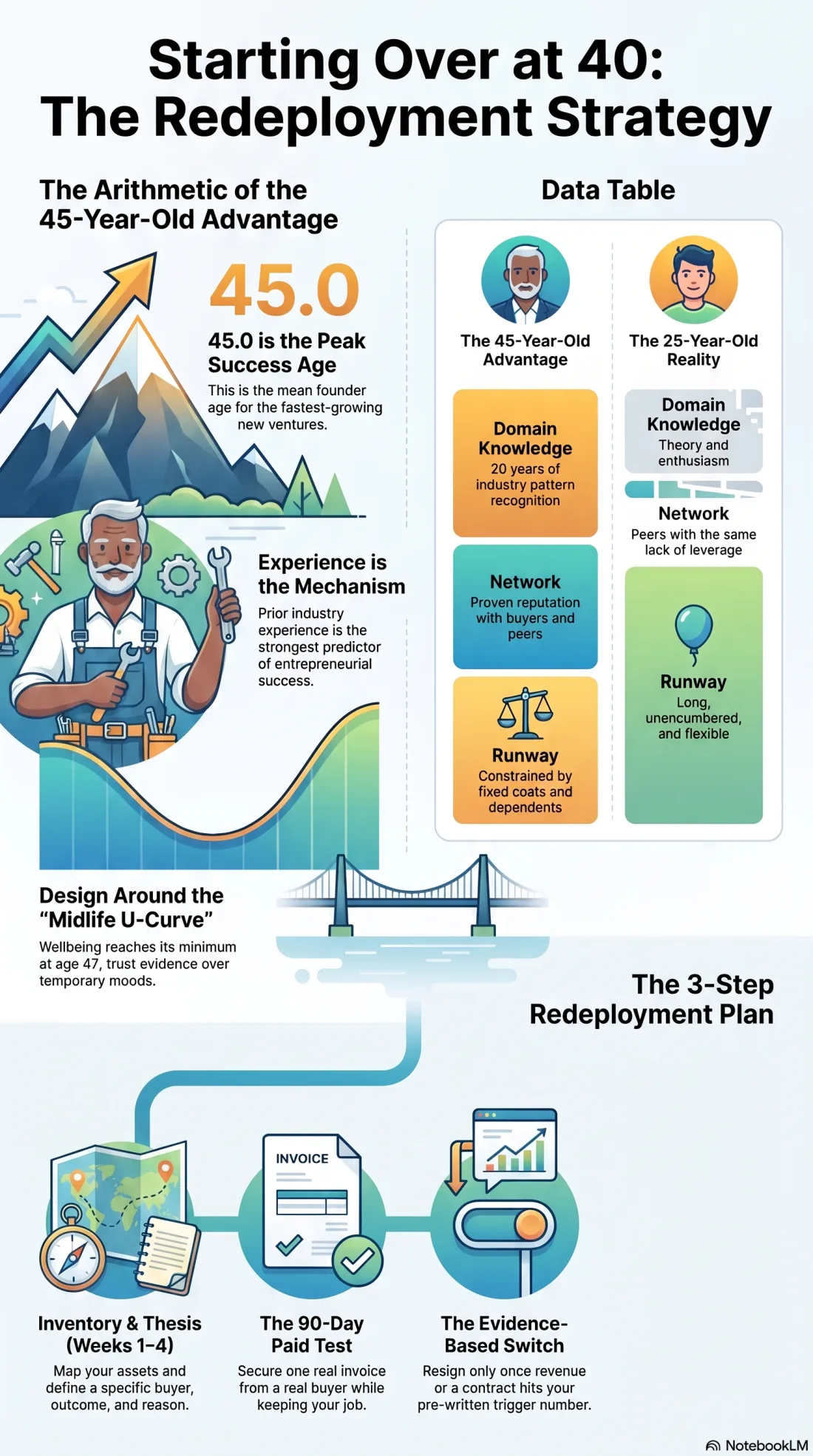
Pierre Azoulay, Benjamin Jones, J. Daniel Kim and Javier Miranda went to the administrative data covering US company founders and looked at who actually succeeds. Their conclusion is direct: successful entrepreneurs are middle aged, not young. The mean founder age for the top 1 in 1,000 fastest growing new ventures is 45.0. The finding held across high technology sectors, entrepreneurial hubs, and successful exits.
They found something else that matters more for your planning than the headline age. Prior experience in the specific industry predicts much greater rates of entrepreneurial success. The twenty years are not baggage you are overcoming. They are the mechanism.
This reframes the whole question. The task is not to become a different man. It is to point the existing man somewhere better.
Redeploying, not restarting
Do an honest inventory before you touch anything. Most men in this position dramatically undercount what they hold, because assets you acquired slowly feel like they were always there.
| Asset class | What you actually have at 45 | What a 25 year old has |
|---|---|---|
| Domain knowledge | Twenty years of pattern recognition in one industry, including what quietly fails | Theory and enthusiasm |
| Network | Hundreds of people who have seen you deliver under pressure | Peers with the same lack of leverage |
| Credibility | Buyers return your calls because of what you shipped, not what you promise | Must be built from zero |
| Judgement | Calibrated instincts about risk, people and timelines | Uncalibrated, learned by paying for it |
| Capital | Some savings, some equity, some borrowing capacity | Typically none |
| Runway | Constrained by dependents and fixed costs | Long, unencumbered |
Look at the last row. It is the only column where the younger man wins, and it is the only one the popular advice optimises for. That is the whole error.
Your strategy is not their strategy. They can afford to be wrong for a decade. You cannot, so you buy information instead of buying time.
The plan
1. Inventory, two weeks
Write down every person who would take your call, every problem you know how to solve that others pay for, and every thing you have shipped. Not a resume, an asset register. Most men are shocked by the length of the list, because they have been measuring themselves against their job title rather than their capability.
2. Thesis, two weeks
A thesis is one sentence: I believe [specific group] will pay for [specific outcome] because [specific reason I am positioned to deliver it].
If it does not name a buyer, it is not a thesis, it is a mood. "I want to do something more meaningful" is a mood. "Mid-sized logistics operators will pay for compliance audits because I ran that function for fifteen years and their regulator just changed the rules" is a thesis.
The strongest theses sit where your existing domain touches something new. Not a leap to an unrelated field. The industry data above is unambiguous that prior experience in the specific industry is what predicts success.
3. Paid test, ninety days
This is the stage men skip, and skipping it is what turns reinvention into a story their friends tell carefully.
Do not resign. Do not announce. Take on one real engagement, for money, from a real buyer, alongside the job. Money is the only honest signal here. Compliments are free, so people give them away. An invoice paid on time tells you something no amount of encouragement can.
Three outcomes, all useful: - Someone pays and it feels right. You have a business and you have evidence. - Someone pays and you hate it. You just saved yourself three years for the cost of one quarter. - Nobody pays. The thesis was wrong. Revise it, at zero cost to your family.
4. The switch, only on evidence
Leave when the new thing has revenue, or a signed contract, or an offer in hand. Not when you feel brave. Bravery is a mood, and moods in the middle are unreliable for a documented reason: wellbeing across a life follows a U shape that reaches its minimum in middle age, a pattern Blanchflower and Oswald found on both sides of the Atlantic and later traced across 132 countries, with the low point averaging 47.2 years in advanced economies. You are likely to be making the biggest financial decision of your adult life at the least reliable moment for judging your own life. Design around that rather than trusting it. We covered the implications in the midlife reckoning.
Set the trigger in advance and in writing: the specific number that means go. Deciding the threshold before you are emotionally invested is how you avoid both mistakes, jumping too early and never jumping at all. If the move is a change of employer or field rather than a business of your own, changing career at 40 sets out what the federal earnings data says about the window you are standing in.
What to do about money
The arithmetic is different from the twenty-five year old's and it deserves plain treatment rather than encouragement.
Know your real number. Not your salary, your actual monthly floor: housing, food, insurance, school, debt service. Most men do not know it, and it is nearly always lower than the salary they believe they are chained to.
Build the runway before the announcement. Twelve months of the floor number is the standard target. Six is thin but workable if a partner's income covers the base.
Do not raid the retirement account to fund the test. The whole design of the ninety day paid test is that it costs you evenings, not your seventh decade. If a plan requires liquidating long term compounding to get started, the plan is not ready.
Count what you keep. Leaving is not only a loss of salary. It is the loss of employer health cover, matching contributions and, for many men, a professional identity that other people responded to. Price all three honestly. It does not mean do not go. It means go with your eyes open, since surprises at this stage are expensive.
The part nobody mentions
Reinvention at this age is rarely stopped by capability. It is stopped by the fear of looking like a man in a crisis.
Which is worth saying plainly: doing this well looks nothing like the caricature. A caricature quits in a week. A plan runs a ninety day test in the evenings and leaves with a contract signed. From the outside the second one barely registers as a change at all, right up until it is complete.
The men who make it work at forty-five are not braver than the ones who do not. They are more sequenced. And if the thing driving all of this is that the work has stopped meaning anything rather than paying anything, deal with that first, in finding purpose after 40, before you rearrange the career on top of an unanswered question. And if the thing ending is the marriage rather than the work, the sequence and the arithmetic both change, which is the subject of starting over after divorce at 40.
The reinvention sequence in one picture
Test yourself
Key takeaways
FAQ
Are older founders actually less successful?
No, older founders do better in the data rather than worse. Analysis of US administrative data found the mean founder age among the fastest growing 1 in 1,000 new ventures is 45.0, and that prior experience in the specific industry strongly predicts success. Your accumulated domain knowledge is an advantage in the data, not a liability.
Should I quit my job first to focus on the new thing?
Almost never, and not as a first move. The ninety day paid test exists precisely so you can gather real evidence while the income continues. Leave on a signed contract, revenue, or an offer, not on a feeling. The cost of being wrong at forty-five is measured in years, so buy information before you buy commitment.
How much runway do I need to start over at 40?
Work from your actual monthly floor rather than your salary: housing, food, insurance, schooling and debt service. Twelve months of that floor is the common target, and six is workable if a partner's income covers the base. Most men find the floor is well below the salary they believed they were tied to.
Can I start over at 40 with no money?
Yes, because the three stages that cost nothing come first. The inventory, the thesis and the ninety day paid test all run alongside the job you already have, and the test is built so that a real buyer pays you for one real engagement rather than you funding anything yourself. Runway only becomes the binding constraint at the fourth stage, the switch, and you do not enter that stage until the new thing already has revenue, a signed contract or an offer in hand. No money delays the exit rather than the start. Two things do not change: work from your actual monthly floor rather than your salary, which is nearly always the lower number, and do not liquidate the retirement account to fund the test, because a plan that needs your seventh decade to get started is not ready.
What if you want to start over at 40 but do not know what you want to do?
Then you are not ready for the plan, you are ready for the inventory. List what people already come to you for, which problems you solve without effort, and who pays for those outcomes today. Direction at this age is usually found by examining what you have already built rather than by introspecting about passion.
Is starting over at 40 a midlife crisis?
It can be either. The distinguishing question is whether you are moving toward something specific or away from something painful. Moving toward a named buyer and a tested thesis is a plan. Moving away from a feeling, with no destination, tends to relocate the feeling rather than resolve it.
Sources
- successful entrepreneurs are middle aged, not young (nber.org)
- reaches its minimum in middle age (pubmed.ncbi.nlm.nih.gov)
- 132 countries (nber.org)