Retirement Planning at 50: What the Numbers Actually Allow
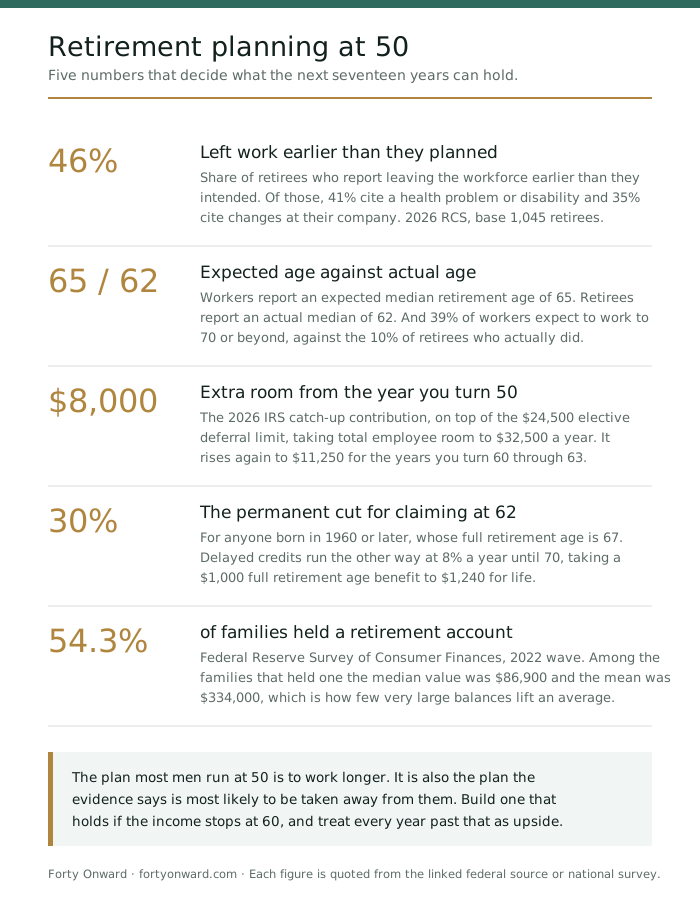
At 50 you have about 17 years until your full retirement age, and one decision that matters more than any fund you pick: whether your plan depends on you staying employed until you choose to stop. Most men's plans do depend on that, quietly and without ever being written down. The evidence says that is the single weakest assumption in the whole structure, because 46 percent of retirees report leaving the workforce earlier than they had planned, and the most common reason is a health problem or disability rather than a change of heart.
This article is about what the arithmetic actually permits at 50. Not what it permits at 30, which is a different and much easier article, and not what it permits at 62, when most of the levers have already been pulled. Fifty is a specific and unusual point on the calendar. It is the year the tax code hands you extra room, and it is roughly the last point at which the Social Security decision is still fully open in both directions.
Last reviewed September 7, 2026. Every figure below comes from the cited federal source or nationally representative survey and is linked inline so you can check it yourself. All tax and benefit figures are United States rules for the 2026 tax year and change annually. Population level findings describe groups rather than individuals. This is general information. It is not financial advice, not tax advice and not a recommendation to buy or sell anything, and a licensed adviser or tax professional in your jurisdiction is the only person who can tell you how any of it applies to your situation.
The short answer
At 50, three things are true at once and they point in the same direction. Your contribution room just got larger, by $8,000 a year in a workplace plan. Your Social Security decision moves the monthly cheque by $540 for every $1,000 of full retirement age entitlement, which is 77 percent more at 70 than at 62, and that spread is larger than most investment decisions you will ever make. And your ability to keep earning is less under your control than you think it is, which means any plan whose success depends on working until 70 is a hope rather than a plan.
The order of operations that follows from those three facts is unglamorous: find out what you actually have, use the new room while you are still earning, and build the plan so it survives an involuntary exit at 60. Everything else is detail.
The plan you are probably running, and what the data says about it
Ask a man of 50 how retirement is going to work and the answer is usually some version of "I will just work longer." It is a reasonable-sounding answer. It is also the assumption the evidence attacks most directly.
The Employee Benefit Research Institute has run its Retirement Confidence Survey since 1991, and the 2026 wave surveyed 2,544 Americans aged 25 and over in January 2026. It asks workers when they expect to retire and it asks retirees when they actually did. The two numbers do not match, and they have not matched for decades.
Workers report an expected median retirement age of 65. Retirees report a median actual retirement age of 62. The gap widens at the edges:
| When people retire | Share of workers who expect this | Share of retirees who report this happened |
|---|---|---|
| Before age 60 | 12 percent | 29 percent |
| Between 60 and 64 | 18 percent | 31 percent |
| At 70 or older, or never | 39 percent | 10 percent |
Look at the bottom row. Nearly four in ten current workers expect to work to 70 or beyond, and one in ten retirees report that is what happened. Two cautions on how to read that. These are two different groups measured at the same moment, today's workers stating expectations and today's retirees recalling outcomes, rather than one group followed from plan through to outcome. The gap is therefore not a failure rate that applies to any individual, and some part of it will be genuine change between cohorts. What it does establish is that this expectation has run far ahead of the result for decades, across a survey that has asked the question since 1991.
The reasons matter, because they determine whether the gap is something you can discipline your way out of. Among retirees who left earlier than planned, 41 percent cite a hardship such as a health problem or disability. Thirty-five percent cite changes at their company. A similar share, 36 percent, say they could afford to retire earlier, so some of the gap is genuinely good news. But the two involuntary categories together describe most of it, and neither responds to willpower.
This is the practical consequence. If your plan requires you to be employed at 68, you are not planning, you are forecasting your own health and your employer's decisions 18 years out. Build the plan to survive an exit at 60 and treat every year past that as upside. Our piece on changing career at 40 covers the earlier version of this problem, when there is still time to change the trajectory of what you earn.
What the tax code hands you at exactly 50
The IRS treats 50 as the year your contribution room jumps, and the size of the jump surprises most people.
The IRS allows catch-up contributions to anyone who is 50 or over at the end of the calendar year. For 2026, the numbers are these. The ordinary elective deferral limit is $24,500. On top of that, a catch-up of up to $8,000 is permitted in a 401(k), a 403(b) or a governmental 457(b). That takes total employee contribution room to $32,500 in a single year, before any employer match.
Three details are worth knowing because they change the sequencing.
The first is that the catch-up gets larger again later. Under SECURE 2.0, employees who turn 60, 61, 62 or 63 in a calendar year get a higher catch-up limit, which for 2026 is $11,250 instead of $8,000. So the room expands twice, once at 50 and again at 60, and then reverts at 64.
The second is a rule that begins in 2026 and catches people out. Participants in plans with Roth features must make catch-up contributions on a Roth basis if their prior-year wages with the plan sponsor exceeded $150,000. That means the catch-up stops being a deduction against this year's income for higher earners and becomes an after-tax contribution instead. It is still worth making. It is just not the tax deferral some people are budgeting around.
The third is that IRAs have their own, much smaller catch-up: up to $1,100 in 2026, and it is due by your tax return deadline rather than by year end. SIMPLE plans sit in between, at $4,000 for 2026.
None of this makes anyone rich. What it does is give a man who is earning well in his fifties a legitimate way to move a large amount into a sheltered account in a compressed window. If the years between 50 and 62 are your peak earning years, and for many men they are, this is the mechanism that turns that fact into something durable.
The Social Security decision is bigger than most portfolio decisions
If you were born in 1960 or later, which covers everyone reading this who is 50 in 2026, your full retirement age is 67. The Social Security Administration publishes the reduction for claiming early and the credit for claiming late, and the spread between them is the part most people underestimate.
Claim at 62, the earliest possible age, and the benefit is permanently reduced by 30 percent. A $1,000 monthly benefit at full retirement age becomes $700. Wait past 67 and delayed retirement credits accrue at 8 percent a year for anyone born in 1943 or later, stopping at age 70.
| Age you claim | What a $1,000 full retirement age benefit becomes | Change |
|---|---|---|
| 62, the earliest possible | $700 | Down 30 percent, permanently |
| 67, full retirement age | $1,000 | The baseline |
| 70, the last useful year to wait | $1,240 | Up 24 percent, permanently |
The distance between the two ends is $540 a month on a $1,000 full retirement age benefit. Measured the way it will actually feel, that is 77 percent more at 70 than at 62, because the comparison a claimant makes is against the reduced figure rather than against the baseline. It is inflation adjusted and it lasts as long as you do, which makes it one of the few genuinely guaranteed returns available to a private individual.
Two cautions belong next to that table, because the arithmetic is not the whole decision. Delaying only pays if you live long enough to collect, and the break-even age, which is a planning rule of thumb rather than a finding from any survey cited here, generally lands somewhere in the late seventies or early eighties depending on the assumptions used. And a spouse's benefit is affected too: the SSA notes the maximum spousal benefit is 50 percent of the worker's full retirement age amount, with its own reduction of up to 35 percent for early claiming.
One more thing that is easy to get wrong and expensive to fix. If you delay your retirement benefit past 65, sign up for Medicare at 65 anyway. The SSA states plainly that Part B medical insurance and Part D prescription coverage may cost more if you wait longer, and that penalty is also permanent.
Where you actually stand, without the comfortable framing
The Federal Reserve's Survey of Consumer Finances is the most careful picture of American household balance sheets that exists, and the 2022 wave is the most recent published. Two of its findings should be read together, because reading either one alone gives a distorted answer.
Start with the one that is usually left out. In 2022, 54.3 percent of families held a retirement account, up almost 4 percentage points since 2019. Just over half of families have one of these accounts at all.
Among the families that did hold one, the median value was $86,900 and the mean was $334,000. Both of those are conditional figures. They describe the families who have an account, not all families. The distance between the median and the mean tells you the rest of the story: the average is being pulled upward by a comparatively small number of very large balances, and the typical account holder is nearer to $86,900.
Median family net worth by age, from the same survey, gives the wider frame. For families whose reference person was 45 to 54, median net worth was $247,200 in 2022, up 27 percent from $195,400 in 2019. For those 55 to 64 it was $364,500, up 48 percent from $246,300. Net worth includes home equity, which is why these numbers look large next to the retirement account figures and why they are not directly spendable.
If those numbers are higher than yours, the useful response is not despair, and it is also not the reassurance that you are somehow secretly fine. It is that you now know the size of the gap, which is the one thing you could not act on while it was vague. If your starting point is closer to zero than to the median, our article on starting over at 40 with no money deals with the rebuilding problem directly.
The order of operations at 50
The sequence below is ordered by how much it changes the outcome, not by how satisfying it feels to do.
Find out what you actually have. Not an estimate. Log in to every old workplace plan, every IRA, and create a my Social Security account to see your real earnings record and benefit estimate. Check the earnings record itself and not only the benefit estimate, because a missing or misposted year is far easier to correct while the payroll records still exist than it will be at 66.
Take the full employer match before anything else. An unclaimed match is the only guaranteed instant return available to most people, and it outranks every other item on this list.
Then use the catch-up room, and know which tax bucket it lands in. From the year you turn 50, that is $8,000 a year in 2026 on top of the $24,500 limit. Check whether your prior-year wages crossed $150,000, because that determines whether the catch-up must be Roth.
Decide what the Social Security claim looks like before you need to make it. The decision is worth roughly 77 percent between claiming at 62 and claiming at 70. The SSA publishes a calculator, Early or Late Retirement, that takes a date of birth and a proposed start month and returns the effect on your own record. Run it against your real benefit estimate, weigh the answer against the break-even age and against the spousal benefit if you are married, and write down what you decide. Deciding it under pressure, in the month you lose a job, is how the 30 percent reduction gets taken by default rather than chosen.
Then make the plan survive an involuntary exit at 60. This is the step that follows from the EBRI data and the one most plans skip entirely. What breaks if the income stops at 60 instead of 67? If the honest answer is everything, the plan needs a cash buffer and a lower fixed cost base more than it needs a better fund selection.
Treat your health as a financial variable, because the evidence says it is one. The leading reason for an involuntary early exit is a health problem or disability, named by 41 percent of the retirees who left before they meant to. That is what earns it a place inside this ranked list rather than a mention alongside it. Our article on aging gracefully treats it as the long game it is rather than a vanity project.
Then write the documents. Beneficiary designations on retirement accounts override your will, and stale ones send money to a former spouse with total reliability. Our piece on what is my legacy covers the wider version of this, and the National Institute on Aging checklist referenced there is a reasonable place to start.
What this article cannot tell you
Three limits, stated plainly.
Every tax and benefit figure here is a United States rule for the 2026 tax year, and all of them change annually with cost of living adjustments. The structure is stable. The numbers are not.
The survey findings describe groups. The 2026 Retirement Confidence Survey has a margin of error of about plus or minus 3.1 percentage points for workers and 3 points for retirees, and it tells you nothing about whether you personally will be forced out at 60. It tells you the odds are high enough that ignoring them is a choice.
And nothing here is a recommendation about what to hold. The choice between funds matters far less at this stage than the contribution rate, the claiming age and the fixed cost base, which is why this article spends its length on those three and none of it on asset allocation.
FAQ
Is 50 too late to start retirement planning?
No, and the tax code is arranged on the assumption that a lot of people start around then. From the year you turn 50 the IRS permits a catch-up contribution of up to $8,000 in 2026 on top of the $24,500 elective deferral limit, taking total employee room to $32,500 a year, and that rises again to $11,250 for the years you turn 60 through 63. What 50 does remove is the ability to rely on compounding alone to do the work. The lever that still moves at 50 is the contribution rate, followed by the age you claim Social Security. Both are larger than they look and both are still fully open.
How much should I have saved by 50?
No balance makes a plan safe, and the honest benchmarks are wider than most articles admit. In the Federal Reserve's 2022 Survey of Consumer Finances, 54.3 percent of families held a retirement account at all, and among those that did the median balance was $86,900. Median family net worth for the 45 to 54 age band was $247,200, though that includes home equity and is not spendable. Rather than measure yourself against those, run this instead. Take what you can genuinely contribute in a year, including the $8,000 catch-up, and multiply it by the years between now and the age at which you might be forced to stop rather than the age you intend to stop. Add the benefit estimate from your my Social Security account. If the total is not something you could live on, your gap sits in the contribution rate or the fixed cost base, and at 50 those are the two levers still fully under your control.
What age can I claim Social Security, and what does claiming early cost?
You can claim from 62. If you were born in 1960 or later your full retirement age is 67, and claiming at 62 reduces your benefit permanently by 30 percent, so a $1,000 benefit becomes $700. Delaying past 67 earns delayed retirement credits of 8 percent a year until 70, taking that same $1,000 to $1,240. The spread between the earliest and latest claim is about 77 percent, inflation adjusted, for life. Delaying only pays if you live past the break-even point, which as a planning rule of thumb rather than a surveyed figure lands somewhere in the late seventies or early eighties, so it is a judgment about your own health and other income rather than a pure arithmetic result.
Should your retirement plan assume you can just work longer?
Plan for it, but do not depend on it. In the 2026 Retirement Confidence Survey, 39 percent of workers expected to work to 70 or beyond while only 10 percent of retirees reported that this is what happened, and 46 percent of retirees left earlier than planned. Among those who left early, 41 percent cite a health problem or disability and 35 percent cite changes at their company. Working longer is a good outcome when it happens and it is the most common plan in the country, but it fails for most of the people who choose it, and it fails for reasons that do not respond to effort. Build the plan so it holds if the income stops at 60.
What is the catch-up contribution at 50, and is it always tax deductible?
For 2026 the catch-up is up to $8,000 in a 401(k), 403(b), SARSEP or governmental 457(b), on top of the $24,500 elective deferral limit. In an IRA it is up to $1,100, and in a SIMPLE plan $4,000. It is not always deductible. Starting in 2026, participants in plans with Roth features must make catch-up contributions on a Roth basis if their prior-year wages with that employer exceeded $150,000. For higher earners the catch-up is therefore after-tax money going into a Roth bucket rather than a deduction against current income, which is still worth doing but should not be budgeted as a tax saving.
Do I need to sign up for Medicare if I am delaying Social Security?
Yes. The Social Security Administration is explicit that if you delay retirement benefits past 65 you should still sign up for Medicare at 65, and that if you do not, your Part B medical insurance and Part D prescription drug coverage may cost more. Like the early claiming reduction, that penalty is permanent. It is one of the cheapest mistakes to avoid and one of the most common to make, because delaying one benefit feels like it should delay the other.
Sources
- Employee Benefit Research Institute and Greenwald Research, 2026 Retirement Confidence Survey, Fact Sheet 2: Expectations About Retirement. Source for the expected median worker retirement age of 65 against the reported median retiree age of 62, for the distributions of 12 percent of workers against 29 percent of retirees retiring before 60, 18 against 31 percent between 60 and 64, and 39 against 10 percent at 70 or older or never, for the finding that 46 percent of retirees left the workforce earlier than planned, and for the reasons given by those who did, being 41 percent a hardship such as a health problem or disability, 35 percent changes at their company and 36 percent being able to afford to retire earlier. Worker n = 795 and retiree n = 957 for the retirement age figures; the 46 percent earlier-than-planned figure and the reasons given for it are drawn from Figure 2, base n = 1,045 retirees.
- Employee Benefit Research Institute and Greenwald Research, 2026 Retirement Confidence Survey. Source for the survey being conducted online from 2 to 28 January 2026 with a total sample of 2,544 respondents aged 25 or older, comprising a general population sample of 2,052 including 1,007 workers and 1,045 retirees plus a caregiver oversample of 492, and for the margin of error of plus or minus 3.1 percentage points for workers and 3 points for retirees.
- Internal Revenue Service, Retirement Topics: Catch-up Contributions. Source for catch-up contributions being available to individuals age 50 or over at the end of the calendar year, for the 2026 catch-up limit of $8,000 in 401(k), 403(b), SARSEP and governmental 457(b) plans, for the 2026 elective deferral limit of $24,500, for the SECURE 2.0 higher catch-up of $11,250 for employees who turn 60, 61, 62 or 63 in a calendar year, for the requirement beginning in 2026 that catch-up contributions be made on a Roth basis where prior-year wages with the plan sponsor exceeded $150,000, for the SIMPLE plan catch-up of $4,000, and for the IRA catch-up of $1,100 due by the tax return due date.
- Social Security Administration, Benefits Planner: Starting Your Retirement Benefits Early. Source for a full retirement age of 67 for those born in 1960 or later, for the 60 months between age 62 and full retirement age for that cohort, for a $1,000 benefit being reduced to $700 at age 62 which is a reduction of 30.00 percent, for the maximum spousal benefit being 50 percent of the worker's full retirement age amount with a further reduction of up to 35.00 percent for early claiming, and for the advice to apply for Medicare within 3 months of a 65th birthday because Part B and Part D may otherwise cost more.
- Social Security Administration, Benefits Planner: Delayed Retirement Credits. Source for delayed retirement credits accruing at a 12 month rate of 8.0 percent, being two thirds of 1 percent per month, for anyone born in 1943 or later, and for the benefit increase stopping at age 70.
- Board of Governors of the Federal Reserve System, Changes in U.S. Family Finances from 2019 to 2022: Evidence from the Survey of Consumer Finances, October 2023. Source for retirement accounts being held by 54.3 percent of families in 2022, up almost 4 percentage points since 2019, for the conditional median value of retirement accounts rising 15 percent between 2019 and 2022 to $86,900 and the conditional mean rising 13 percent to $334,000, and from Table 2 for median family net worth by age of reference person, being $195,400 in 2019 rising to $247,200 in 2022 for the 45 to 54 band, a 27 percent increase, and $246,300 rising to $364,500 for the 55 to 64 band, a 48 percent increase, all in thousands of 2022 dollars.