Starting Over at 40 With No Money: The Sequence When You Cannot Buy Runway
Starting over at 40 with no money is possible, and the reason most advice about it fails is that the advice was written for men with a cushion. Quit, take six months, find yourself, launch. That plan is not merely hard without savings. It is arithmetically unavailable, and being told to follow it anyway is how a man concludes the door is closed when what is actually closed is one particular route through it.
The route that stays open is narrower and slower and it runs alongside the job you already have. It has an order of operations, and the order matters more than any single step in it, because doing the right things in the wrong sequence is how men in this position end up further back than when they started.
Last reviewed August 28, 2026. Every figure below comes from the cited federal source or peer reviewed paper and is linked inline so you can check it yourself. Population level findings describe groups rather than individuals. This is general information about published data, not financial advice, and nothing here accounts for your particular debts, dependants or jurisdiction. Programme eligibility rules vary by state and change; confirm anything you intend to rely on with the administering body before you act on it.
The short answer
You do not start by finding the new thing. You start by making sure the current thing cannot collapse underneath you, because a man with no savings has no margin for a bad month, and one bad month during a transition ends the transition.
The sequence is: stabilise the floor, then buy back time from the week you already have, then acquire the skill in the cheapest paid way available, then run one small test that a real buyer pays for, and only then borrow, and only against revenue that already exists. Five stages. None of them require capital you do not have. All of them run while you stay employed.
The other half of the answer is a warning about what the constraint does to your thinking, and it has a published basis rather than being a motivational aside. Being short of money measurably degrades the quality of the decisions you make about money. That is the single most useful thing to know before you make any of them, and it is the reason the first stage of this plan is not a plan.
What "no money" usually means, precisely
It is worth pinning the phrase down, because it covers a wide range and the range determines which stage you start at.
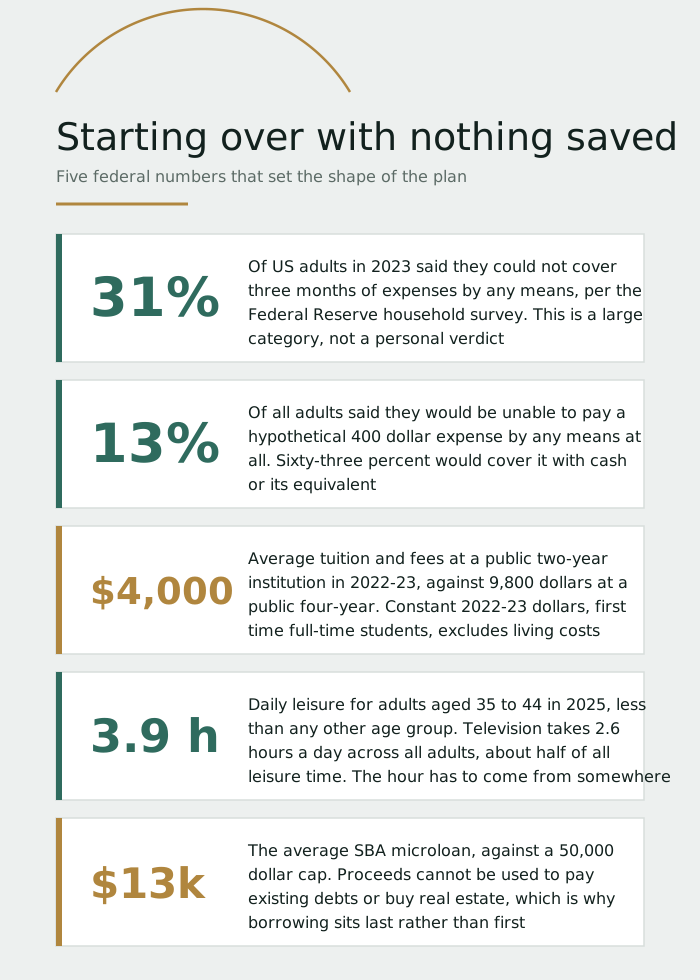
The Federal Reserve's Survey of Household Economics and Decisionmaking asked American adults in 2023 what they would do about a hypothetical $400 expense. Sixty-three percent said they would cover it entirely with cash, savings, or a credit card paid off at the next statement. That leaves 37 percent who would not, and within that group, 13 percent of all adults said they would be unable to pay the expense by any means at all.
The larger figure is the one that describes reinvention, because a career transition is not a $400 problem. On the three month question, 54 percent of adults said they had money set aside to cover three months of expenses if they lost their main source of income. Another 15 percent said they could cover three months by borrowing, selling assets, or drawing on other savings. And 31 percent said they could not cover three months by any means.
If you are in that 31 percent, the advice to build a twelve month runway before you move is not advice. It is a description of a state you are not in and have no near term path to, and following the plans that assume it will simply keep you where you are. That is the audience this article is written for.
The thing scarcity does to your judgment
There is a finding here that changes the order of the plan, and it is not a self help claim.
In 2013 a team led by Anandi Mani published Poverty impedes cognitive function in Science. Two studies. In the first, participants were prompted to think about a difficult financial scenario before taking cognitive tests, and the prompt reduced performance among poorer participants but not among well off ones. In the second, sugarcane farmers were tested twice, once before harvest when money was short and once after harvest when it was not. The same farmer performed worse on the earlier test than on the later one.
The authors checked the obvious alternative explanations and reported that the gap could not be accounted for by differences in available time, nutrition, or work effort, nor by stress, even though the farmers did show more stress before harvest. Their reading is that money worries consume mental capacity, leaving less of it for everything else.
Read that as an instruction rather than as a comment on character. The judgment you are about to apply to the biggest decision of your working life is being made under exactly the condition the study describes. That is an argument for making the decision in small reversible pieces, at a deliberate pace, with the floor stabilised first, and against any move that is dramatic, irreversible, and made in a week when the account is empty. The study measured cognitive test performance, not resignations, so treat this as a reason to be suspicious of any same-week irreversible decision rather than as a finding about career moves specifically.
The five stages, and what each one actually costs
| Stage | What it costs you | What it buys |
|---|---|---|
| 1. Stabilise the floor | An evening of arithmetic. No money | A real number for your monthly minimum, and the knowledge of how many weeks you can survive a shock |
| 2. Buy back time | Roughly one hour a day, taken from somewhere specific | The only capital you have that is not money, in a quantity large enough to matter |
| 3. Get the skill the cheap way | An unused employer budget, a public workforce centre, or, if neither applies, community college fees | A credential or competence a buyer recognises, without four year tuition |
| 4. One paid test | The hours from stage two, over about ninety days | Evidence that a stranger will pay for this, which is the only evidence that counts |
| 5. Borrow, last | Interest, and personal liability | Scale, and only for something already earning. Never runway, never a hunch |
The order is the argument. Stage five is where most men want to start, because borrowing feels like solving the money problem directly, and it is the only stage that can leave you worse off than doing nothing.
Stage one: the floor, not the salary
Your salary is not the number that governs this. Your monthly floor is: the sum you must produce to keep the housing, the food, the transport, the insurance and the minimum debt payments intact. Everything above that line is preference, and preference is negotiable in a way the floor is not.
Two things happen when you write that number down honestly. The first is that it is almost always lower than the salary, often by a wide margin, which means the replacement income you need in order to move is smaller than you assumed. The second is that it tells you exactly how many weeks you could absorb a shock, and if the answer is under four, then stage one is not a step you pass through. It is the whole project for the next several months, and the reinvention waits.
That is not a delay. A man with a four week floor is one broken car away from restarting the whole plan from the beginning. Building the floor to eight or twelve weeks removes that single point of failure, and at that point building it is the transition.
This site's general guide to starting over at 40 makes the case that at forty you are redeploying rather than starting from zero, because twenty years of work leaves you with assets that a twenty-five year old does not have. That argument holds here, with one correction: those assets are skills, relationships and judgment. They are not liquid, and this plan is built around the fact that they cannot be spent this month.
Stage two: the hour has to come from somewhere named
With no money, the only input you can invest is time, and the honest version of that requires looking at how much you actually have.
The Bureau of Labor Statistics measures this directly. In the 2025 American Time Use Survey, men averaged 5.6 hours a day of leisure and sports activities against 4.8 for women. Watching television took 2.6 hours a day, which is about half of all leisure time.
The number that matters most to this audience is a different one, and it cuts against the easy version of this argument. Adults aged 35 to 44 averaged 3.9 hours a day of leisure, less than any other age group measured. So the premise that men in this decade are sitting on a large idle reserve is wrong. What is true is narrower and still enough: television is the single largest block inside whatever leisure you do have, and one hour a day is roughly a quarter of the whole allowance for a man in that age band.
Take the hour from a named place rather than from goodwill. Not "I will find time." One hour, one specific source, at a fixed point in the day. An hour a day is about three hundred and sixty hours a year. How far that takes you depends on the skill rather than on the arithmetic, and this magazine has no source that puts a number on it, so treat three hundred and sixty hours as a serious quantity of deliberate practice rather than as a guaranteed level of competence. It is not enough to become a doctor, and this plan does not pretend otherwise.
Stage three: three free routes before you pay anyone
Nothing in this stage should cost you money until you have exhausted the routes that do not. Work through these three first, in this order, because each is a phone call rather than a bill.
Your local American Job Center. The Department of Labor reports that Employment Service offices are co-located with approximately 2,300 American Job Centers nationwide under the Workforce Innovation and Opportunity Act, offering job search assistance, referrals and placement help. The department is explicit that services are designed to meet local needs, vary from state to state, and that some carry eligibility requirements, so the only way to find out what is available to you is to ask your local centre directly. It is a phone call, and men who would happily spend forty hours researching a career change online routinely never make it.
Your current employer's unused budget. Tuition assistance and certification allowances sit unclaimed in a great many companies, because nobody advertises them and the people who would benefit assume they do not qualify. Ask human resources what exists and what the conditions are before you assume the answer.
The examination without the course. In a number of licensed trades and technical fields the credential is an examination rather than a course, and the course is optional preparation for it. Whether that applies to yours is a question for the state licensing board or the certifying body itself, and it is another phone call. Ask them directly whether the examination can be sat without completing an approved course, because a training provider has an obvious interest in the answer being no.
If all three come back empty, then and only then does paid tuition enter the plan, and the pricing gap is wider than most people assume. According to the National Center for Education Statistics, average tuition and fees at two-year degree granting institutions in 2022-23 were $4,000 a year for public institutions, against $9,800 a year at public four-year institutions and $40,700 at private nonprofit four-year institutions. Those figures cover first-time, full-time degree or certificate seeking students, in constant 2022-23 dollars, and they are annual tuition and fees rather than total cost of attendance, which is higher. Read them as a comparison between routes rather than as a quote for your situation.
Stage four: the smallest test a stranger will pay for
This is where the plan converges with the one in this site's guide to changing career at 40, and the convergence is deliberate. The test is the same whether you have savings or not. What changes is that with no savings, the test is not optional and it cannot be skipped in favour of a leap.
The test is one real engagement, for money, from a buyer who is not a friend, delivered in the evenings and weekends you freed in stage two, inside roughly ninety days. Not a portfolio. Not a course completion. Not a certificate. An invoice that a stranger paid.
What it produces is the only thing that reliably distinguishes a viable move from an expensive hobby, which is the discovery of whether anybody outside your own head values the work at a price. It also produces the first dollar of the replacement income you eventually need to clear your floor, and it produces it without you having resigned from anything.
Do not announce it. Do not resign to make room for it. Do not raid a retirement account to fund it, which is the single most expensive mistake available at this stage, because it converts a reversible experiment into a permanent loss in your seventh decade in exchange for money the experiment did not need.
If the ninety days produce nothing a buyer wanted, that is not a failed year. It is a cheap answer to a question that would have cost you your income to ask the other way round.
Stage five: borrow only against revenue that already exists
Debt is last, it is optional, and its purpose is narrow.
The Small Business Administration's microloan programme provides loans of up to $50,000 through nonprofit intermediary lenders, and the SBA states that the average microloan is about $13,000. Funds can go to working capital, inventory, supplies, furniture, fixtures, machinery and equipment. The SBA is explicit that proceeds cannot be used to pay existing debts or to purchase real estate, and that the intermediary lenders, not the SBA, make all credit decisions and set all terms.
The microloan money cannot touch survival costs or old debt. It exists for one narrow job: buying equipment or stock for something that is already operating and already has a paying customer. That is why it sits at stage five, after a stranger has paid you. Borrowing before that point means borrowing to fund a hypothesis, personally guaranteed, at forty, with no floor underneath it.
What this article is not
This sequence has no guarantee attached. What it has is a structure where each stage survives its own failure without wrecking the ones before it, which is a narrower claim and a more honest one.
It is also not a claim that you have no money because you did something wrong. The Federal Reserve figures above describe roughly a third of American adults, and a category that large is a feature of how wages and costs currently sit, not a personal verdict. Where the psychology genuinely matters is in the opposite direction: the Science finding says the shortage is already taxing your judgment, which is an argument for a slower and more reversible plan, not for trying harder.
One thing that reliably makes this harder is doing it entirely alone, with nobody who knows the plan and nobody to check the reasoning during the months when nothing is visibly working. That is a common condition for men in this decade rather than a personal failing, and this site covers what actually rebuilds it in the male loneliness epidemic. If the flatness you are feeling is heavier than the money and predates it, the more useful starting point is the piece on lost motivation at 45, because a plan does not fix a problem that is not really about the plan. If the reason the money is short is a marriage ending, the floor is calculated differently and that calculation is in starting over after divorce at 40.
Starting over with no money in five numbers
FAQ
Can you really start over at 40 with no money?
Yes, but not by the route the popular advice describes, which assumes savings that roughly a third of American adults do not have. The Federal Reserve found in 2023 that 31 percent of adults could not cover three months of expenses by any means. For that group, quitting to retrain is not an available option, and the plan that remains runs alongside the existing job: fix the monthly floor first, free one hour a day, get the skill through the cheapest available route, run a single paid engagement for a real buyer inside about ninety days, and only borrow once something is already earning. It is slower than the version with savings. It is not closed.
How much money do I need to start over at 40?
Less than the salary you are replacing, which is the fact most people get wrong. The number that governs the move is your monthly floor, meaning housing, food, transport, insurance and minimum debt payments, and it is usually well below take-home pay. Work out the floor, then work out how many weeks you could survive without income. If that answer is under four weeks, then rebuilding the floor is the project, and the career move waits behind it. A transition with no shock tolerance is ended by the first shock, and at forty the first shock is usually a car or a boiler.
Can I retrain at 40 without going into debt?
Often, yes, and the pricing gap is larger than most people assume. Federal education statistics put average tuition and fees at public two-year institutions at $4,000 a year in 2022-23, against $9,800 a year at public four-year institutions, in constant 2022-23 dollars, for first-time full-time students. Those are annual tuition figures rather than the total cost of a credential, and they exclude living costs entirely. Three other routes cost nothing to check before you pay anyone: your employer's unused tuition or certification budget, whether your target credential is an examination you can sit without the course, and your local American Job Center. The Department of Labor reports approximately 2,300 of those centres nationwide, though services and eligibility vary by state, so you have to ask yours what applies to you.
Should I take out a loan to fund starting over?
Not to fund the search, and not to buy yourself time. Borrowing works at one point only, which is after a real buyer has already paid you and the constraint has become equipment or stock rather than direction. The SBA microloan programme lends up to $50,000 through intermediary lenders, with an average loan around $13,000, and it explicitly cannot be used to pay existing debts or buy real estate. Personally guaranteed debt taken at forty to fund an untested idea, with no emergency floor underneath it, is the version of this that ends badly, and it tends to end quietly, well after the initial confidence has worn off.
Is 40 too late to start over with nothing saved?
The age is not the binding constraint here, the absence of a cushion is, and those two things get confused constantly. What forty actually changes is the shape of the plan rather than its availability: you have less tolerance for a lost year and more accumulated skill to redeploy, so the correct plan is slower, more reversible, and runs alongside your income instead of replacing it. The trap specific to this decade is treating the lack of savings as final proof that the door shut. What the numbers say is that a third of adults are standing at the same door.
How long does starting over at 40 with no money take?
Longer than the version with savings, and the honest range is measured in years rather than months, because every stage is funded by hours left over from a full working week. A workable expectation is several months on the floor if it is thin, a few months to reach saleable competence at roughly an hour a day, then about ninety days for a first paid engagement. You are not aiming at a resignation date. You are aiming at the point where the new income clears your monthly floor, and that point arrives gradually enough that the exact date is usually obvious only in hindsight.
Sources
- Board of Governors of the Federal Reserve System, Economic Well-Being of U.S. Households in 2023: Expenses. Source for the $400 emergency expense figures (63 percent, and 13 percent unable to pay by any means) and the three month figures (54 percent with money set aside, 15 percent able by other means, 31 percent unable by any means).
- Mani A, Mullainathan S, Shafir E, Zhao J, Poverty impedes cognitive function, Science, 30 August 2013, volume 341, pages 976 to 980. Source for the finding that the same farmer showed diminished cognitive performance before harvest than after, not explained by time, nutrition, work effort or stress.
- U.S. Bureau of Labor Statistics, American Time Use Survey, 2025 results, released 25 June 2026. Source for men averaging 5.6 hours a day of leisure and sports, television occupying 2.6 hours a day or about half of leisure time, and adults aged 35 to 44 averaging 3.9 hours, less than any other age group.
- National Center for Education Statistics, Price of Attending an Undergraduate Institution, Condition of Education, U.S. Department of Education. Source for average tuition and fees in 2022-23 of $4,000 at public two-year institutions, $9,800 at public four-year institutions and $40,700 at private nonprofit four-year institutions, in constant 2022-23 dollars, for first-time full-time degree or certificate seeking students.
- U.S. Department of Labor, Employment and Training Administration, American Job Centers. Source for approximately 2,300 centres nationwide under the Workforce Innovation and Opportunity Act, the services listed, and the statement that services vary by state and some carry eligibility requirements.
- U.S. Small Business Administration, Microloans. Source for the $50,000 cap, the approximately $13,000 average loan, the permitted uses, and the exclusions on paying existing debts and purchasing real estate.