Change Career at 40: What the Numbers Say About the Move You Keep Postponing
You can change career at 40, and the federal data says you probably will whether you plan it or not. Americans born between 1957 and 1964 held an average of 2.9 jobs between the ages of 35 and 44, and another 2.2 between 45 and 54. Moving after 40 is not the exception. It is the ordinary shape of a working life, mislabeled as a crisis by everyone who has not looked at the numbers.
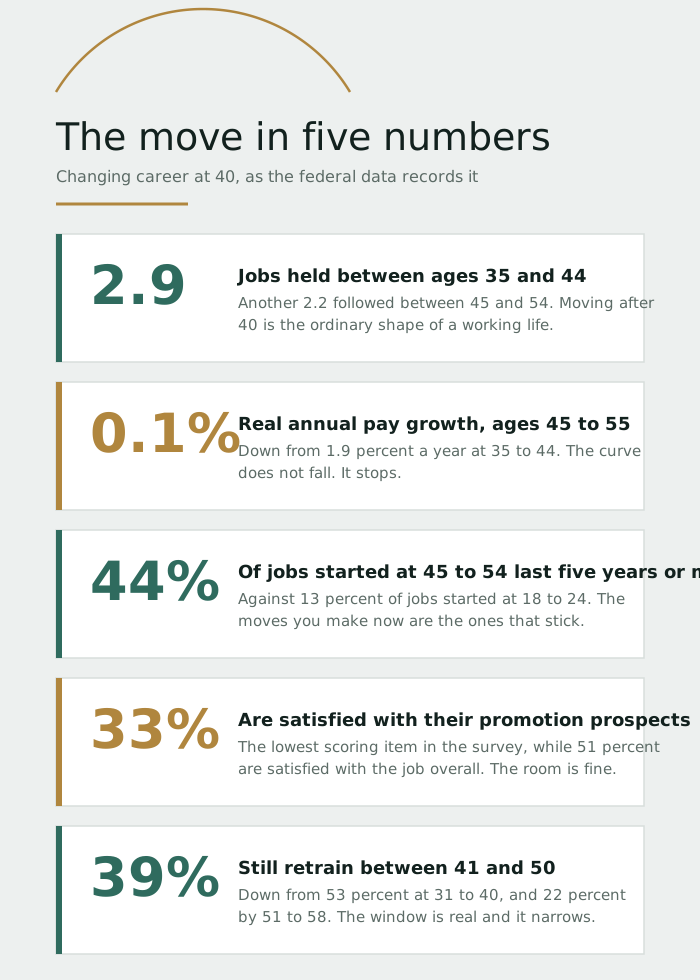
The real finding in that same dataset is the one nobody puts on a motivational poster. Inflation adjusted hourly earnings for that cohort grew 1.9% a year between 35 and 44, then 0.1% a year between 45 and 55. Not a drop. A flatline. Whatever you are being paid at 45, the historical pattern says you will be paid roughly that, in real terms, at 55.
Last reviewed August 20, 2026. Every figure below comes from the cited federal source or primary survey (US Bureau of Labor Statistics, Pew Research Center) and is linked inline so you can check it yourself. The job count and earnings figures track one specific generation, Americans born 1957 to 1964, through the decades they actually lived, not a live forecast for today's economy. Treat them as the clearest historical pattern available, not a guarantee. This is general information about labor market data, not individual financial or career advice.
The short answer
Changing career at 40 is normal, measurable and common. What is not normal is treating it as a leap while treating staying put as neutral. Staying put has a number attached to it, and the number is 0.1% real earnings growth a year from 45 to 55.
Three things are true at once. First, job changes after 35 are routine: 2.9 jobs from 35 to 44 and 2.2 from 45 to 54 in the Bureau of Labor Statistics longitudinal cohort. Second, the compensation curve for that cohort had already slowed to 1.9% annual real growth by 35 and went flat at 45. Third, the jobs people start in their forties actually stick: of jobs begun between 45 and 54, 44% lasted five years or more, against 13% of jobs begun between 18 and 24.
So the honest framing is not "is 40 too late". It is "you have roughly a five year window in which a move can still compound, and you are standing in it". Use it deliberately or spend it by default, and the regrets that last are the ones attached to the second option.
What the data actually says about changing jobs after 40
The Bureau of Labor Statistics has followed 9,964 Americans born between 1957 and 1964 since 1979, most recently interviewing them in 2022 and 2023 when they were 57 to 66. It is the best long horizon record of what an American working life actually looks like, and it reports that this cohort held an average of 12.9 jobs from 18 to 58.
Over 40% of those jobs were held before age 25. That number is usually quoted to make young people feel better about churn. Read the other end of the table and it says something more useful to a man of 42: after 35, the average person still had five more employers ahead of them.
The other number worth sitting with is duration. Among jobs started between 45 and 54, the average worker had 21% end in under a year and 56% end in fewer than five years, which means 44% ran past five years. Compare that with jobs started between 18 and 24, where 61% ended inside a year and 87% inside five. A job you take at 47 is roughly three times more likely to still be yours at 52 than a job you took at 22 was to survive to 27.
Whatever the fear of changing career at 40 is made of, it is not made of instability. The moves you make now are the ones that last.
The number that should actually worry you
Hourly earnings for this cohort grew 6.5% a year in their late teens and early twenties, 3.3% a year from 25 to 34, 1.9% a year from 35 to 44, and 0.1% a year from 45 to 55.
Read that last figure slowly. It is not a recession. It is the ordinary trajectory of ordinary careers, and it says that after about 45 the machine that was quietly raising your standard of living every year switches off. The raises may still arrive. Inflation takes them.
Two caveats, because the number is strong enough that overstating it would be a disservice. This is one birth cohort passing through a specific set of decades, and BLS says as much: the growth rates reflect the state of the economy during the years the cohort occupied each bracket. And education changes the shape. Among 55 to 58 year olds, those with less than a high school diploma saw 0.0% growth while those with a bachelor's degree or higher saw 1.0%.
But the direction is not ambiguous, and it reframes the entire question. Men in their forties usually describe a career change as the risky option and staying as the safe one. On the earnings evidence, staying is the option where nothing moves. If you want the next fifteen years to look different from the last five, something has to change while the curve still has slope in it.
Why it feels impossible when the data says it is ordinary
Part of the answer is that the job itself is usually fine. In Pew Research Center's February 2023 survey of 5,188 US workers, 51% said they were extremely or very satisfied with their job overall, 67% with their co-workers and 62% with their manager.
Then look at what they were not satisfied with. Only 34% were highly satisfied with how much they were paid, and only 33% with their opportunities for promotion, the lowest scoring item in the whole survey. Just 44% were satisfied with their opportunities for training and skills development.
That is a precise picture of a specific kind of stuck. The room is pleasant. The people are decent. The ladder has no more rungs. It is very hard to justify leaving something that is 62% good, which is exactly why so many men stay until the decision is made for them.
There is a second reason it feels impossible, and it is a measurement error. Median tenure with a current employer in January 2024 was 3.9 years, the lowest since January 2002, and 4.2 years for men. Among workers aged 35 to 39, only 21% had been with their employer ten years or more. If you have been somewhere a decade, you are the unusual one, and the stability you are afraid of losing is rarer than it feels from the inside.
Where the doors actually are
The most common mistake in career change research is reading a fastest growing list. Percentage growth lists are dominated by tiny occupations. The BLS projections for 2024 to 2034 name wind turbine service technicians and solar photovoltaic installers as the two fastest growing occupations in the economy, and note that both combined will add fewer than 20,000 jobs.
Absolute job creation is the number that decides whether anyone will interview you. Here are occupations from the BLS list of most new jobs projected for 2024 to 2034, filtered to those a mid career changer can plausibly enter with transferable management, analytical or technical experience.
| Occupation | Median pay, 2024 | New jobs projected, 2024 to 2034 |
|---|---|---|
| Software developers | $133,080 | 267,700 |
| General and operations managers | $102,950 | 164,000 |
| Medical and health services managers | $117,960 | 142,900 |
| Computer and information systems managers | $171,200 | 101,600 |
| Management analysts | $101,190 | 94,500 |
| Data scientists | $112,590 | 82,500 |
| Substance abuse and mental health counselors | $59,190 | 81,000 |
| Electricians | $62,350 | 77,400 |
The sector level picture is blunter still. Healthcare and social assistance is projected to be both the largest and the fastest growing sector at 8.4%, driven by an ageing population. Computer and mathematical occupations grow 10.1%, more than three times the 3.1% projected for the economy as a whole. Services for the elderly and people with disabilities is projected to add 528,500 jobs, more than any other detailed industry.
Against that, retail trade is projected to lose more jobs than any other sector, and BLS attributes declines in office and administrative support to automation including AI. If your current function sits in one of those, the flat earnings curve is not your only problem.
What actually transfers
This next table is the site's own framework rather than a sourced finding, and we label it that way because nobody publishes a federal statistic on this. It is a reasoned extrapolation from the tenure, training and duration data above, not a separate body of fieldwork.
| Transfers almost fully | Transfers partly | Does not transfer |
|---|---|---|
| Running a budget and a P&L | Domain knowledge, discounted heavily outside the sector | Your seniority |
| Managing people through a bad quarter | Your professional network, thinner one industry over | Internal reputation |
| Selling an idea to someone senior | Technical tooling, usually a version behind | Tenure based pay |
| Holding a deadline when things go wrong | Credentials, sometimes requiring a top up | Being the person everyone asks |
The left column is why a 45 year old career changer is not competing with a 25 year old. The right column is why the first eighteen months feel like a demotion even when the trajectory is better. Both are true, and men who only expect one of them tend to quit the change halfway through.
The window, and why it closes quietly
Two more figures from the same cohort mark the edges of the window.
Training peaks earlier than most people expect. Fifty three percent of that cohort received training outside regular schooling between the ages of 31 and 40, falling to 39% between 41 and 50 and 22% between 51 and 58. Whatever retraining you are going to do, the population level pattern says it happens before 50 or mostly not at all.
Health does the rest. The share reporting that their health limits the kind or amount of work they can do was 10% at 44, 19% at 54 and 23% at 58. Between 44 and 54 the figure roughly doubles. That is not a reason to panic at 41. It is a reason to stop treating "in a couple of years" as a free option, because the version of you who executes the move in five years has measurably fewer physical and financial degrees of freedom than the one reading this.
This is the same logic we set out in starting over at 40 when you are not starting from zero: the asset is not time, it is the accumulated capability you already have. The window is how long you have to redeploy it while it still compounds.
The move that makes it worse
Quitting first. It is the single most common way a reasonable career change at 40 turns into a bad year.
The reason is structural rather than motivational. The moment income stops, the search stops being a strategic decision and becomes a runway calculation, and men negotiate badly on a runway. You take the first offer that clears the mortgage, which is frequently a sideways move into the same flat curve you just left, minus your tenure and your internal reputation.
Test the new direction while the old one still pays. Do the paid project, the evening qualification, the contract weekend. Move when there is evidence, not when there is frustration. If the frustration itself is the loudest thing in the room right now, that is worth its own diagnosis, and the difference between a career problem and something else is covered in what a midlife crisis in men actually is.
One last thing the data quietly recommends. In the Pew survey, 55% of workers said they have no mentor at work, and only 34% of workers aged 50 to 64 said they had one. Career changes after 40 run almost entirely on relationships one industry over, which is precisely the network most men have let thin out. If that describes you, read the male loneliness epidemic, because the fix for the social problem and the fix for the career problem are the same set of phone calls. And if the pull you feel is toward meaning rather than money, finding purpose after 40 is the better starting point than a job board.
The move in five numbers
FAQ
Is 40 too late to change careers?
No. Americans born between 1957 and 1964 held an average of 2.9 jobs between the ages of 35 and 44 and another 2.2 between 45 and 54, according to the Bureau of Labor Statistics. Changing employers and direction after 40 is the statistical norm rather than an exception. Jobs started later also last longer: 44% of jobs begun between 45 and 54 ran five years or more, against 13% of jobs begun between 18 and 24.
How do I change career at 40 with no experience in the new field?
Enter through the column that transfers. Budget ownership, people management, senior stakeholder persuasion and delivery under pressure are portable across sectors, while your seniority and internal reputation are not. Target roles where your existing capability is the requirement and the domain knowledge is teachable, and prove the direction with a paid project or contract while you are still employed.
What is the best career to change to at 40?
There is no single answer, but the BLS projections for 2024 to 2034 point at where hiring volume will be. In absolute new jobs, software developers (267,700), general and operations managers (164,000), medical and health services managers (142,900), computer and information systems managers (101,600) and management analysts (94,500) lead the fields a mid career changer can plausibly enter. Judge options by absolute job creation, not by percentage growth lists, which are dominated by very small occupations.
Will I take a pay cut if I change career at 40?
Often in the first eighteen months, because tenure based pay and internal reputation do not transfer. The relevant comparison is not against your current salary but against your current trajectory, and for the BLS cohort that trajectory was 0.1% real annual growth from 45 to 55. A temporary cut that restores slope can be worth more over a decade than a flat curve that never dips.
Should I quit my job before starting a career change?
Not as a default. Once income stops, a strategic search turns into a runway calculation and negotiating position collapses, which frequently produces a sideways move into the same flat earnings curve. Test the new direction with paid work while the current job still pays, and move on evidence rather than on frustration.
How long do people actually stay in a job now?
Median tenure with a current employer was 3.9 years in January 2024, the lowest since January 2002, and 4.2 years for men. Among workers aged 35 to 39, only 21% had ten years or more with their employer. Long tenure is now the unusual case rather than the standard one.
Is it harder to get retrained after 40?
The population pattern says retraining becomes less likely rather than harder. In the BLS cohort, 53% received training outside regular schooling between the ages of 31 and 40, falling to 39% between 41 and 50 and 22% between 51 and 58. Most people who retrain do it before 50, which argues for treating the early forties as a window rather than a warm up.
How do I change career at 40?
Work the sequence rather than the leap. Pick the destination by absolute job creation rather than by percentage growth lists, which are dominated by occupations too small to hire anyone. Enter through what transfers: budget ownership, managing people through a bad quarter, persuading someone senior and holding a deadline are all portable, while your seniority, internal reputation and tenure based pay are not. Test the direction with a paid project, an evening qualification or a contract weekend while the current job still pays, because once income stops the search becomes a runway calculation and the negotiating position collapses. Do any retraining early: 53% of the BLS cohort received training outside regular schooling between the ages of 31 and 40, against 39% between 41 and 50. And rebuild the network one industry over before you need it, because 55% of US workers report having no mentor at work and mid career moves run almost entirely on those relationships.
Sources
- US Bureau of Labor Statistics, Number of Jobs, Labor Market Experience, Marital Status, and Health for those Born 1957-1964, National Longitudinal Survey of Youth 1979, released August 26, 2025, reissued July 21, 2026. Survey of 9,964 men and women first interviewed in 1979.
- US Bureau of Labor Statistics, Employee Tenure in 2024, released September 26, 2024. Current Population Survey supplement, about 60,000 households.
- US Bureau of Labor Statistics, Employment Projections 2024-2034, released August 28, 2025.
- US Bureau of Labor Statistics, Occupational Outlook Handbook, Most New Jobs, last modified August 28, 2025.
- Pew Research Center, How Americans View Their Jobs, March 30, 2023. Based on 5,188 US adults working part time or full time who are not self-employed, surveyed February 6 to 12, 2023.