Career Change at 40 With No Degree: What Is Actually Open to You
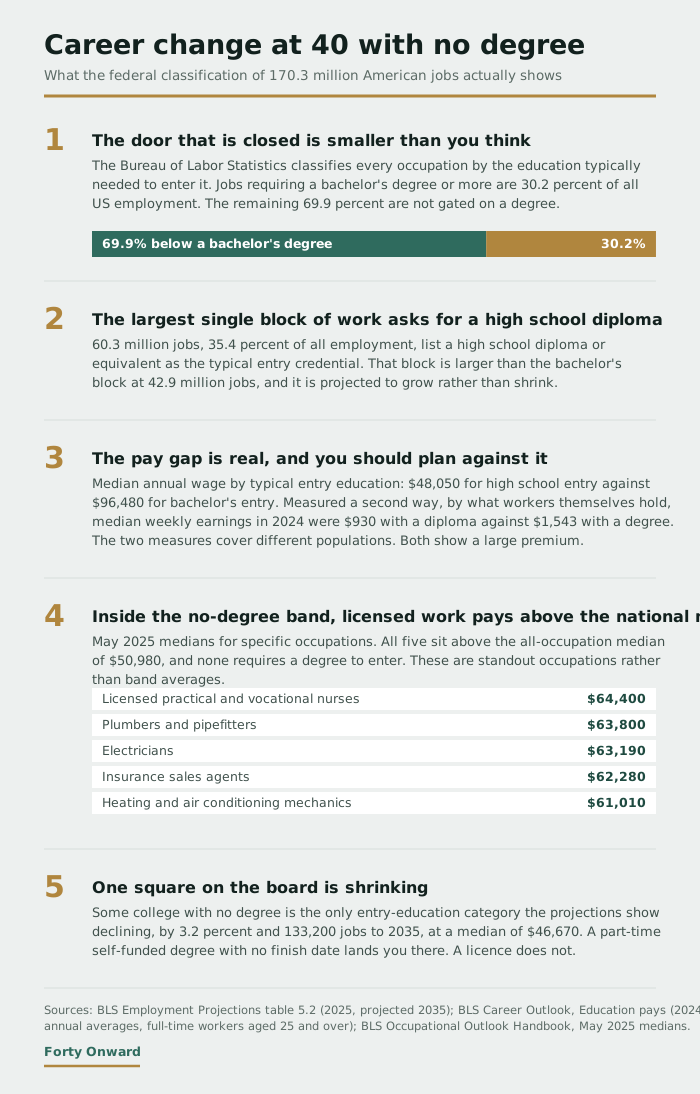
You can change career at 40 without a degree, and the wall you have been picturing is a filter on about three jobs in ten. In 2025 the Bureau of Labor Statistics counted 170.3 million jobs in the American economy and classified every one of them by the education typically needed to enter it. Occupations that typically require a bachelor's degree or more account for 30.2 percent of that total. The other 69.9 percent do not. If you are 40 and you never finished a degree, that is the real reach of the filter, and it is narrower than the version of it you have been carrying around.
That is genuine good news and it is only half the finding. The other half is less comfortable. Jobs that do not require a degree pay less on average, substantially and measurably less, and pretending otherwise would be no use to you. The useful move is not to argue with the average. It is to notice that the average is made of two very different groups, and that what separates them is usually a licence or a certificate you can hold inside a year, not four years and a loan.
Last reviewed September 8, 2026. Every figure below comes from the cited federal source or nationally representative survey and is linked inline so you can check it yourself. All employment and wage figures are United States data and are revised annually. Population level findings describe groups rather than individuals, and no occupational median tells you what any specific person will be offered. This is general information rather than career, financial or legal advice.
The short answer
You can change career at 40 without a degree, and the federal classification says roughly seven in ten American jobs were never gated on one. The constraint is real and it is narrower than most men at 40 assume.
The mistake almost everyone makes is to treat "no degree" as one category. It is two. There is a band of work that asks for no formal credential at all, which is 23.6 percent of employment at a median annual wage of $36,400, and there is a band that asks for a postsecondary licence or certificate, which is 6.3 percent of employment at a median annual wage of $49,910. Sitting inside those bands, and inside the high school diploma band beside them, are specific licensed and apprenticed occupations paying in the low sixties. Those are standout occupations rather than band averages, and the section below names them.
So the question to work on is not "how do I get hired without a degree". It is "which credential that is not a degree unlocks the largest pay step from where I stand, and who pays me while I earn it". For a lot of men at 40 the answer is a registered apprenticeship, because it is the one training route that pays a wage from the first week.
How big the constraint actually is
Here is the whole classification rather than the part that flatters the argument. This is Employment Projections table 5.2, which assigns every occupation a typical entry-level education and reports both current employment and the ten year projection.
| Typical education needed to enter | Employment 2025 (thousands) | Share of all jobs | Median annual wage 2025 | Projected change 2025 to 2035 |
|---|---|---|---|---|
| No formal educational credential | 40,201.2 | 23.6% | $36,400 | +2.3% |
| High school diploma or equivalent | 60,319.0 | 35.4% | $48,050 | +2.0% |
| Some college, no degree | 4,172.9 | 2.5% | $46,670 | -3.2% |
| Postsecondary nondegree award | 10,679.1 | 6.3% | $49,910 | +5.7% |
| Associate's degree | 3,554.1 | 2.1% | $64,990 | +4.9% |
| Bachelor's degree | 42,870.1 | 25.2% | $96,480 | +5.6% |
| Master's degree | 3,941.3 | 2.3% | $83,210 | +11.0% |
| Doctoral or professional degree | 4,543.2 | 2.7% | $128,870 | +6.4% |
| All occupations | 170,280.8 | 100% | $50,980 | +3.5% |
Two readings of that table matter and they pull in opposite directions.
The first is the one nobody tells a 40 year old without a degree: the largest single block of American employment, by a wide margin, is work whose typical entry credential is a high school diploma. That block is 60.3 million jobs, larger than the bachelor's block at 42.9 million, and it is growing rather than shrinking. Add the categories below a bachelor's together and you get 69.9 percent of everything.
The second reading is the one the motivational version of this article leaves out. Look down the wage column. The bachelor's row is $96,480 against $48,050 for the high school row. That is not a rounding difference. It is roughly double, a comparison this magazine calculated from the two published figures, and it is the reason the degree question keeps being asked at all.
Both readings are true at once: access is wide, and the average price of that access is low, which is why the rest of this article is about the gap between the average and the specific.
The counterweight: what work without a degree costs you in pay
The pay gap by credential shows up in worker level data as clearly as in occupational data. The Bureau of Labor Statistics publishes median usual weekly earnings and unemployment rates by educational attainment for full-time workers aged 25 and over. The 2024 annual averages run like this, lowest to highest:
| Educational attainment | Median usual weekly earnings | Unemployment rate |
|---|---|---|
| High school diploma | $930 | 4.2% |
| Some college, no degree | $1,020 | 3.8% |
| Associate's degree | $1,099 | 2.8% |
| Bachelor's degree | $1,543 | 2.5% |
The two measurements point the same way. Both show a large premium for a degree and a lower unemployment rate alongside it.
They do not agree on the size of it, and that distinction matters enough to spell out. At the high school level the two are close: $48,050 a year by occupational entry requirement against $930 a week, which annualises to about $48,360. At the bachelor's level they separate: $96,480 a year by occupational entry requirement against $1,543 a week, which annualises to about $80,236. The reason is that one series counts what an occupation typically requires of a new entrant, and the other counts what degree holders are paid across whatever work they actually ended up doing. Take the direction from both. Take the magnitude from whichever one answers your question, and do not average them.
Public opinion has moved a long way from that data, which is worth knowing so you can discount the conversation you will have with friends. Pew Research Center surveyed American adults and found only about a quarter say it is extremely or very important to hold a four-year degree in order to get a well-paying job now, while 40 percent say it is not too important or not at all important. Roughly half say a degree matters less than it did 20 years ago. Pew's own reporting is careful to note the other side of it: the earnings gap between young adults with and without a degree has not narrowed.
So the sentiment has shifted and the arithmetic has not. Plan against the arithmetic.
Where the money actually sits inside the no-degree band
The $48,050 median for high school entry occupations is an average across 60.3 million very different jobs. Averages of that size are close to useless for a decision. What you want is the tail of that distribution: specific occupations that ask for no degree and still pay above the all-occupation median of $50,980.
They exist, there are a lot of them, and they share one feature. Entry is controlled by a licence, an apprenticeship or a clinical certificate rather than by a diploma.
| Occupation | Typical entry education | Median annual pay, May 2025 | Projected openings each year | Growth 2025 to 2035 |
|---|---|---|---|---|
| Licensed practical and licensed vocational nurses | Postsecondary nondegree award, about 1 year | $64,400 | 51,800 | +3% |
| Plumbers, pipefitters and steamfitters | High school diploma plus apprenticeship | $63,800 | 42,000 | +7% |
| Electricians | High school diploma plus apprenticeship | $63,190 | 72,700 | +9% |
| Insurance sales agents | High school diploma | $62,280 | 43,100 | +3% |
| Heating, air conditioning and refrigeration mechanics | Postsecondary nondegree award | $61,010 | 40,600 | +11% |
| Heavy and tractor-trailer truck drivers | Postsecondary nondegree award | $58,640 | 214,500 | +4% |
| Customer service representatives | High school diploma | $44,770 | 289,500 | -5% |
The last row is in the table on purpose, and it carries the sharpest lesson in the article. Customer service representatives are one of the largest no-degree occupations in the country at 2.67 million jobs, and the projection is a decline of 141,800 positions over the decade. The occupation still shows about 289,500 openings a year, more than any other row here, and the Bureau of Labor Statistics attributes every one of those openings to replacing workers who leave rather than to growth. A large openings figure is not the same thing as a growing occupation, and this row is how you tell the difference. It is the default landing spot for a man who needs work quickly and does not have a credential, and it is the one square in this table that is contracting. Being in the no-degree band is not the problem. Being in the wrong part of it is.
Compare the top of that table against the band median. Electricians at $63,190 sit about 31 percent above the $48,050 median for high school entry occupations, a comparison this magazine calculated from the two published figures, and above the all-occupation median of $50,980. Every one of those top rows is a job you can begin qualifying for at 40 with the education you already have.
One note on vintages, because this magazine has published a second figure for the same occupation. Every wage and openings number in this article comes from the May 2025 medians and the 2025 to 2035 projection round. Our earlier piece on changing career at 40 quotes electricians at $62,350 and 77,400 openings, which are the figures from the previous 2024 to 2034 round. Both are correct for the release they came from. Where they differ, the numbers on this page are the newer ones.
The mechanism that makes this work at 40 rather than at 20
The reason a 20 year old and a 40 year old give different answers to the same career question is not ambition. It is that one of them has a mortgage. Any retraining route that requires you to stop earning for two to four years is not a route for you, whatever its return on paper. That single constraint removes most of the standard advice.
It is also what makes apprenticeship the specific answer rather than a nice idea. In a registered apprenticeship you are an employee from the first day. You are paid a wage while you train, that wage rises on a schedule as you hit competency milestones, and the classroom hours are part of the arrangement rather than something you fund separately in the evenings. The federal listing service at apprenticeship.gov is where the registered programmes are published, searchable by occupation and location.
Note what the Bureau of Labor Statistics says about entry for electricians: most learn through an apprenticeship, some start at a technical school, and most states require a licence. The route in is a job, not an admission letter. Plumbers, pipefitters and steamfitters follow the same pattern.
The clinical route works differently and is worth knowing because it is faster. Licensed practical and licensed vocational nurses must complete a state-approved educational programme, which typically takes about one year, then hold a licence. That is a year of tuition rather than a paid apprenticeship, so it is a harder cash flow, but it is one year and it opens a $64,400 median with 51,800 openings a year.
If the cash flow question is the thing actually blocking you rather than the credential question, our piece on starting over at 40 with no money works through the sequencing of that specific problem.
The one square you do not want to land on
Go back to the classification table and find the only row projected to shrink.
"Some college, no degree" is 4.17 million jobs at a median annual wage of $46,670, and it is forecast to fall by 133,200 jobs, a decline of 3.2 percent, while every other category grows. It also pays less than the plain high school diploma row, which sits at $48,050.
That is the occupational picture rather than a statement about people. At the worker level, someone who has some college and no degree does earn more on average than someone with a diploma alone, $1,020 a week against $930. The two facts are not in conflict because they measure different things: one counts occupations by their entry requirement, the other counts workers by what they finished. Keep them apart.
The practical warning is about a course of action rather than about your past. Enrolling in a degree at 40, part time, self funded, with no clear finish date, is one of the more expensive ways to stand still. It costs money now, it costs the evenings you would need for a licensed credential, and it deposits you in the one entry-education category the projections show shrinking. If you are going to spend a year of evenings, spend it on something that ends in a licence with a name.
What the law does for you at 40, and what it does not
You cross a legal line at 40 that most men do not know about. The Age Discrimination in Employment Act of 1967 protects applicants and employees aged 40 and over from discrimination in hiring, promotion, discharge, compensation and the terms of employment, as the Department of Labor sets out in its summary of age discrimination law. It is enforced by the Equal Employment Opportunity Commission.
Be clear about what that protection can and cannot reach. It gives you a remedy against a decision you can document. It does nothing about an automated filter that removes you before a human sees the file, because a degree requirement is a lawful screen and nobody has to tell you that you failed it.
That points at the same conclusion as the rest of this article, reached from a different direction. Apply where the gate is a credential you can actually hold. A licence number is a fact about you that survives a filter. A story about your capability, however true, does not.
The order of operations
The sequence matters more than any individual choice inside it, because the common failure is doing these in the wrong order and paying for training that leads nowhere in particular.
- Pick the occupation first, not the course. Use the Occupational Outlook Handbook and read the field called typical entry-level education. That single field tells you whether the door is a diploma, a certificate, an apprenticeship or a degree, and it is the only screen you need at this stage.
- Check the openings figure, not just the growth rate. Electricians grow 9 percent, which sounds modest, and produce about 72,700 openings a year, which is the number that determines whether anyone is hiring. Most openings come from replacing people who retire or move on rather than from growth.
- Then find the credential, and only then the provider. In that order, because the credential defines the acceptable providers and stops you buying a course nobody recognises.
- Ask who pays you during it. A registered apprenticeship pays a wage. A one year clinical programme does not. That answer decides which route is realistic against your outgoings, and it is a cash flow question rather than an ambition question.
- Count the years to your own break-even, not to somebody's average. If you are 42 and the route costs one year, you are looking at a payback horizon inside your working life with room to spare. Our piece on changing career at 40 covers what the earnings curve does after 45 and why the arithmetic pushes towards acting sooner.
What this article is not
Credentials still matter, and nothing here argues otherwise. The federal data says they matter a great deal, in both directions, and anyone telling you the degree premium is a myth is selling you something.
Nor are the trades the only answer. They are the clearest illustration because their entry requirements are published and unambiguous. The same principle applies anywhere the gate is a licence rather than a diploma.
None of this is advice to avoid higher education for good. It is advice about sequencing. A funded degree later, with an employer paying and a job already in hand, is a completely different proposition from a self-funded one begun at 40 out of a sense that you should have one.
Career change at 40 with no degree, in five numbers
Growth rates get quoted in every article on this subject. Openings are the number that decides whether anyone interviews you. These are the projected average annual openings, over the decade to 2035, for the occupations named above.
- 289,500 a year for customer service representatives, every one of them a replacement rather than growth, in an occupation projected to shrink by 5 percent.
- 72,700 a year for electricians, the largest of the licensed trades listed here, alongside 9 percent growth.
- 51,800 a year for licensed practical and licensed vocational nurses, reachable through a programme of about one year.
- 42,000 a year for plumbers, pipefitters and steamfitters, on the same paid apprenticeship route as electricians.
- 40,600 a year for heating, air conditioning and refrigeration mechanics, the fastest growing of the group at 11 percent.
FAQ
Can you change careers at 40 with no degree?
Yes. About 69.9 percent of United States employment in 2025 had a typical entry-level education below a bachelor's degree, so most American work was never gated on one. The binding constraint at 40 is usually cash flow during retraining rather than the missing credential, which is why a paid apprenticeship route tends to fit this age better than full-time study.
What jobs pay well without a degree?
Using May 2025 federal medians, licensed practical and licensed vocational nurses earn $64,400, plumbers and pipefitters $63,800, electricians $63,190, insurance sales agents $62,280 and heating, air conditioning and refrigeration mechanics $61,010. All five sit above the all-occupation median of $50,980, and none requires a bachelor's degree to enter.
Is it worth getting a degree at 40 instead?
It depends entirely on who is paying and whether it ends in a specific qualification. A funded degree with an employer behind it is a strong position. A self-funded, part-time degree with no fixed finish date is the most expensive available way to stand still, and the occupational category of "some college, no degree" is the only entry-education band the federal projections show shrinking, by 3.2 percent to 2035.
How long does it take to retrain at 40 without a degree?
The two common shapes are about one year for a state-approved clinical programme such as licensed practical nursing, and several years for a registered apprenticeship in a licensed trade. The difference that matters more than the length is that an apprenticeship pays you a wage throughout while a classroom programme does not.
Will employers hold my age against me?
Some will, and it is unlawful when it can be shown. The Age Discrimination in Employment Act of 1967 protects applicants and employees aged 40 and over in hiring, promotion, discharge and compensation. What the law cannot reach is a screen you never see, which is the practical argument for pursuing roles where the gate is a licence you can hold rather than a degree box you cannot tick.
Are the trades really hiring, or is that just a talking point?
The openings figures are published annually and are separate from the growth rate. Electricians are projected to have about 72,700 openings a year over the decade to 2035, plumbers about 42,000, heating and air conditioning mechanics about 40,600, and licensed practical nurses about 51,800. Most of those come from replacing workers who retire or move to other occupations rather than from expansion.
What is the biggest mistake when changing career at 40 without a degree?
Choosing the course before choosing the occupation. It leads to paying for training that no specific employer requires. Read the typical entry-level education field for the occupation first, then work backwards to the credential that satisfies it, then to the provider, and last to who funds you while you do it.
Sources
- U.S. Bureau of Labor Statistics, Employment Projections, Table 5.2: Employment, wages, and projected change in employment by typical entry-level education, 2025 and projected 2035. Source for total employment of 170,280,800, for the employment counts, employment shares, median annual wages and projected changes for every entry-education category quoted here, and for the derived totals of 69.9 percent below a bachelor's degree and 30.2 percent at bachelor's or above. Wage data in that table come from the Occupational Employment and Wage Statistics programme and exclude the self-employed.
- U.S. Bureau of Labor Statistics, Career Outlook, Education pays, 2024. Source for 2024 annual average median usual weekly earnings and unemployment rates for full-time wage and salary workers aged 25 and over: $930 and 4.2 percent for a high school diploma, $1,020 and 3.8 percent for some college with no degree, $1,099 and 2.8 percent for an associate's degree, and $1,543 and 2.5 percent for a bachelor's degree. The annualised figures of about $48,360 and about $80,236 quoted in the text are this magazine's arithmetic on those weekly medians, shown only to compare the two series like for like.
- U.S. Bureau of Labor Statistics, Occupational Outlook Handbook, Electricians. Source for the May 2025 median annual wage of $63,190, the typical entry-level education of a high school diploma or equivalent with apprenticeship training, projected growth of 9 percent from 2025 to 2035, and about 72,700 projected openings each year.
- U.S. Bureau of Labor Statistics, Occupational Outlook Handbook, Plumbers, Pipefitters, and Steamfitters. Source for the May 2025 median of $63,800, high school diploma entry with apprenticeship, 7 percent growth and about 42,000 projected openings each year.
- U.S. Bureau of Labor Statistics, Occupational Outlook Handbook, Licensed Practical and Licensed Vocational Nurses. Source for the May 2025 median of $64,400, the state-approved programme typically taking about one year plus licensure, 3 percent growth and about 51,800 projected openings each year.
- U.S. Bureau of Labor Statistics, Occupational Outlook Handbook, Heating, Air Conditioning, and Refrigeration Mechanics and Installers. Source for the May 2025 median of $61,010, postsecondary nondegree award entry, 11 percent growth and about 40,600 projected openings each year.
- U.S. Bureau of Labor Statistics, Occupational Outlook Handbook, Heavy and Tractor-trailer Truck Drivers. Source for the May 2025 median of $58,640, postsecondary nondegree award entry, 4 percent growth and about 214,500 projected openings each year.
- U.S. Bureau of Labor Statistics, Occupational Outlook Handbook, Insurance Sales Agents. Source for the May 2025 median of $62,280, high school diploma entry, 3 percent growth and about 43,100 projected openings each year.
- U.S. Bureau of Labor Statistics, Occupational Outlook Handbook, Customer Service Representatives. Source for the May 2025 median of $44,770, employment of 2,666,000, high school diploma entry, the projected decline of 5 percent and 141,800 jobs from 2025 to 2035, and about 289,500 projected openings each year, which the Bureau attributes entirely to replacing workers who leave rather than to growth.
- Pew Research Center, Is College Worth It?, May 23, 2024. Source for the finding that one in four US adults say a four-year degree is extremely or very important for getting a well-paying job, 35 percent say somewhat important and 40 percent say not too or not at all important, that 49 percent say a degree is less important than it was 20 years ago, and for Pew's own observation that the earnings gap between young adults with and without a degree has not narrowed.
- U.S. Department of Labor, Age Discrimination. Source for the statement that the Age Discrimination in Employment Act of 1967 protects certain applicants and employees 40 years of age and older from discrimination in hiring, promotion, discharge, compensation and the terms, conditions or privileges of employment, and that it is enforced by the Equal Employment Opportunity Commission.
- U.S. Department of Labor, Apprenticeship.gov. Cited as the federal listing service for registered apprenticeship programmes. No statistic in this article is drawn from it.