The Best Career Change Jobs at 40, Screened by the Only Test That Matters
The fastest growing occupation in the United States, nurse practitioner, is close to the worst entry on the list for a 40 year old man starting from outside healthcare, despite a projected 41.0 percent gain in headcount between 2025 and 2035 and a median annual wage of $132,300. Getting there needs a bachelor's degree in nursing, a registered nurse licence, clinical hours, and then a master's degree. That is most of a decade before the first paycheque at the new rate.
This is the mistake that a "best jobs" list built on growth rate walks you straight into. Growth rate tells you whether an occupation will be hiring. It says nothing about whether you can get in, how long it takes, or whether the years it costs you are years you can still spare. At 40, counting to a traditional retirement age of 65, you have about twenty five working years left, and every one of them spent in a classroom is one not spent earning at the new number.
Last reviewed September 12, 2026. Every figure below comes from the cited federal source and is linked inline so you can check it yourself. All employment and wage figures are United States data, are revised annually, and describe occupations rather than individuals. No occupational median tells you what any specific person will be offered. This is general information rather than career, financial or legal advice.
The short answer
The best career change jobs at 40 are the ones that clear three lines at once: they pay above the all occupation median of $50,980, they grow faster than the 3.5 percent the whole economy is projected to add by 2035, and they can be entered on an associate's degree or less. Eleven occupations clear all three. The five strongest are industrial machinery mechanic, electrician, diagnostic medical sonographer, physical therapist assistant, and occupational therapy assistant.
The occupations that dominate the headlines mostly fail the third line, and the third line is the one that decides whether a move at 40 is a plan or a wish. One further number reorders even that shortlist, and it appears nowhere in a "best jobs" ranking: the wage at the bottom of each occupation, which is where you will actually start. On that measure diagnostic medical sonography is the standout, because even its lowest paid tenth earns 33 percent more than the median American worker.
Why "fastest growing" is the wrong filter at 40
A growth rate is a measure of an occupation's demand curve. It is not a measure of your access to it.
Consider the top of the Bureau of Labor Statistics list of fastest growing occupations for 2025 to 2035. Nurse practitioners lead at 41.0 percent. Data scientists sit at 34.6 percent and $120,230. Information security analysts at 21.0 percent and $129,180. Substance abuse, behavioral disorder and mental health counselors at 18.4 percent.
Now put the entry requirement beside each one, taken from the same agency's education and training assignments by occupation. Nurse practitioner: master's degree. Substance abuse counselor: master's degree plus an internship or residency. Data scientist: bachelor's. Information security analyst: bachelor's plus under five years of related work experience before entry.
Four of the most attractive numbers on the page are gated behind a credential that takes roughly four to seven years to acquire from a standing start. That range is an editorial working estimate based on typical programme lengths, since BLS publishes the credential type and not the time it takes to earn one. The number that sold you the occupation and the number that determines whether you can reach it are printed in different tables, and only one of them shows up in the articles.
If you do not hold a degree at all, the size of that gate is worth knowing precisely rather than guessing at, and we covered it separately in career change at 40 with no degree.
The test that actually sorts the list
Replace growth rate with payback period. Ask one question of every candidate occupation: how many months until the new wage starts, and how large is the step up when it does.
That produces three practical filters.
Filter one, the wage floor. The occupation has to pay more than the median of all US occupations, which was $50,980 in 2025. An occupation paying below that line is not a career change, it is a lateral move with tuition attached.
Filter two, the demand floor. It has to grow faster than total employment, projected at 3.5 percent to 2035. Anything slower means you are joining a queue that is getting longer relative to the openings.
Filter three, the time gate. Typical entry education has to be an associate's degree, a postsecondary nondegree award, or a high school diploma. This is the filter that does the real work, because it is the one that converts an attractive occupation into a reachable one.
There is a fourth consideration that no table captures, and it matters more at 40 than at 25: whether the occupation values accumulated judgement. Industrial maintenance, safety, logistics and the clinical assistant roles all reward someone who has already spent twenty years being responsible for outcomes. That is not a number, so treat it as a tiebreaker rather than a filter.
The eleven occupations that pass all three filters
Every row below comes from the two BLS tables already linked. Growth and wage are 2025 to 2035 projections and 2025 medians. Entry is the typical entry level education, with the training that normally follows it.
| Occupation | Growth to 2035 | Median wage | Entry | Jobs in 2025 |
|---|---|---|---|---|
| Physical therapist assistants | 23.0% | $68,380 | Associate's | 114,100 |
| Occupational therapy assistants | 21.5% | $72,300 | Associate's | 52,200 |
| Hearing aid specialists | 19.4% | $65,160 | High school, moderate on the job training | 11,200 |
| Occupational health and safety technicians | 19.4% | $61,560 | High school, moderate on the job training | 31,200 |
| Industrial machinery mechanics | 17.8% | $64,520 | High school, long term on the job training | 446,900 |
| Health information technologists | 15.9% | $68,020 | Associate's | 42,000 |
| Diagnostic medical sonographers | 13.9% | $96,590 | Associate's | 92,200 |
| Solar photovoltaic installers | 36.5% | $53,140 | High school, moderate on the job training | 31,100 |
| Wind turbine service technicians | 29.5% | $64,120 | Postsecondary nondegree, long term training | 11,800 |
| Electricians | 9.2% | $63,190 | High school, apprenticeship | 821,000 |
| Heavy and tractor trailer truck drivers | 3.8% | $58,640 | Postsecondary nondegree, short training | 2,221,200 |
The last column is there for a reason. Two of these occupations, solar photovoltaic installers and wind turbine service technicians, post spectacular growth rates on bases of 31,100 and 11,800 jobs, which is why a percentage growth ranking flatters them and a hiring manager in your city may never have posted one of these roles. We made that case at length in how to change career at 40 and will not re-argue it here. Read the 2025 jobs column beside the growth column and the flattery disappears on its own.
How eleven became five
Five of the eleven are profiled below. The other six are in the table because they pass the filters honestly, and out of the profile section for stated reasons: hearing aid specialists, occupational health and safety technicians and wind turbine service technicians all sit on national bases under 32,000 jobs, so local availability is the binding constraint rather than your suitability. Solar photovoltaic installers clear the wage floor by only $2,160. Heavy and tractor trailer truck drivers carry by far the largest base in the table at 2.2 million but grow at 3.8 percent, barely above the whole economy. Health information technologists are the closest omission and arguably belong: 15.9 percent growth, $68,020, an associate's degree, on a base of 42,000. If the clinical assistant roles below appeal but patient contact does not, that is the one to look at.
The five worth serious consideration, and who each one is for
Industrial machinery mechanics, $64,520, high school entry. The strongest single entry on the list for most men changing career at 40, and it is not close. It pays 27 percent above the all occupation median, grows at five times the rate of total employment, adds nearly 80,000 jobs on a large existing base, and asks for no formal credential beyond a high school diploma. The cost is long term on the job training, meaning you learn on someone else's payroll rather than on your own tuition. If you have ever been responsible for keeping physical things running, this is the shortest distance between what you already know and a wage above $64,000.
Electricians, $63,190, high school entry plus apprenticeship. Lower growth, far larger base, and the apprenticeship route means you are paid a rising wage from the first week rather than paying for school. The trade off is that a registered apprenticeship typically runs four to five years to full journeyman status, so the payback is real but slower than the wage table implies. That four to five year figure is an editorial working estimate: BLS publishes the training type for this occupation, not its duration.
Diagnostic medical sonographers, $96,590, associate's degree. The highest paid occupation on this list that does not require a bachelor's degree, at 89 percent above the all occupation median. A two year associate's programme is the gate. For a 40 year old that is a genuine two year cost with a genuinely large step at the end, and it is the clearest example on the page of a credential that pays for itself inside the working years you have left.
Physical therapist assistants, $68,380, and occupational therapy assistants, $72,300, both associate's degree. Growing at 23.0 and 21.5 percent, both well above median pay, both two year credentials. These are the two roles on the list that most reward someone who is good with people who are frustrated and in pain, which is a competence that tends to arrive with age rather than before it.
What the first year actually pays
Every wage quoted so far is a median, which is the midpoint of people already doing the job, most of whom have been doing it for years. You will not start there. The same OEWS programme publishes the bottom of each distribution, and for a career changer the 10th percentile is the honest number to plan against.
| Occupation | 10th percentile | 25th percentile | Median |
|---|---|---|---|
| Diagnostic medical sonographers | $67,820 | $80,430 | $96,590 |
| Occupational therapy assistants | $51,490 | $61,710 | $72,300 |
| Physical therapist assistants | $47,750 | $59,820 | $68,380 |
| Industrial machinery mechanics | $46,120 | $55,010 | $64,520 |
| Electricians | $42,640 | $49,430 | $63,190 |
May 2025 national estimates. Read the first column against the $50,980 all occupation median and the shortlist reorders itself.
Only two of the five put their lowest paid tenth above the median American wage. Diagnostic medical sonographers manage it by a distance: $67,820 at the tenth percentile is 33 percent above the all occupation median, so the worst paid sonographers in the country still out-earn the typical American worker. Occupational therapy assistants clear it by $510.
The other three do not. A new electrician at the tenth percentile is on $42,640, which is 16 percent below the all occupation median and less than he may be earning now. Industrial machinery mechanics start 10 percent below it, physical therapist assistants 6 percent below.
This does not demote those three. It dates the payoff. The gap between the tenth percentile and the median is $20,550 for an electrician and $18,400 for a mechanic, and closing it is what the first few years of the new trade are for. What it does mean is that anyone modelling this move on the median wage is modelling year eight and calling it year one.
The two costs the wage table does not show
A licence, in most cases, after the credential. The entry education column is not the last gate. All states require physical therapist assistants to be licensed or certified, which typically means graduating from an accredited programme and passing a qualifying exam. Occupational therapy assistants usually need a state issued licence, requiring an accredited programme, fieldwork and an exam. Most states require electricians to pass a test and be licensed. Some diagnostic medical sonographers need a state issued licence, and employers may require or prefer professional certification on top.
Industrial machinery mechanics are the exception, and it is a real part of why that occupation keeps winning here: the federal handbook lists no licence, certification or registration requirement for it at all.
A body that has to do the work for twenty more years. This is the cost a table of wages cannot show you and the one a 42 year old should weigh hardest. Electricians occasionally work in cramped spaces, find the long periods of standing and kneeling tiring, and may be required to work at great heights, with electrical shocks, falls and burns named as the common injuries. Occupational therapy assistants spend much of their time standing, and constant kneeling and stooping are part of the job, along with the occasional need to lift clients. Physical therapist assistants are frequently on their feet and, because they must often lift and move patients, are vulnerable to back injuries. Sonographers may need to stand for long periods and to lift or turn patients.
None of that is a reason to rule an occupation out. It is a reason to be honest with yourself about a back or a knee before you spend two years and a tuition bill discovering the answer.
Checking whether any of this is true where you live
National projections are the wrong instrument for a decision made in one city, and there are two free federal tools that are the right one. The BLS publishes metropolitan and nonmetropolitan area wage and employment estimates, which tell you how many people hold an occupation in your metro area and what it pays there rather than nationally. The Department of Labor's CareerOneStop carries local wage lookups by location along with the state by state licensing requirements that decide what your particular state will ask of you.
Run the occupation you are considering through both before you enrol in anything. A national median of $64,520 is not a promise about your county, and a state licence you did not know about is not a surprise you want in month twenty three.
The trap, stated plainly
The single fastest growing occupation in America is the single worst pick on this page for someone starting over at 40 without a healthcare background. Nurse practitioner pays $132,300 and adds 137,800 jobs. It requires a master's degree, and the route to that master's runs through a nursing bachelor's and an RN licence first.
That is not an argument against it if you are already a registered nurse. If you are, it may be the best move available to anyone reading this page. It is an argument against reading it off a growth ranking and treating it as a career change option, which is exactly what a ranking sorted by growth rate invites you to do.
The same applies more quietly to medical and health services managers at 24.2 percent and $123,860. Bachelor's degree, plus less than five years of related work experience required before entry. Not a starting point. A destination, reachable from several of the roles in the table above.
Volume is not quality, and the biggest number on the page proves it
Home health and personal care aides will add 847,300 jobs by 2035, more than three times the next largest gain in the American economy. It is the largest single block of new hiring anywhere in the projections.
The median wage is $35,800, which is 30 percent below the all occupation median.
It fails the first filter and it is not a career change worth retraining for, however many openings it carries. The same reasoning removes stockers and order fillers at $37,330, fast food and counter workers at $31,200, and restaurant cooks at $37,390, all of which appear near the top of the occupations with the most job growth table. Openings are abundant. That is a different fact from the job being worth having.
Why your forties are the window, measured
This is the part of the case that is specific to your age, and the federal data on it is unambiguous.
The BLS Displaced Workers Survey tracks people who lost a job they had held for three or more years. Of the 3.3 million long tenured workers displaced between January 2023 and December 2025, 66.1 percent were reemployed by January 2026. Split by age, the picture changes sharply:
| Age at displacement | Reemployed by January 2026 |
|---|---|
| 25 to 54 | 72.9% |
| 55 to 64 | 57.3% |
| 65 and over | 38.6% |
A sixteen point drop sits between the band you are in now and the band you enter at 55. That is not a reason to panic and it is not a claim that reinvention after 55 fails. It is a measurement of how much easier the same move is while you are still inside the 25 to 54 band, and it is the most concrete argument available for doing this at 42 rather than at 52.
The other half of that survey is worth knowing before you decide to wait and see. Among reemployed full time workers who reported earnings on the job they lost, about 49 percent were earning as much or more than before, down from about 62 percent in the previous survey two years earlier. A move you make by choice and a move made for you are not the same transaction. Among reemployed full time workers who reported earnings on both jobs, roughly half took a pay cut.
Changing employer at 40 is normal, not aberrant
If what is holding you still is the sense that long service is what a serious man does, the employee tenure data disagrees, and our sibling article on how to change career at 40 works through it properly. The one line worth carrying into this decision: the long tenure you see in the men above you accumulated after they stopped moving. It is not a virtue they practised while they still had options.
The mechanics of actually making the move, as opposed to choosing the destination, are covered in how to change career at 40. If the constraint is money rather than direction, starting over at 40 with no money deals with funding a two year credential without savings, and retirement planning at 50 covers what a mid career earnings step actually does to the back end.
What this article is not
It is not a promise that any of these occupations is hiring where you live. National projections describe a country, not a county.
It is not a ranking of which job you would enjoy. Every filter here is financial and structural, because those are the two things that can be measured. Whether you can stand doing the work for twenty years is a question the tables cannot answer and you can.
It is not advice to ignore an occupation because it needs a degree. It is advice to price the degree in years before you file the occupation under "options", and to notice when a list has quietly stopped doing that for you.
What it is, in the end, is a screen rather than a verdict. It narrows 170 million jobs down to eleven you could plausibly reach and five worth a weekend of serious thought. Which of the five is right for you is decided by a back, a commute, a mortgage and a temperament, and none of those are in the federal tables.
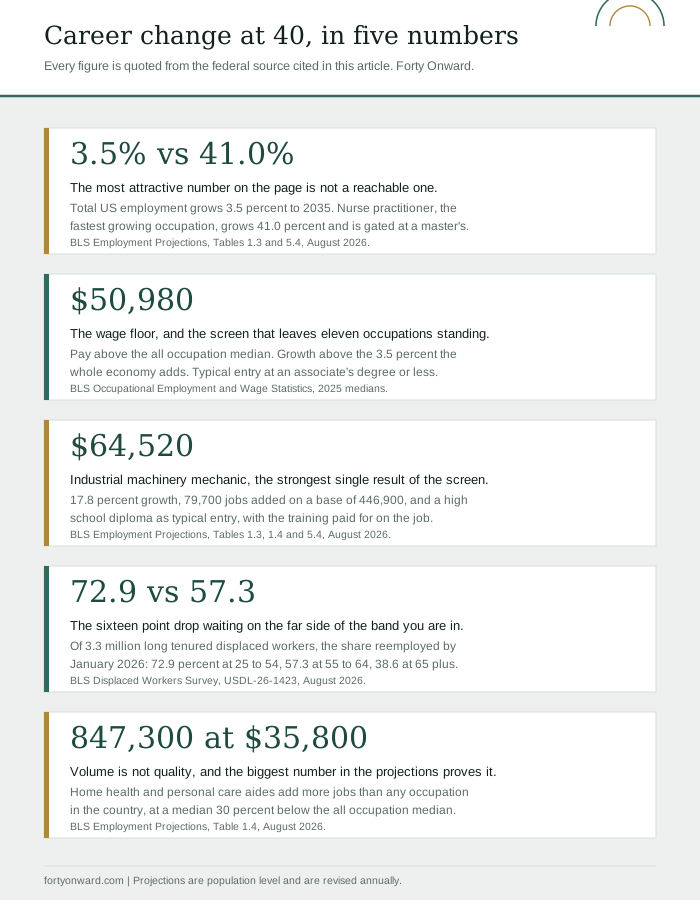
The case in six numbers
| The number | What it is | Source |
|---|---|---|
| 3.5% | Projected growth in total US employment, 2025 to 2035, across 170.3 million jobs | BLS Employment Projections, August 2026 |
| $50,980 | Median annual wage, all US occupations, 2025 | BLS Occupational Employment and Wage Statistics |
| 41.0% | Growth of nurse practitioners, the fastest growing occupation, entry gated at master's degree | BLS Employment Projections, August 2026 |
| $64,520 | Median wage for industrial machinery mechanics, entry gated at high school diploma | BLS Employment Projections, August 2026 |
| 72.9% vs 57.3% | Reemployment of long tenured displaced workers, ages 25 to 54 against 55 to 64 | BLS Displaced Workers Survey, January 2026, 3.3 million workers |
| 3.9 years | Median employee tenure with current employer, January 2024, lowest since 2002 | BLS Employee Tenure, September 2024 |
Test yourself
Key takeaways
FAQ
What is the best career to switch to at 40?
On the three filters that matter at 40, above median pay, faster than average growth, and no new degree required, industrial machinery mechanic is the strongest single option for most people. It pays a 2025 median of $64,520, is projected to grow 17.8 percent to 2035 against 3.5 percent for total employment, adds 79,700 jobs on a base of 446,900, and lists a high school diploma as its typical entry education with training delivered on the job. Diagnostic medical sonography pays considerably more at $96,590 but costs a two year associate's degree first.
Is 40 too late to change careers?
No, and the federal reemployment data is the clearest evidence for acting now rather than later. Among long tenured workers displaced between 2023 and 2025, 72.9 percent of those aged 25 to 54 were back in work by January 2026, against 57.3 percent of those aged 55 to 64 and 38.6 percent of those 65 and over. You are inside the band with the strongest reemployment rate, and you have about fifteen years before you leave it.
Which high paying jobs do not require a degree at 40?
Five need no degree of any kind, only a high school diploma or a postsecondary nondegree award as typical entry: industrial machinery mechanics at $64,520, hearing aid specialists at $65,160, occupational health and safety technicians at $61,560, electricians at $63,190 and solar photovoltaic installers at $53,140. Two more clear the same pay and growth bars but do require a two year associate's degree, which is a degree even though it is not a bachelor's: diagnostic medical sonographers at $96,590 and health information technologists at $68,020.
How long does a career change at 40 actually take?
It depends entirely on which of three routes the occupation sits on. On the job training routes such as industrial maintenance or safety technician start paying immediately and take months. Associate's degree routes such as sonography or physical therapy assistant take about two years of study before the new wage begins. Apprenticeship routes such as electrician pay from the first week but typically run four to five years to full rate. Degree gated occupations such as nurse practitioner or data scientist run roughly four to seven years from a standing start, an editorial working estimate rather than a BLS figure, and that is the route most "best jobs" rankings quietly assume you will take.
Should I pick the fastest growing occupation when choosing a career change job?
Not on its own. Solar photovoltaic installers post 36.5 percent growth and employ 31,100 people, which is roughly 11,300 additional jobs over ten years nationally. Electricians post 9.2 percent growth and add 75,900 jobs on a base of 821,000. The lower percentage represents almost seven times more new positions and a far larger pool of replacement hiring. Read the absolute job change column next to the percentage, always.
Will changing careers at 40 mean taking a pay cut?
It can, and there is a useful distinction in the data between chosen and forced moves. Among people who lost a long held full time job and were reemployed, about 49 percent were earning as much or more than before, down from about 62 percent two years earlier. That is the outcome when the timing is not yours. Choosing your own destination and training for it is precisely how you avoid landing in that distribution.
Is it a bad sign that I have changed employer several times already?
No. Median tenure with a current employer across all US wage and salary workers was 3.9 years in January 2024, the lowest since 2002, and 4.2 years for men. Only 21 percent of workers aged 35 to 39 had been with the same employer for ten years or more. Long tenure is something that accumulates after 55, not a standard you are already failing at 40.
Is home health aide a good career change job, given how many openings there are?
Home health and personal care aides will add 847,300 jobs by 2035, the largest gain of any occupation in the country by a wide margin, at a median wage of $35,800. That is 30 percent below the all occupation median. Abundant openings and a job worth retraining for are two separate questions, and this occupation answers the first one and not the second.
What will I actually earn in my first year after a career change at 40?
Plan against the 10th percentile, not the median. On May 2025 national estimates the bottom tenth earns $67,820 in diagnostic medical sonography, $51,490 as an occupational therapy assistant, $47,750 as a physical therapist assistant, $46,120 as an industrial machinery mechanic and $42,640 as an electrician. Only the first two of those sit above the $50,980 all occupation median, so three of the five recommended routes involve starting below the median American wage and climbing. The medians quoted everywhere else describe people who have been doing the job for years.
Do trade and health technician jobs need a licence as well as the qualification?
Mostly yes, and the entry education column does not show it. All states require physical therapist assistants to be licensed or certified, occupational therapy assistants usually need a state issued licence after an accredited programme and fieldwork, most states require electricians to pass a test and be licensed, and some sonographers need a state licence with employers often preferring professional certification on top. Industrial machinery mechanics are the exception: the federal handbook lists no licence or certification requirement for that occupation.
Are trade and health technician jobs physically realistic to start at 40?
That depends on your back and your knees more than your age, and the federal handbook is specific about what each one asks. Electricians occasionally work in cramped spaces, and stand and kneel for long periods; they may also work at great heights. Occupational therapy assistants do constant kneeling and stooping and occasionally lift clients. Physical therapist assistants must often lift and move patients and are described as vulnerable to back injuries. Sonographers stand for long periods and lift or turn patients. Check this against your own condition before you pay for a programme, not after.
How do I find out which jobs and wages exist in my local area?
Two free federal tools. The BLS publishes metropolitan and nonmetropolitan area estimates showing how many people hold each occupation in your area and what it pays locally. CareerOneStop, run by the Department of Labor, carries local wage lookups and the state by state licensing requirements. National figures describe a country, so check both before committing to any training.
Sources
- U.S. Bureau of Labor Statistics. Fastest growing occupations, 2025 and projected 2035. Employment Projections program, Table 1.3. Last modified August 27, 2026. Wage data from the Occupational Employment and Wage Statistics program.
- U.S. Bureau of Labor Statistics. Occupations with the most job growth, 2025 and projected 2035. Employment Projections program, Table 1.4. Last modified August 27, 2026.
- U.S. Bureau of Labor Statistics. Education and training assignments by detailed occupation. Employment Projections program, Table 5.4. Typical entry level education, work experience required, and typical on the job training.
- U.S. Bureau of Labor Statistics. Displaced Workers Summary, 2023 to 2025. USDL-26-1423, released August 27, 2026. 3.3 million long tenured displaced workers, Current Population Survey supplement, January 2026.
- U.S. Bureau of Labor Statistics. Employee Tenure Summary, 2024. USDL-24-1971, released September 26, 2024. Current Population Survey supplement of about 60,000 households, January 2024.
- U.S. Bureau of Labor Statistics. Occupational Employment and Wage Statistics, May 2025 Occupation Profiles. National 10th, 25th and 50th percentile annual wage estimates by detailed occupation.
- U.S. Bureau of Labor Statistics. May 2025 Metropolitan and Nonmetropolitan Area Occupational Employment and Wage Estimates. Area level employment and wage data by state.
- U.S. Bureau of Labor Statistics Occupational Outlook Handbook, licensing and work environment sections: Physical Therapist Assistants and Aides, Occupational Therapy Assistants and Aides, Electricians, Diagnostic Medical Sonographers, Industrial Machinery Mechanics, Machinery Maintenance Workers, and Millwrights.
- U.S. Department of Labor. CareerOneStop. Local wage lookups, state licensing requirements and certification finder.