Starting Over After Divorce at 40: The Arithmetic Nobody Does First
Starting over after divorce at 40 fails on arithmetic more often than it fails on feelings, and the arithmetic is what decides how the next five years go. The hardest part is not the day you move out. It is the third month, when the adrenaline has gone and what is left is a lease, a payment schedule, a calendar that hands you your own children on alternating weekends, and a phone that stops ringing. Almost every man in this position was braced for the grief. Almost none of them were braced for the arithmetic.
This is not an article about whether the divorce was right. That question is closed by the time you are reading this. It is about the four things that actually change on the day the decree lands, in the order they will hit you, with the numbers attached so you can plan against something real rather than against a feeling.
Last reviewed August 29, 2026. Every figure below comes from the cited federal source, university research centre or peer reviewed paper and is linked inline so you can check it yourself. Population level findings describe groups, not individuals, and none of the studies cited here were designed to tell any single man what will happen to him. This is general information, not legal advice, not financial advice and not therapy. Divorce law and property division vary by state and a licensed attorney in your jurisdiction is the only person who can tell you how any of this applies to your case. If you are in crisis in the United States, the 988 Suicide and Crisis Lifeline is available around the clock by calling or texting 988, or at 988lifeline.org.
The short answer
Starting over after divorce at 40 comes down to four separate problems that arrive at once and get confused with each other: the cost of running two households on one income, the legal machinery required to divide retirement money, the loss of a social network that was mostly held together by your marriage, and a measurable rise in health risk during the first years after separation. Handle them in that order. The money problem is the only one that starts costing you immediately, with no grace period, the retirement problem is the only one that becomes permanent if you get it wrong, and the other two are the ones that actually determine whether year three is better than year one.
You are not an outlier, and the age you are is the part that is rising
Divorce in the United States has become less common overall and more common at your age. In 1990 there were 19 divorces for every 1,000 married people. By 2021 there were 13. That national decline hides a split by age: between 1990 and 2021 the divorce rate fell for everyone aged 15 to 44 and rose for everyone aged 45 and older, according to the National Center for Family and Marriage Research at Bowling Green State University in its analysis of age variation in the divorce rate.
The shift is large enough to have changed who divorce happens to. In 1990, 8 percent of everyone who divorced was aged 50 or older. Today the share is close to 40 percent, and the median marriage lasted 29 years before a first divorce at that age. If you are 43 and separating after seventeen years, you are not on the tail of a distribution. You are near the middle of the part of it that is growing.
That matters for one practical reason. Advice written for divorce assumes a 28 year old with a rented flat, a car and no pension worth arguing about. Almost none of it survives contact with a mortgage, two children in school and a retirement account with two decades in it.
The two household problem, which starts the day you move out
Here is the number that explains the panic almost every man feels in month three, and it has nothing to do with anybody behaving badly.
In 2023 a one-person household in the United States spent an average of $46,603 a year. A two-person household spent $80,485, according to the Bureau of Labor Statistics Consumer Expenditure Survey. Two people living apart therefore spend about $93,206 between them, against $80,485 for the same two people living together. The separation itself costs roughly $12,721 a year, close to sixteen percent, before a single lawyer is paid and before anyone is unreasonable about anything.
Two numbers decide your actual floor and neither of them is on this page. Child support, and spousal support where it applies, are set by state guidelines and by your settlement, and they vary more between two men in the same city than any national average can capture. The federal figures above tell you the shape of the problem. A state guideline calculator and an attorney tell you its size. A budget built on the first without the second is a guess wearing a decimal point.
Nobody caused that gap. It exists because a second rent, a second set of utilities, a second sofa and a second internet bill do not halve when a household splits. This is the single most useful fact to understand early, because it reframes the first year correctly. You are not failing at money. You are funding an expense that did not exist last year, out of an income that did not grow.
| What changes | Before | After |
|---|---|---|
| Annual household spending, US averages, 2023 | $80,485 for one two-person household | $93,206 across two one-person households |
| Who carries the shortfall | Shared, invisibly | Split by a court order and felt monthly by both sides |
| Retirement account | One balance, one owner on paper | Divisible only by a qualified domestic relations order |
| Time with your children | Daily and unmeasured | A written schedule, and about one in five custodial parents is the father |
| Friendships | Mostly held by the couple | Mostly follow one address, and rarely yours |
The retirement account is the one mistake that is permanent
Of everything on the table, the retirement money is the item most likely to be handled casually and the item where casual handling is least recoverable.
A workplace retirement plan governed by federal law cannot be split because two adults agree it should be split, and it cannot be split by the divorce decree alone. Under the Employee Retirement Income Security Act, retirement interests may be assigned only where the judgment, decree or order recognising a former spouse's interest constitutes a qualified domestic relations order, the QDRO. The plan administrator, not the court and not either spouse, decides whether the order it receives qualifies.
Two practical consequences follow, and both bite men in their forties hardest because their forties are when the balance first becomes large.
The first is that a settlement can say the right thing and still fail to move any money, because the separate order was never drafted, never sent, or was rejected by the administrator. The second is that a retirement balance and a cash balance of the same size are not the same asset, because one has tax treatment and withdrawal rules attached and the other does not. Trading one against the other at face value is how a settlement that looked even on paper turns out not to have been.
Neither point is legal advice and neither is a substitute for an attorney. They are the two questions worth asking out loud before you sign: has the separate order been drafted, and has the plan administrator confirmed it qualifies.
The ten year line you cannot see from inside a marriage
Federal regulation sets one date that quietly matters and that nobody thinks about at 42. Under 20 CFR 404.331, a divorced person may be entitled to benefits on a former spouse's record if the marriage lasted at least 10 years immediately before the divorce became final, if they are not currently married, if they are aged 62 or older, and, where the former spouse is not yet claiming, if they have been divorced for at least two years.
The reason to know this at 40 rather than at 60 is that the ten year condition is measured at the moment the divorce becomes final, and it is the only variable on this page that a calendar can still change. If a marriage is at nine years and eight months, that fact belongs in the room with your attorney. It applies in both directions, to you and to your former spouse, and it is worth understanding rather than discovering.
The four things that do not update themselves
The decree ends the marriage. It does not, on its own, touch a surprising number of the arrangements the marriage set up. Each of these is cheap to handle in month one and expensive to discover in year two.
Health coverage. If you were insured through a spouse's employer plan, that arrangement ends. Divorce is one of the qualifying life events under the Consolidated Omnibus Budget Reconciliation Act, which gives workers and their families who lose health benefits the right to continue group coverage for a limited period, generally where the employer had 20 or more employees in the prior year. It is not free continuation: the Department of Labor notes that qualified individuals may be required to pay the entire premium, up to 102 percent of the cost to the plan. That number belongs in the monthly floor from day one, alongside whatever a new employer plan or an individually purchased policy would cost instead.
Joint credit and joint debt. A decree allocating a debt between two spouses and a lender's contract with two named borrowers are two different documents. Which joint obligations survive the decree, and what has to happen for a name to come off one, is a question for an attorney in your state rather than an assumption to carry into year two.
Beneficiary designations. The person named on a retirement account or a life insurance policy is named on that account's own paperwork, not in the decree. Confirming what each designation currently says is an afternoon of admin and the kind of thing that is only ever discovered by someone else.
The tax treatment of support. This one catches men out because the rule reversed recently and the old version is still repeated everywhere. Under IRS Topic 452, a payer cannot deduct alimony or separate maintenance paid under a divorce or separation agreement executed after 2018, and the recipient does not include it in gross income. Agreements executed before 2019 generally follow the older rule, where the payment was deductible by the payer and taxable to the recipient, unless a later modification expressly adopts the repeal. Child support is separate and has never been deductible by the payer or taxable to the recipient. If you have budgeted a support payment net of a deduction, check which regime your agreement falls under before you rely on the number.
Where everybody went
Then the phone goes quiet, and almost nobody is braced for that part.
A marriage is usually also a social infrastructure. The dinners, the group holidays, the other couples, the school gate acquaintances and the standing Saturday arrangement were, in most households, organised by one of the two people in it, and when the household splits that infrastructure mostly stays with one address. For a large share of men it is not their address.
This lands on top of a pattern that was already there. As we covered in our piece on the male loneliness epidemic, men in midlife have typically built fewer independent friendships than their partners have and have routed a disproportionate share of their emotional life through one person. Divorce removes that one person and the network in the same week.
The workable response is unglamorous and it is the same one that works for loneliness generally: accept that you are now the person who has to do the calling, and accept that it will feel one-sided for months. Two men waiting for the other to make contact produce nothing. It is not a personality flaw that you have to initiate. It is just who was left holding the address book.
The risk that is never in the settlement paperwork
There is a health dimension here and it deserves stating plainly and accurately, because understating it is dishonest and overstating it is frightening for no purpose.
A systematic review and meta-analysis of 62 studies on midlife suicide risk factors, covering adults aged 35 to 65, found a pooled risk ratio of 3.18, with a 95 percent confidence interval of 2.72 to 3.72, for being separated or divorced among the included studies reporting marital status (Qin et al., 2022). In the same analysis, psychiatric illness of any type carried a pooled risk ratio of 11.68 and unemployment 3.91. Separately, a meta-analysis of 21 studies covering 1,888,752 deaths found that divorced or separated men carried a higher risk of cardiovascular and cancer mortality, and that the association between being unmarried and all-cause mortality was stronger in men than in women (Wang et al., 2020).
Both are population level associations across large groups, and an association is not a mechanism and not a forecast about you. Neither establishes that divorce causes the outcome rather than tracking alongside the things that surround it.
What they do support is treating the period after a separation as a genuine health event and not only a legal and financial one, and that the standard male response of treating it as something to be absorbed silently runs against the evidence. If the flatness has not lifted in months rather than weeks, that is a medical question rather than a character question, and our guide to finding a therapist in midlife covers what that actually involves. If what you are feeling is closer to crisis, 988 is available around the clock.
The order to do this in
The first ninety days reward sequence over effort. Most of the damage men do in this window comes from taking the fourth step first.
- Establish the real monthly floor. Not what you used to spend. What one household costs now, with the new rent, the new utilities and the payment schedule included. This is an evening with a calculator and it is the number every later decision depends on.
- Secure housing against the floor number, not against the grief. Take the figure from step one and check the new housing cost against it before signing anything, including the utilities and the commute the old address did not have. The most expensive decisions in this window are made to prove something, usually about not being diminished, and a lease signed in month two is lived in for years. If the marital home is still in play, the question is not whether you want it. It is whether one income covers the mortgage, the taxes, the insurance and the maintenance that two incomes were covering, and whether a lender will refinance it into one name at all.
- Get the retirement order confirmed. Ask whether the separate order exists and whether the administrator has accepted it. Ask twice.
- Protect the parenting schedule as written, interim or final. Most men in the first ninety days are living under a temporary arrangement rather than a settled one, and the temporary one still sets the pattern everyone gets used to. Treat whatever is currently written down as fixed infrastructure rather than as something to renegotiate when you are angry.
- Rebuild one social contact a week. One call, one arrangement, expecting nothing back for six months.
Only after those five does the reinvention question belong on the table. The urge to answer it in month one is strong and it is the single most common way this goes wrong, because a career decision made to escape a feeling is a career decision made without information. If money is the binding constraint, our piece on starting over at 40 with no money sets out the sequence that does not require capital you do not have.
What this article is not
None of this is legal, financial or therapeutic advice. Property division, spousal support and custody are governed by state law that varies substantially, and nothing here accounts for the terms of your particular retirement plan. The federal statistics quoted here are United States averages, which means they describe a national distribution rather than your city, your income or your circumstances. Averages are useful for planning and useless for prediction.
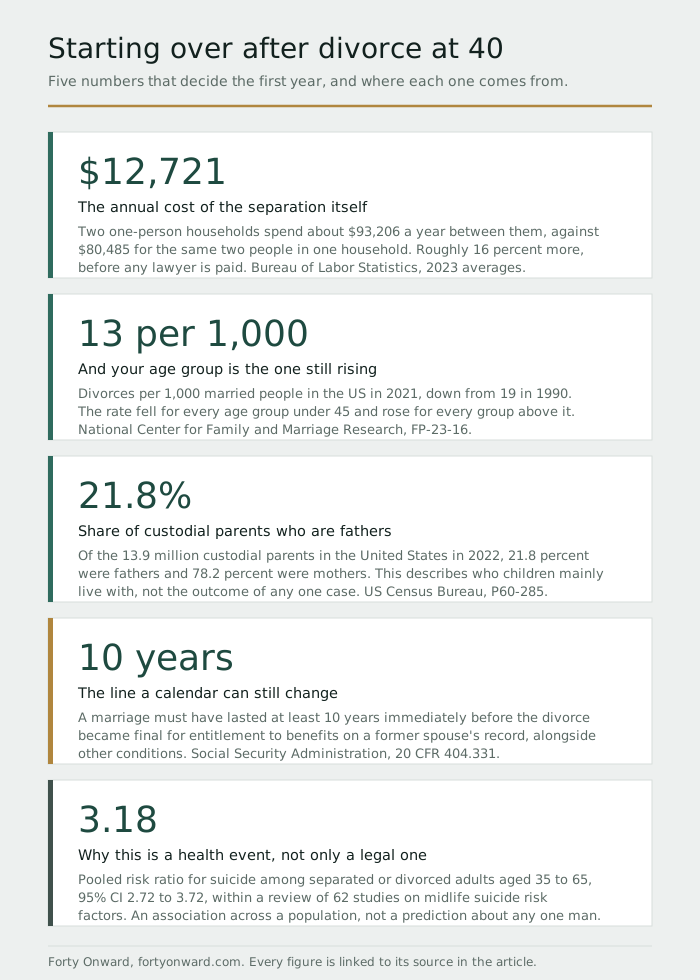
Starting over after divorce in five numbers
| Number | What it is |
|---|---|
| $12,721 | Extra annual spending when the same two people run two one-person households instead of one two-person household, on 2023 US averages |
| 13 per 1,000 | Divorces per 1,000 married people in the US in 2021, down from 19 in 1990, with the rate rising only among those aged 45 and older |
| 21.8% | Share of the 13.9 million US custodial parents who were fathers in 2022 |
| 10 years | Marriage length required, immediately before the divorce is final, for entitlement to benefits on a former spouse's record under 20 CFR 404.331 |
| 3.18 | Pooled risk ratio for suicide among separated or divorced adults aged 35 to 65, from a systematic review of 62 studies on midlife suicide risk factors |
FAQ
Is 40 too late to start over after a divorce?
No, and the demographics have moved decisively against that assumption. The divorce rate in the United States fell for every age group under 45 between 1990 and 2021 and rose for every group above it, and nearly 40 percent of people divorcing today are aged 50 or older. Starting over at 40 is now a common life stage rather than an unusual one. The practical constraints at 40 are different from those at 28, mainly because of housing, children and retirement assets, but none of them are a bar.
How much does it actually cost to live alone after a divorce?
In 2023 a one-person household in the United States spent an average of $46,603 a year, against $80,485 for a two-person household. Two people living separately spend roughly $12,721 a year more between them than the same two people living together, around sixteen percent, before legal costs. That gap is structural rather than the result of anyone overspending, because rent, utilities and furnishings do not halve when a household splits.
Can my ex-wife take half my 401k?
A workplace retirement plan governed by federal law can only be divided by a qualified domestic relations order, a separate court order that the plan administrator must accept as qualifying. The divorce decree alone does not move the money and an agreement between the two of you does not either. How much is divided is a matter of state property law and your settlement. Whether the division actually happens is a matter of whether that separate order was drafted and accepted. Ask a licensed attorney in your state about both.
How many divorced fathers get custody?
In 2022 there were 13.9 million custodial parents in the United States and 21.8 percent of them were fathers, against 78.2 percent mothers, according to the Census Bureau. That figure covers all custodial parents rather than divorced fathers specifically, and it describes who children primarily live with rather than the outcome of any individual case.
Why did I lose my friends after my divorce?
Because most of them were the marriage's friends rather than yours, and shared friendships tend to follow one household when a couple separates. This lands hardest on men because men in midlife typically hold fewer independent friendships and route more of their emotional life through a partner. The response that works is accepting that you are now the one who has to initiate contact, and continuing to do it for months without keeping score.
Does divorce affect a man's health?
Population level research finds meaningful associations. A meta-analysis of 21 studies covering 1,888,752 deaths found divorced or separated men carried higher cardiovascular and cancer mortality risk, and a systematic review of 62 studies on midlife suicide risk factors found a pooled risk ratio of 3.18 for suicide among separated or divorced adults aged 35 to 65. These are associations across large populations, not predictions about individuals, and they do not by themselves establish cause. They are a reason to treat the period after a separation as a health event rather than something to absorb quietly.
What happens to my health insurance after a divorce?
If you were covered through a spouse's employer plan, that coverage ends, and divorce is one of the qualifying life events under COBRA. COBRA gives workers and their families who lose health benefits the right to continue group coverage for a limited period, generally where the employer had 20 or more employees in the prior year. It is not free: the Department of Labor states that qualified individuals may be required to pay the entire premium, up to 102 percent of the cost to the plan. The alternatives are coverage through your own employer or a policy bought individually. Whichever route applies, the premium belongs in the monthly floor before you sign a lease, not after.
Is alimony tax deductible after a divorce?
Not under agreements executed after 2018. The IRS states that a payer cannot deduct alimony or separate maintenance paid under a divorce or separation agreement executed after 2018, and that the recipient does not include it in gross income. Agreements executed before 2019 generally follow the older rule, where the payment was deductible by the payer and taxable to the recipient, unless a later modification expressly adopts the repeal. Child support is separate and has never been deductible by the payer or taxable to the recipient. The rule reversed recently enough that older advice still circulates, so check which regime your agreement falls under before budgeting around a deduction.
Should I keep the house after a divorce at 40?
That is a decision for you and an attorney, but the arithmetic that should inform it is straightforward. The question is not whether you want the house. It is whether one income covers the mortgage, the taxes, the insurance and the maintenance that two incomes were covering, and whether a lender will refinance the loan into a single name at all. A house kept on a payment the new floor cannot carry becomes a forced sale in eighteen months with less negotiating room than you have now.
How long does it take to recover from a divorce at 40?
The two halves of it recover on different clocks, and that distinction is more useful than any single figure. The financial change is permanent rather than temporary: the gap between running one household and running two does not close, so the realistic target is a stable new cost base rather than a return to the old one. The health risks associated with separation, by contrast, are concentrated in the period following it rather than spread evenly across the years after. Anyone quoting you a specific recovery timeline in months is offering an editorial working estimate, not a sourced finding, because no reliable average exists.
Sources
- Bureau of Labor Statistics, Consumer expenditures in 2023, BLS Reports. Source for average annual expenditures of $46,603 for a one-person consumer unit, $80,485 for a two-person consumer unit and $77,280 for all consumer units in 2023. The comparison of two one-person households against one two-person household is this magazine's arithmetic from those published averages.
- U.S. Census Bureau, Valle LC, Custodial Parents and Their Child Support: 2022, Report P60-285, August 2025. Source for 13.9 million custodial parents in 2022, of whom 78.2 percent were mothers and 21.8 percent were fathers, and for the 20.7 percent family poverty rate among families including a custodial parent.
- Westrick-Payne KK, Lin I-F, Age Variation in the Divorce Rate, 1990 & 2021, Family Profiles FP-23-16, National Center for Family & Marriage Research, Bowling Green State University. Source for 19 divorces per 1,000 married people in 1990 against 13 per 1,000 in 2021, and for the finding that the rate decreased for those aged 15 to 44 and increased for those aged 45 and older.
- Westrick-Payne KK, Brown SL, Marriage Duration at Time of Gray Divorce, Family Profiles FP-24-12, National Center for Family & Marriage Research, Bowling Green State University, 2024. Source for the share of people divorcing aged 50 or older rising from 8 percent in 1990 to nearly 40 percent today, and for the median marital duration of 29 years at first divorce among those aged 50 and older in 2022.
- U.S. Department of Labor, Employee Benefits Security Administration, QDROs: The Division of Retirement Benefits Through Qualified Domestic Relations Orders. Source for the requirement that retirement interests may be assigned only where the judgment, decree or order recognising a former spouse's interest constitutes a qualified domestic relations order.
- U.S. Department of Labor, Continuation of Health Coverage (COBRA). Source for divorce being among the qualifying life events, for COBRA generally applying to group health plans sponsored by employers with 20 or more employees in the prior year, and for the statement that qualified individuals may be required to pay the entire premium, up to 102 percent of the cost to the plan.
- Internal Revenue Service, Topic no. 452, Alimony and separate maintenance. Source for the rule that a payer cannot deduct alimony or separate maintenance paid under a divorce or separation agreement executed after 2018, that the recipient does not include such payments in gross income, and for the treatment of agreements executed before 2019 and of later modifications that expressly adopt the repeal.
- Social Security Administration, 20 CFR 404.331, Who is entitled to wife's or husband's benefits as a divorced spouse. Source for the conditions quoted: marriage of at least 10 years immediately before the divorce became final, not currently married, aged 62 or older, and divorced for at least 2 years where the insured person is not yet entitled.
- Qin P, Syeda S, Canetto SS, Arya V, Liu B, Menon V, Lew B, Platt S, Yip P, Gunnell D, Midlife suicide: A systematic review and meta-analysis of socioeconomic, psychiatric and physical health risk factors, Journal of Psychiatric Research, October 2022, volume 154, pages 233 to 241. PMID 35961179. Source for the pooled risk ratio of 3.18 (95% CI 2.72 to 3.72) for being separated or divorced, and the comparison figures of 11.68 for psychiatric illness of any type and 3.91 for unemployment. The review identified 62 studies of adults aged 35 to 65 across three risk-factor domains; the marital status estimate is drawn from the subset reporting it, and the paper's abstract does not break out that subset count.
- Wang Y, Jiao Y, Nie J, O'Neil A, Huang W, Zhang L, Han J, Liu H, Zhu Y, Yu C, Woodward M, Sex differences in the association between marital status and the risk of cardiovascular, cancer, and all-cause mortality: a systematic review and meta-analysis of 7,881,040 individuals, Global Health Research and Policy, February 2020, volume 5, article 4. PMID 32161813. Source for the analytic sample of 21 studies covering 1,888,752 deaths, and for the findings that divorced or separated men carried higher cancer and cardiovascular mortality risk and that the association between being unmarried and all-cause mortality was stronger in men than in women.