Midlife Crisis and Marriage: What Is Actually Happening to the Two of You
A midlife crisis usually lands on the marriage without being about the marriage. The man is unhappy, the marriage is the largest and most visible structure in his life, and so the marriage gets blamed first. Sometimes that is correct. More often the marriage is carrying weight that belongs to something else: a stalled career, twenty years of accumulated load, a depression nobody has named. The research on this age bracket does not tell you whether to stay or go. It tells you which questions to answer before you decide, and it is blunt about what the decision costs either way.
Last reviewed September 29, 2026.
If you are in danger now: if you are having thoughts of ending your life, call or text 988 in the United States. If there is violence or fear of violence at home, deal with safety before anything else in this article. More in when this is urgent.
The short answer
A midlife crisis does not have to end a marriage, and most of the time the marriage is not what the crisis is about. What usually happens is one of three things. The two of you have drifted, and the distance feels like a verdict when it is a maintenance failure. Or the load on the household (children, money, ageing parents, a job that stopped going anywhere) has crowded out everything the marriage used to run on. Or one of you has quietly finished with it. The first two respond to changes you can test inside a few months. The third is real and deserves to be treated as real. The expensive mistake is acting on the third when you are living in the first or second.
What men mean when they say "midlife crisis" about a marriage
The phrase covers very different situations, and the right response depends entirely on which one you are in.
The drift. Nothing has gone wrong. There was no betrayal and no fight worth remembering. You just notice, somewhere around forty-five, that you and your wife run the house together like competent colleagues and have not had a conversation about anything else in years. This is the most common version and the most easily mistaken for the end.
The load. The marriage is fine in principle and starved in practice. Two jobs, children at the age where they need rides and money and supervision, a parent who has started to need help. Every hour is allocated. The marriage gets whatever is left, which is nothing. This version often feels like resentment of your wife when it is resentment of the calendar.
The exit. One of you has concluded, often privately and often a long time ago, that the marriage is over. The behaviour looks like a crisis from the outside because it arrives suddenly. From the inside it is the end of a long, silent decision.
A useful rule, offered as editorial judgment rather than a research finding: if the feeling appeared recently alongside other changes in you (sleep, mood, work, drinking), treat it as a symptom first. If it has been stable for years and survives a good month, take it more seriously. Our piece on the midlife crisis in men lays out the wider version of this distinction between a crisis and a correction.
What the numbers say about marriages at this age
Divorce in the forties and fifties is common enough that it is not a failure of character and rare enough that it is not inevitable. Pew Research Center's analysis of federal data gives the clearest picture by age bracket. The figures are divorces per 1,000 married people in each group.
| Age group | 1990 | 2015 |
|---|---|---|
| 25 to 39 | 30 | 24 |
| 40 to 49 | 18 | 21 |
| 50 and older | 5 | 10 |
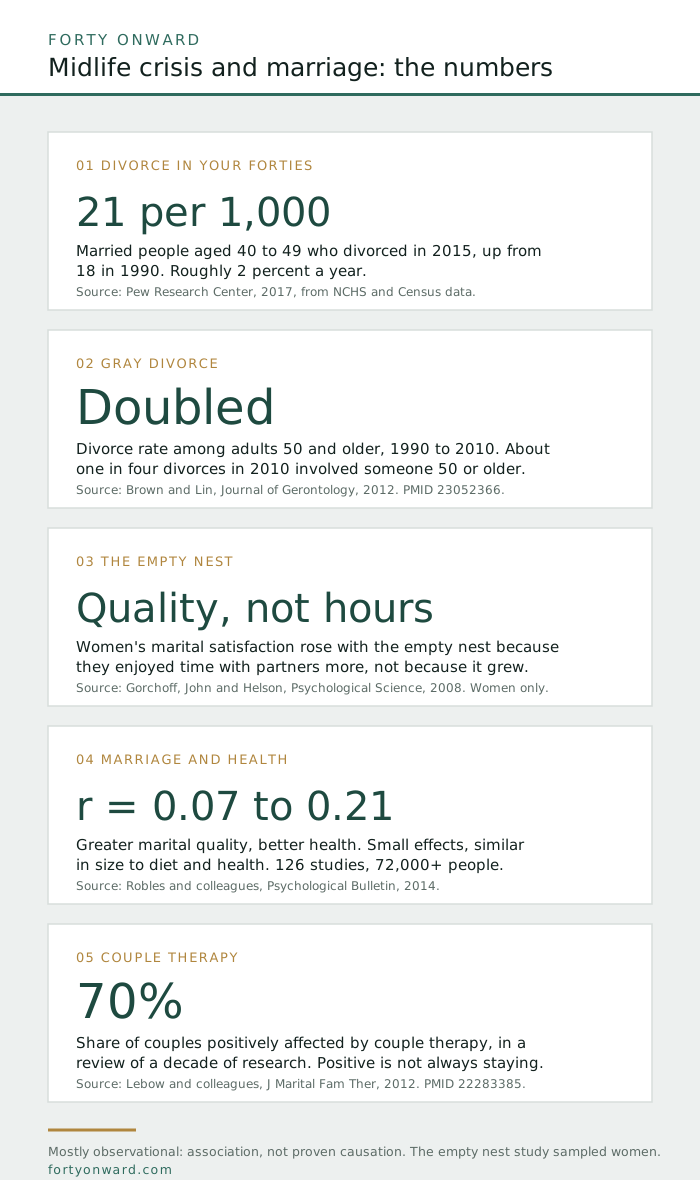
The 40 to 49 row is the one that describes you: 18 divorces per 1,000 married people in 1990, 21 in 2015. For comparison, the 50 and older group went from 5 to 10, and the 25 to 39 group fell from 30 to 24. So in a given year roughly 2 percent of married people in their forties divorce. That is higher than it was a generation ago and far from the "half of marriages end" figure people repeat without knowing what it refers to.
The bigger shift is further up the age range. Sociologists Susan Brown and I-Fen Lin, using 1990 vital statistics and the 2010 American Community Survey, found that the divorce rate among adults aged 50 and older doubled between 1990 and 2010, and that roughly one in four divorces in 2010 involved someone 50 or older, over 600,000 people that year. Their paper calls it the gray divorce revolution.
Two things in these sources change what a man should take from his own unhappiness.
Remarriages are much less stable than first marriages. Brown and Lin found the divorce rate was 2.5 times higher in remarriages than in first marriages. Pew reports that among adults over 50 the rate in remarriages was 16 per 1,000 against 8 for people married once. If part of the appeal of leaving is the picture of a better second marriage, that picture carries a measured risk.
Long marriages end too. Among adults over 50 who divorced, Pew found about a third (34 percent) had been married at least 30 years. Duration protects on average. It does not protect a marriage that has been running on autopilot for a decade.
The story that the kids leaving fixes it
Much of the reassurance offered to couples in their forties amounts to "hold on until the children leave, it gets better". There is evidence behind that, and it is narrower than the slogan.
The best-known study, an 18-year longitudinal study of marital satisfaction in middle age by Sara Gorchoff, Oliver John and Ravenna Helson at Berkeley, found marital satisfaction increased across middle age and that the move to an empty nest was linked to higher marital satisfaction, though not higher life satisfaction. The mechanism was specific: women enjoyed the time they spent with their partners more. The quantity of that time did not increase.
Three limits apply before you lean on this.
- The sample was women. The study followed wives, not husbands. It says nothing directly about how men experience the same transition.
- It was the quality of time, not the amount. The couples did not get more hours together. The hours they had got better, plausibly because they were no longer being spent on logistics.
- It describes an average. It shows what tended to happen to the women who stayed married through the period. It cannot tell you what will happen in your house.
The practical reading is more useful than the slogan. If the thing that improves after the children leave is the experience of the time you already share, you do not need to wait eight years to find out whether that is available to you. You can protect some of that time now and see.
Why the marriage becomes the target
When a man in his forties is unhappy, the marriage gets blamed for reasons that have little to do with whether it is the cause.
It is the most visible structure in his week. It is the one thing he can imagine changing with a single decision, where a career or a body or a depression looks slow and uncertain. And it is the relationship where his irritability lands, so it generates daily evidence that something is wrong.
The research on couples and health adds a less obvious mechanism. In a review of how couples' relationships influence health, Janice Kiecolt-Glaser and Stephanie Wilson describe depression as pivotal in the path between marital trouble and physical health, and name sleep problems as one of two emerging routes from marital distress to poor health. The review stresses that partners strongly influence each other's mental and physical health, so the influence plausibly runs both ways. A man who is sleeping badly and quietly depressed is likely to read his marriage as worse than it is, and a strained marriage makes sleep and mood harder to repair. Pulling that loop apart is the first task, because until you do, you cannot trust your own reading of the marriage.
This is also why the question "do I still love her" is a poor starting point. A flat mood makes every relationship feel flat. If the same deadness shows up in your work, your friendships and your hobbies, the marriage is probably not the variable. Our guide to lost motivation at 45 covers how to tell exhaustion, depression and a direction problem apart.
Four checks before you decide anything
The order matters because each check is cheaper and more reversible than the next, and because the early ones change how you read the later ones.
1. Check yourself first. Before judging the marriage, audit the instrument doing the judging. How have you been sleeping for the last three months? How much are you drinking compared with two years ago? Is the flatness you feel at home also present at work, with friends and in things you used to enjoy? If the answer is yes everywhere, the problem is probably upstream of the marriage. A worked example: a man who says "I feel nothing when I walk in the door" and also "I feel nothing on the golf course I used to love" has told you more about his mood than about his wife. That is a conversation for a doctor or a therapist first, and our guide to finding a therapist for a midlife crisis covers who to see.
2. Check the load. Write down every hour of a normal week and mark the ones that belong to the two of you as people rather than as co-managers of a household. Driving children to practice together does not count. Talking about the mortgage does not count. Many couples who do this honestly find the number is close to zero. A marriage cannot be evaluated when it has been given no hours to exist in. Take a couple with two teenagers, two full time jobs and a parent in care: their only shared unscheduled time may be the forty minutes after the kids go to bed, which both of them spend on their phones.
3. Check the time you share. This is the test the empty-nest research points at. Protect two hours a week, every week, for eight weeks, with no logistics allowed. Walk, eat, drive somewhere. The point is not romance. It is to see whether the experience of time together improves when it stops being spent on administration. Eight weeks is our editorial working estimate for long enough to get past the awkwardness and short enough to sustain, not a figure from a trial. If it improves, you were in the drift or the load. If it stays empty on both sides, that is real information.
4. Check whether either of you has already left. This is the question underneath the others, and it is the only one that is a verdict. Signs include a settled indifference rather than anger, plans for the future that no longer include the other person, and a refusal to try anything in step three. It can be true of you or of her. If it is true, the question is no longer how to repair the marriage but how to end it with the least damage, and the arithmetic in our piece on starting over after divorce at 40 is the place to start.
What the marriage is worth, measured as health
The health stakes of a marriage are real and smaller than the headlines suggest. Both halves of that sentence matter.
The largest review is a 2014 meta-analysis by Theodore Robles and colleagues, covering 126 published studies and more than 72,000 people. Greater marital quality was associated with better health, including lower mortality risk. The effect sizes were small, correlations between 0.07 and 0.21, and the authors note they are similar in size to the associations between health behaviours such as diet and health outcomes. So the link between a good marriage and health is about as strong as the link between diet and health. That is meaningful over decades and not, on its own, a reason to stay in a bad one.
The narrower evidence on men points the same way. Harvard Health Publishing's review of marriage and men's health summarises data from the Framingham Offspring Study in which, among 3,682 adults followed for ten years and after accounting for major cardiovascular risk factors, married men had a 46 percent lower rate of death than unmarried men. In the Framingham data, marital happiness did not seem to change the size of that protective effect. The same review notes that other studies link marital unhappiness and stress to hypertension, so an unhappy marriage is not risk free even where the mortality advantage of being married holds.
Neither finding settles causation. These are observational studies. They show that marriage and health travel together, not that marriage causes the difference, and some of it reflects who marries and who stays married. And the Robles review found effect sizes for some clinical outcomes were susceptible to publication bias. Take the direction seriously and hold the size loosely.
What couples therapy actually does
Couples therapy has a better evidence base than most men expect. A review of a decade of research on the treatment of couple distress by Jay Lebow and colleagues concluded that couple therapy positively affects 70 percent of couples who receive it, that its effectiveness is comparable to individual therapy and far better than no treatment, and that two approaches had especially promising findings: integrative behavioural couple therapy and emotionally focused therapy.
"Positively affects" is not the same as "saves the marriage". Some couples in therapy discover they want to separate, and do so with less damage than they otherwise would have. That counts as a good outcome in this framing, and it is worth deciding in advance whether it would count as one for you.
The same review flags something relevant to the first check above: the link between couple distress and individual depression and anxiety is well established, and couple therapy has a role in treating those conditions. A man who is both depressed and unhappily married is not choosing between two separate problems.
The practical point is sequencing. Most men arrive at couples therapy after the fourth check has already come back positive, when one partner has left in all but logistics. Therapy is far more useful during the second and third checks, when the question is still whether the drift and the load can be reversed.
If it does end
Some marriages should end, and the research does not argue otherwise. What it adds is a clear view of the costs that men in particular underestimate.
Pew notes that people who divorce later in life tend to be less financially secure than married or widowed adults, and that for men, living alone at older ages can hurt their satisfaction with their social lives. That second point is easy to wave away at forty-five and hard to live with at sixty. Many men's friendships are maintained by their wives, and they discover this only when the maintenance stops. Our piece on the male loneliness epidemic covers how that plays out and what rebuilds it.
None of this is an argument to stay. It is an argument to leave deliberately, with the money modelled and the friendships you own separately identified, rather than on the strength of a bad year.
When this is urgent
If you are having thoughts of ending your life, or you are worried about what you might do, call or text 988 in the United States to reach the 988 Suicide and Crisis Lifeline. The same applies if you are worried about your wife. If there is any violence or fear of violence in the house, safety comes before every question in this article, and a counsellor should hear about it the same day.
Where this leaves you
The phrase "midlife crisis" makes it sound as though the marriage is under attack from something outside it. The more accurate picture is a man whose instrument for judging his life has drifted out of calibration at the same moment his household is carrying its heaviest load. Some of those marriages are finished. Many more are starved, and a starved marriage and a dead one feel identical from inside until you feed it for a couple of months and see.
So feed it first. Check yourself, count the hours, protect the time, and only then ask the last question. If the answer is still that it is over, you will leave knowing that, rather than guessing.
Midlife crisis and marriage in one picture
Test yourself
Key takeaways
FAQ
Can a midlife crisis end a marriage?
It can, but it usually does not have to. Most of what men describe as a midlife crisis in their marriage is either drift, where the couple has stopped spending time together as people rather than co-managers, or load, where children, work and ageing parents have taken every available hour. Both respond to changes you can test within a couple of months. The version that ends marriages is the one where one partner has already decided privately that it is over.
Should I leave my marriage during a midlife crisis?
Not before you have checked whether the unhappiness is about the marriage at all. If the flatness you feel at home also shows up at work, with friends and in things you used to enjoy, the cause is more likely mood, sleep or exhaustion than your wife. Address that first, then protect regular time together for a couple of months. If the marriage still feels empty to both of you after that, the decision rests on better evidence.
Does marital satisfaction improve after the kids leave home?
On average it did in the best-known study, an 18-year Berkeley study of women in middle age, which linked the move to an empty nest with higher marital satisfaction. The improvement came from enjoying time with their partners more, not from spending more time together. The sample was women only, so it does not directly describe how men experience the change.
How common is divorce in your forties?
In 2015, about 21 of every 1,000 married Americans aged 40 to 49 divorced, according to Pew Research Center's analysis of federal data. That is roughly 2 percent a year, slightly up from 18 per 1,000 in 1990. The sharper rise has been among people over 50, whose divorce rate doubled between 1990 and 2010.
Does couples therapy work for couples in their forties and fifties?
The evidence is encouraging. A review of a decade of research found couple therapy positively affects about 70 percent of couples who receive it, with effectiveness comparable to individual therapy. The review did not break results out by age. Therapy works best when started before either partner has already decided to leave.
Are second marriages more likely to fail?
Yes. Research on divorce among adults 50 and older found the divorce rate was 2.5 times higher in remarriages than in first marriages, and Pew reports 16 divorces per 1,000 married people over 50 in remarriages against 8 among those married only once. If leaving is tied to the idea of a better second marriage, that risk belongs in the calculation.
What if my wife is the one having the midlife crisis?
The same four checks apply, pointed at her situation rather than yours, and most of them you can only raise, not run. Ask about her sleep, her mood and her workload before reading the change as a verdict on you. Offer protected time together without making it a test she can fail. If she has already decided to leave, the conversation moves from repair to how to separate with the least damage, and a couples therapist can help with either.
Sources
- Stepler R. Led by Baby Boomers, divorce rates climb for America's 50+ population. Pew Research Center, 2017. Divorce rates by age group, 1990 and 2015, from National Center for Health Statistics and Census Bureau data.
- Brown SL, Lin IF. The gray divorce revolution: rising divorce among middle-aged and older adults, 1990-2010. Journal of Gerontology Series B, 2012. PMID 23052366.
- Gorchoff SM, John OP, Helson R. Contextualizing change in marital satisfaction during middle age: an 18-year longitudinal study. Psychological Science, 2008. Sample of women. PMID 19076493.
- Kiecolt-Glaser JK, Wilson SJ. Lovesick: How Couples' Relationships Influence Health. Annual Review of Clinical Psychology, 2017. PMID 28301763.
- Robles TF, Slatcher RB, Trombello JM, McGinn MM. Marital quality and health: a meta-analytic review. Psychological Bulletin, 2014. 126 studies, more than 72,000 individuals. PMID 23527470.
- Harvard Health Publishing. Marriage and men's health. Harvard Medical School. Source of the Framingham Offspring Study figures.
- Lebow JL, Chambers AL, Christensen A, Johnson SM. Research on the treatment of couple distress. Journal of Marital and Family Therapy, 2012. PMID 22283385.
- 988 Suicide and Crisis Lifeline.